

If you follow the pharmaceutical news, you know the landscape changed drastically in late 2025. The U.S. Food and Drug Administration (FDA) tightened its grip on weight-loss drug imports, specifically targeting GLP-1 receptor agonists. This wasn't just a warning; it was a full-scale enforcement action that left many manufacturers scrambling. Understanding FDA Import Alerts is no longer just for compliance officers-it’s critical for anyone involved in the drug supply chain. These alerts act as a digital border control, stopping potentially unsafe medicines before they ever reach American patients.
The system isn't new, but its application has become sharper. Established back in 1995, the Import Alert system has evolved into a sophisticated risk assessment tool. Today, it prevents non-compliant products from entering the U.S. market by flagging specific sources based on historical data. When the FDA identifies a pattern of violations, they don't wait for a shipment to arrive and fail a test. They stop it at the door. This proactive approach protects public health but creates significant hurdles for manufacturers who haven't kept up with quality standards.
Understanding the PREDICT System and Import Alerts
At the heart of this enforcement mechanism is the Predictive Risk-based Evaluation for Dynamic Import Compliance Targeting (PREDICT) program. Think of PREDICT as the brain behind the operation. It evaluates over 150 data points for every shipment. These points include a facility's inspection history, previous refusal rates, the risk classification of the product type, and the importer's compliance records. When the algorithm spots a risk, it triggers an Import Alert.
As of November 2025, there were approximately 238 active Import Alerts across all product categories. These alerts are not random. They are issued when the agency sees a pattern suggesting future shipments from a specific source will likely be non-compliant. This allows field staff to detain products without physical examination (DWPE). Essentially, if a manufacturer is on the radar, their goods are held at customs until they prove otherwise. The system integrates with the Automated Commercial Environment (ACE) portal, processing about 12 million drug entry lines annually. This high volume means decisions are often automated and swift, typically issued within five business days of shipment arrival.
The GLP-1 Crackdown and the Green List Initiative
The most significant recent development occurred in September 2025. The FDA issued Import Alert 66-80, specifically targeting bulk drug substances for GLP-1 receptor agonists. This included active pharmaceutical ingredients (APIs) like semaglutide, tirzepatide, liraglutide, exenatide, and dulaglutide. The move was aggressive, driven by concerns over the proliferation of unapproved products posing public health risks. Dr. Susan Huang, Director of the Office of Pharmaceutical Quality, highlighted the dangers of contamination, incorrect dosing, and lack of quality controls during the September 5 announcement.
To manage this, the FDA introduced a 'Green List' initiative. This is a color-coded listing structure that defines compliance pathways. Manufacturers on the Green List are exempt from DWPE. Those on Yellow or Red Lists face automatic detention. The impact was immediate. Preliminary data from the Customs and Border Protection (CBP) showed refusal rates for non-Green List shipments reaching 98.7% through October 2025. This effectively shut down access for many generic manufacturers who could not meet the new transparency requirements.
| Status | Inspection Requirement | Clearance Rate | Remediation Time |
|---|---|---|---|
| Green List | Exempt from DWPE | 99.2% | N/A |
| Yellow List | Heightened Scrutiny | Variable | 6-12 Months |
| Red List | Automatic Detention (DWPE) | 1.3% | 11.7 Months Avg |
The geographic impact was also notable. An October 2025 enforcement report showed that 73 of the 89 affected facilities (82.0%) were located in India. This shift forced a rapid consolidation of the API supply chain. Companies like Novo Nordisk saw their manufacturing partners gain significant market share, while others faced revenue impacts in the hundreds of millions. For example, Viatris reported a $417 million third-quarter revenue impact directly attributable to the alert.
Detention Without Physical Examination (DWPE)
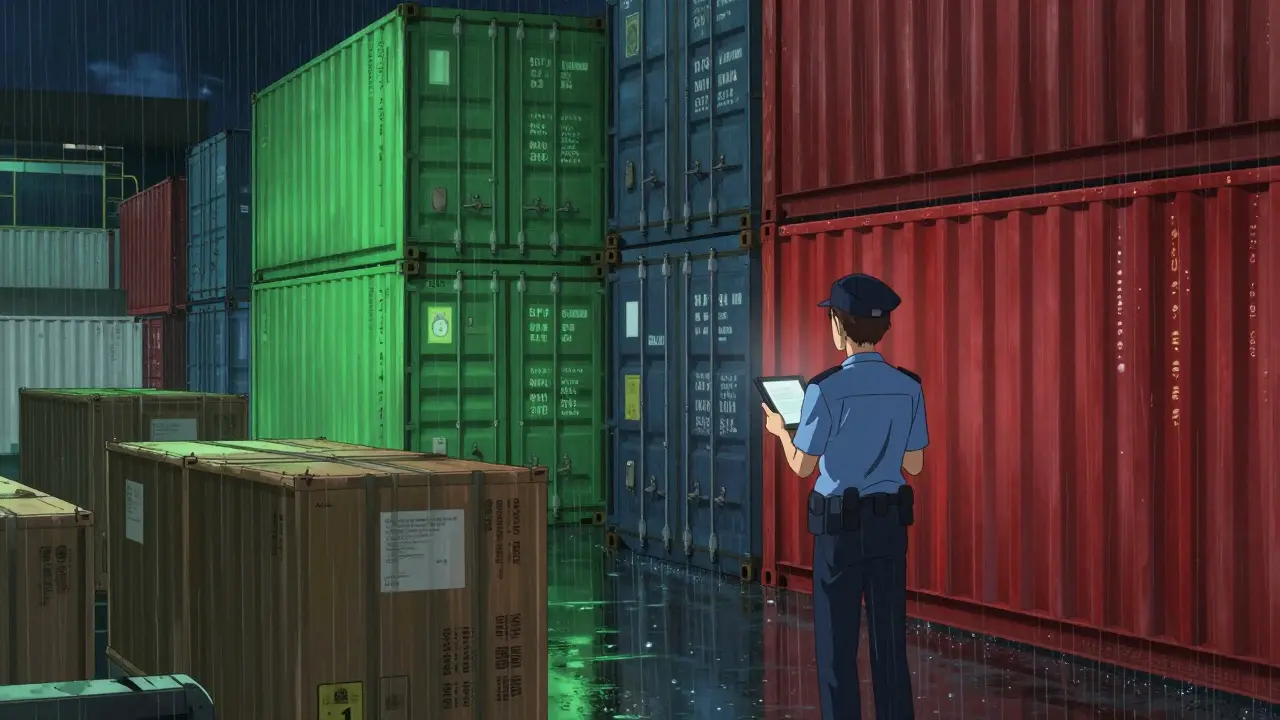
One of the most confusing aspects for importers is the concept of Detention Without Physical Examination (DWPE). Unlike traditional customs checks where an officer opens a container and tests a sample, DWPE relies on data. If your shipment matches the criteria in an Import Alert, it is held at one of the 328 U.S. ports of entry immediately. You do not get the benefit of a physical inspection to prove the product is safe on the spot. Instead, the burden of proof shifts entirely to you.
To release a detained shipment, importers must submit comprehensive corrective action plans. These plans need Certificates of Analysis (CoA), third-party audit reports, and facility compliance documentation. According to Registrar Corp's analysis, shipments subject to DWPE face immediate holds. If the documentation isn't perfect, the goods stay stuck. Refused shipments must be exported or destroyed within 90 days under FDA and CBP oversight. This timeline is tight and creates logistical nightmares for companies trying to manage inventory and cash flow.
Financial Consequences and Penalties
The cost of non-compliance extends far beyond the value of the detained goods. Under 19 CFR § 159.14, liquidated damages can reach up to three times the commercial value of the goods. A case study by Frier Levitt attorneys in October 2025 calculated potential penalties exceeding $2.7 million for a single $900,000 shipment. This is a massive financial risk that can threaten the viability of smaller manufacturers.
Furthermore, the operational costs to regain compliance are high. Successful Green List applications require roughly 137 hours of preparation. This includes FDA-recognized third-party audits costing between $45,000 and $68,000. You also need stability testing across three temperature zones and supply chain mapping to Tier 3 suppliers. Many companies are investing between $200,000 and $500,000 in blockchain traceability systems to meet new batch-level transparency requirements. Pfizer, for instance, achieved a 99.8% Green List acceptance rate after deploying the MediLedger network across 17 API suppliers.
Global Comparison: FDA vs. EMA vs. NMPA
It is helpful to see how the FDA's approach compares to other major regulators. The European Medicines Agency (EMA) uses a different model. They require physical examination of 10-15% of high-risk shipments. A PharmaTech Journal study from November 2025 found that the FDA's DWPE system reduces inspection time by 78% compared to the EMA's risk-based sampling. However, this speed comes with a trade-off. The FDA system increases false positive rates by 12.3 percentage points, jumping from 4.7% to 17.0%.
China's National Medical Products Administration (NMPA) takes yet another approach. They maintain a single 'blacklist' of banned facilities. The FDA's color-coded system (Green/Yellow/Red) provides graduated compliance pathways. While the NMPA is simpler, it offers less flexibility for remediation. The FDA system allows for a path back to the Green List, whereas a blacklisted facility in China often faces a permanent ban unless they undergo a complete overhaul. As of late 2025, the European Commission announced plans to adopt similar API screening protocols by Q2 2026, signaling a move toward global harmonization of these strict standards.

Remediation and Getting Back on Track
If your facility finds itself on an Import Alert, the path to removal is lengthy. Registrar Corp data shows the average removal from an Import Alert requires 11.7 months, with a range of 4.2 to 28.6 months. This is significantly longer than Health Canada's average of 6.3 months. The FDA's Import Alert Removal page specifies four mandatory remediation steps. First, you need a comprehensive facility inspection, which takes a minimum of five days. Second, you must conduct a root cause analysis with Corrective and Preventive Action (CAPA) documentation.
Third, you need three consecutive compliant shipment verifications. Finally, you require executive compliance certification. Companies failing initial petitions typically require 2.3 additional submissions. The most successful petitions include video evidence of corrective actions, which have an 87.4% approval rate versus 42.1% for document-only submissions. This emphasis on visual proof highlights the FDA's desire to see tangible changes rather than just paperwork.
Future Outlook for 2026 and Beyond
Looking ahead, the framework is expanding. FDA Commissioner Dr. Robert Califf stated at the November 2025 CDER Advisory Committee meeting that the GLP-1 import alert framework will be extended to all high-risk biologics starting Q1 2026. This begins with monoclonal antibodies. Industry analysts project that 65-75% of global API manufacturers will need to invest between $500,000 and $2 million in compliance upgrades by 2027 to maintain U.S. market access.
Legal challenges are also mounting. Four Indian pharmaceutical associations filed suit in the U.S. Court of International Trade in November 2025, arguing the Green List constitutes an unlawful technical barrier to trade. However, the FDA's stance remains firm on safety. The agency launched the 'API Transparency Portal' on November 1, 2025, providing real-time status updates for 1,842 registered GLP-1 API manufacturers. As we move through 2026, the expectation is that transparency and digital traceability will become the baseline for all pharmaceutical imports, not just weight-loss drugs.
Frequently Asked Questions
What is an FDA Import Alert?
An FDA Import Alert is a regulatory notice that allows the agency to detain products without physical examination if they come from a source with a history of violations. It is a key enforcement tool to prevent unsafe drugs from entering the U.S. market.
What is the Green List in pharmaceutical imports?
The Green List is a status granted to manufacturers who meet specific FDA compliance standards. Products from Green List manufacturers are exempt from Detention Without Physical Examination (DWPE) and experience much higher clearance rates.
How long does it take to get removed from an Import Alert?
The average time to removal is 11.7 months. This process involves facility inspections, root cause analysis, and verifying three consecutive compliant shipments. Some cases can take up to 28.6 months.
What are the penalties for non-compliant drug imports?
Penalties can include liquidated damages up to three times the commercial value of the goods. Additionally, refused shipments must be exported or destroyed within 90 days, resulting in total loss of the product value.
Does the FDA Green List apply to all drugs?
As of late 2025, the Green List specifically targeted GLP-1 receptor agonist APIs. However, plans are in place to extend this framework to all high-risk biologics, including monoclonal antibodies, starting in early 2026.
How does the FDA system compare to the EMA?
The FDA uses a data-driven Detention Without Physical Examination (DWPE) model, while the EMA relies on physical examination of 10-15% of high-risk shipments. The FDA method is faster but has a higher false positive rate.
Can I appeal an Import Alert decision?
Yes, companies can submit petitions for removal. Successful petitions often include video evidence of corrective actions, which have a significantly higher approval rate compared to document-only submissions.
What is the PREDICT program?
PREDICT stands for Predictive Risk-based Evaluation for Dynamic Import Compliance Targeting. It is the risk assessment algorithm used by the FDA to evaluate over 150 data points to determine if a shipment should be detained.
Are GLP-1 drugs still available in the US?
Yes, but access has tightened. Import volumes from non-Green List manufacturers dropped by over 92% in late 2025. Approved products from compliant manufacturers remain available, though prices may have increased due to supply consolidation.
How much does compliance certification cost?
Third-party audits alone can cost between $45,000 and $68,000. Full compliance upgrades, including blockchain traceability systems, can range from $200,000 to $500,000 depending on the facility size and complexity.