
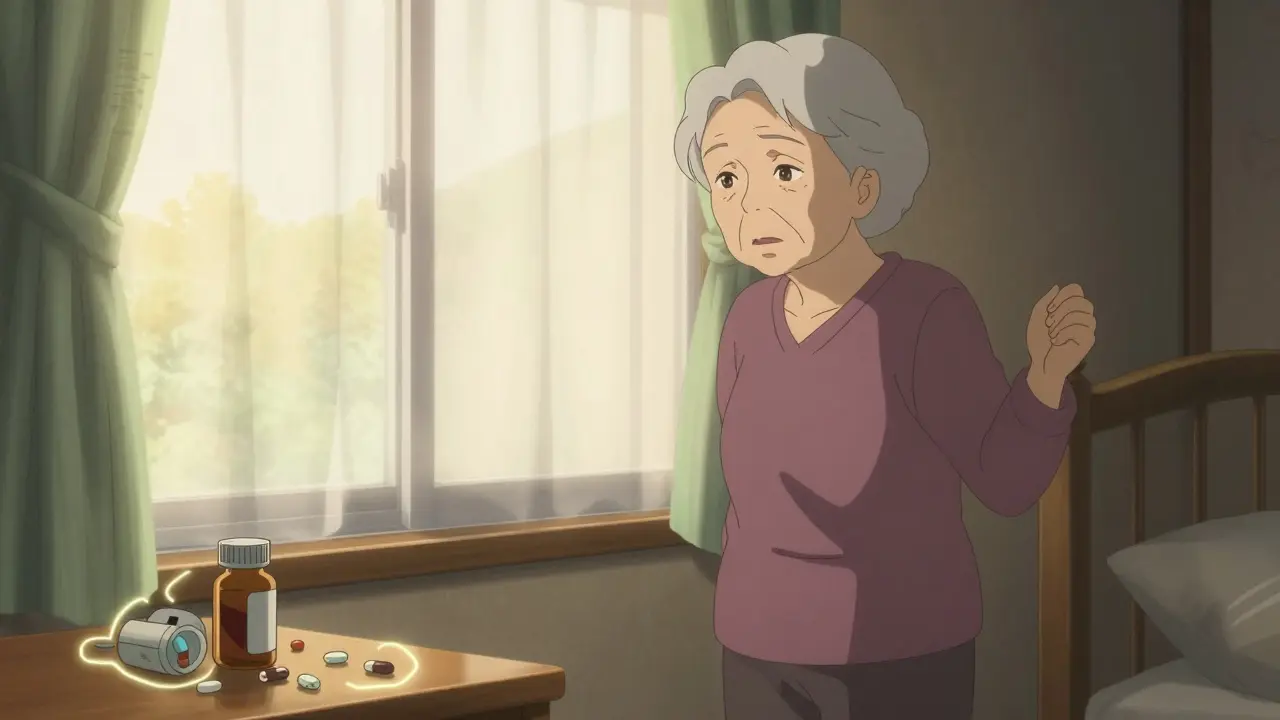
Every year, more than 36,000 older adults in the U.S. die from falls. That’s more than car crashes. And while many assume it’s just aging, weakness, or slippery floors, the real culprit is often hidden in the medicine cabinet. For seniors, the drugs meant to help - for sleep, anxiety, blood pressure, or pain - can be the very thing that makes them stumble, fall, and sometimes never get back up.
Why Medications Make Seniors Fall
Falls don’t happen because someone is "just clumsy." They happen because the brain, nerves, heart, and muscles aren’t working together the way they should. Many medications throw off that balance - literally. They cause dizziness, slow reaction times, lower blood pressure when standing, or fog the mind. Even a small drop in blood pressure when getting out of bed can mean a trip to the ER. The body changes as we age. Kidneys and liver don’t clear drugs as quickly. The brain becomes more sensitive to sedatives. A dose that was fine at 50 can be dangerous at 75. And when multiple medications are taken together, the risks multiply. A 2023 study found that 65% to 93% of seniors hospitalized after a fall were taking at least one medication known to increase fall risk. Many were taking three or more.Top Medications That Increase Fall Risk
Some drugs are riskier than others. Here’s what the research and guidelines from the American Geriatrics Society, CDC, and NHS consistently point to:- Antidepressants - Especially SSRIs like sertraline (Zoloft) and fluoxetine (Prozac), and tricyclics like amitriptyline. These drugs can cause dizziness, low blood pressure, and slowed reflexes. Studies show they doubles the chance of falling.
- Benzodiazepines - Drugs like diazepam (Valium), lorazepam (Ativan), and alprazolam (Xanax). Used for anxiety or sleep, they cause sedation, confusion, and poor coordination. Long-acting versions are especially dangerous in older adults.
- Antipsychotics - Medications like risperidone (Risperdal) or quetiapine (Seroquel), sometimes prescribed off-label for agitation in dementia. They cause stiffness, slow movement, and dizziness - symptoms that mimic Parkinson’s.
- Blood pressure meds - ACE inhibitors (lisinopril), beta-blockers (carvedilol), and diuretics (hydrochlorothiazide) can drop blood pressure too much, especially when standing. The risk spikes right after a dose change.
- Opioids - Painkillers like oxycodone or hydrocodone. They cause drowsiness, dizziness, and slow reaction time. When mixed with benzodiazepines, fall risk jumps by 150%.
- Antihistamines - Over-the-counter sleep aids like diphenhydramine (Benadryl) or doxylamine (Unisom). These are anticholinergics - they dry out the mouth, blur vision, and fog thinking. They’re still widely sold as "sleep aids" for seniors, despite being on the Beers Criteria list of drugs to avoid.
- Muscle relaxants - Cyclobenzaprine (Flexeril), carisoprodol (Soma). These can cause extreme drowsiness and loss of balance.
- Anticholinergics for bladder control - Oxybutynin (Ditropan), tolterodine (Detrol). These help with frequent urination but can cause confusion, dry mouth, and dizziness.
Even drugs considered "safer" - like short-acting benzodiazepines or newer antidepressants - still carry risk. There’s no truly safe option in this category for older adults. The problem isn’t always the drug itself. It’s that they’re often prescribed for years without review.
Polypharmacy: The Silent Danger
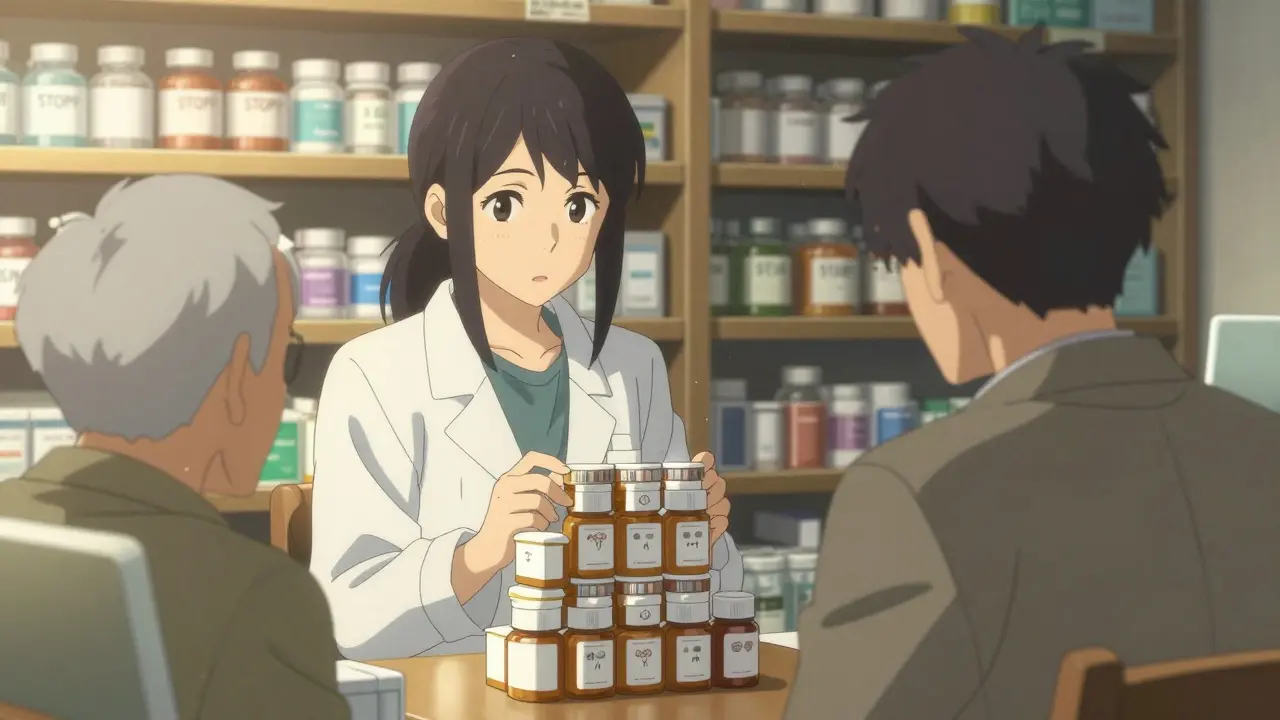
Taking four or more prescription drugs is common among seniors. But the more meds, the higher the fall risk. It’s not just about one bad drug - it’s about how they interact. A 2021 study in the Journal of the American Geriatrics Society found that seniors who had a pharmacist review their full medication list - not just one or two - saw a 22% drop in falls over the next year. Why? Because pharmacists spotted hidden dangers: a sleeping pill added to an antidepressant, a blood pressure drug increased without checking balance, or an OTC antihistamine used nightly for years. The National Council on Aging warns that many of these medications were started years ago - for a short-term issue - and never stopped. A sedative for post-surgery anxiety becomes a nightly habit. A diuretic for swelling becomes a permanent fix. No one ever asks: "Do you still need this?"What You Can Do: A Practical Plan
The good news? Falls from medication are preventable. Here’s what works:- Review every pill, every year. Bring a full list - including vitamins, supplements, and OTC meds - to your doctor or pharmacist. Don’t rely on memory. Use a phone photo or printed sheet.
- Ask: "Can this be stopped?" For every medication, ask: "What is it for? Is it still needed? Are there safer options?" If it’s for sleep, anxiety, or pain, question it first.
- Watch for dizziness when standing. Test yourself: Sit on the edge of the bed for a minute, then stand slowly. If you feel lightheaded, tell your doctor. That’s orthostatic hypotension - a red flag.
- Don’t rush dose changes. Blood pressure or antidepressant changes should be slow. A sudden increase can cause a fall within days.
- Ask for a pharmacist-led review. Many pharmacies now offer free medication reviews. Ask if your pharmacy has one. Studies show these reduce falls by up to 30%.
- Challenge the "just a pill" mindset. If your doctor says, "It’s just a little sleep aid," push back. That "little" pill might be the one that causes your next fall.

What Experts Are Doing Differently
Leading geriatricians now use two tools: START and STOPP. START finds medicines you should be on. STOPP finds ones you shouldn’t. The American Geriatrics Society’s Beers Criteria - updated every two years - is the gold standard. The 2023 version lists over 100 medications to avoid or use with extreme caution in seniors. Some hospitals now use electronic alerts in patient records to flag high-risk combinations. Others have dedicated deprescribing clinics - where doctors help patients safely stop unnecessary meds. Dr. Michael Steinman, a lead author of the Beers Criteria, says reducing fall-risk drugs can cut falls by 20-30%. That’s not a small win. That’s life-changing.It’s Not About Stopping All Meds - It’s About Stopping the Wrong Ones
This isn’t about avoiding treatment. It’s about smarter treatment. A senior with depression needs help. But there are non-drug options: light therapy, exercise, counseling. A senior with overactive bladder might benefit from pelvic floor exercises before a pill. A person with chronic pain might find relief with physical therapy instead of opioids. The goal isn’t to leave someone untreated. It’s to treat them safely. The CDC calls medication review "the single most effective clinical intervention for reducing fall risk." And yet, only 42% of primary care doctors routinely check for medication-related fall risk. If you’re caring for an older adult, don’t wait for the next fall. Start today. Grab the pill bottles. Write down every drug. Ask the questions. Talk to the pharmacist. You might just prevent the next hospital visit - or worse.Can over-the-counter sleep aids cause falls in seniors?
Yes. Over-the-counter sleep aids like diphenhydramine (Benadryl) and doxylamine (Unisom) are anticholinergics. They cause drowsiness, confusion, dry mouth, and blurred vision - all of which increase fall risk. These drugs are on the American Geriatrics Society’s Beers Criteria list of medications to avoid in older adults. Even one dose can be risky, especially when combined with other sedatives or blood pressure meds.
Are antidepressants safe for seniors?
Some antidepressants are safer than others, but none are risk-free. SSRIs like sertraline or escitalopram are preferred over tricyclics like amitriptyline, which have stronger anticholinergic effects and cause more dizziness. But even SSRIs double the risk of falling. The key is to use the lowest effective dose, monitor for dizziness, and avoid long-term use without review. Non-drug treatments like exercise and therapy should be tried first.
What should I do if my parent is taking five or more medications?
Request a comprehensive medication review. Start with the pharmacist - they can spot interactions and unnecessary drugs. Then schedule a visit with the doctor to discuss deprescribing. Focus on drugs that affect the brain or blood pressure: sleep aids, anxiety meds, painkillers, and anticholinergics. A 2021 study showed that pharmacist-led reviews reduced falls by 22%. Don’t stop meds on your own - work with a professional to taper safely.
Can stopping a medication actually prevent a fall?
Yes - and often quickly. A senior who stops a benzodiazepine or an anticholinergic bladder pill may notice improved balance and alertness within days. A 2022 study found that reducing or eliminating fall-risk drugs lowered fall rates by 20-30%. The key is doing it safely and under medical supervision. Many seniors feel better once they’re off unnecessary meds - not worse.
Is it safe to combine opioids and benzodiazepines?
No. Combining opioids and benzodiazepines increases fall risk by 150% compared to either drug alone. Both depress the central nervous system, causing extreme drowsiness, slow reflexes, and poor coordination. The American Geriatrics Society strongly advises against this combination in older adults. If your loved one is on both, ask the doctor for a safer pain or anxiety management plan immediately.


Comments
Lisa Cozad
My grandma took Benadryl for years because it was "just an OTC sleep aid." She fell twice in six months. The third time, she broke her hip. Turns out, the pharmacist flagged it during a free review. We got her off it, switched to melatonin, and she’s been walking without a cane since. Sometimes the simplest fix is the one no one thinks to ask about.
Ian Cheung
Doctors prescribe like they’re playing Jenga and the meds are the blocks. One more won’t hurt right? Until the whole tower crashes. I’ve seen it with my dad. Three antidepressants, two blood pressure pills, a muscle relaxer, and a nightly Unisom. No one ever asked if he still needed any of it. Just kept adding. We got him down to one med after a pharmacist review. He says he feels like he’s 60 again. Not 80.
Mario Bros
Just had this convo with my aunt last week. She’s 78, on 7 meds. Said her doc told her "it’s fine." We took her list to the pharmacy. Turns out two were expired in her mind, three were unnecessary, and one was literally making her dizzy. She cried because she thought she was just getting old. Turns out she just needed someone to ask.
Jay Amparo
As someone who grew up watching my mother navigate the labyrinth of geriatric prescriptions, I’ve learned this: the real danger isn’t the drugs-it’s the silence around them. No one talks about deprescribing because it feels like admitting failure. But stopping a harmful med isn’t quitting-it’s reclaiming. My mom stopped her benzodiazepine after 12 years. Within days, she remembered names again. She started gardening. She laughed louder. That’s not a side effect. That’s a life returned.
Saumya Roy Chaudhuri
Let’s be honest-this is why you shouldn’t let non-doctors write medical advice. The Beers Criteria is outdated. Many of these drugs are perfectly safe when monitored properly. The real issue is lazy caregivers who swap pills like trading cards without understanding pharmacology. If your loved one is on five meds, it’s because they need them. Blaming the drugs is easier than accepting that aging is hard.
anthony martinez
So let me get this straight. We’re supposed to believe that every single senior who falls is just on too many pills? What about the ones who fall because they didn’t install grab bars? Or the ones who wear slippers on hardwood? Or the ones who ignore their cataracts? The medication angle is real-but it’s not the whole story. You’re making it sound like the only solution is to strip every pill from the cabinet like it’s a witch hunt.
Jake Nunez
My cousin in India takes three antihypertensives and a nightly anticholinergic for bladder issues. He’s 82. He walks 3 miles every morning. No falls. No dizziness. His doctor reviews his meds every six months. He doesn’t take OTC sleep aids. He sleeps because he’s tired from walking. Culture matters. In the U.S., we treat aging like a disease to be managed with pills. Elsewhere, it’s treated like a phase of life to be lived.
Faith Edwards
It is profoundly disconcerting that our medical-industrial complex has normalized the pharmacological sedation of the elderly as a convenient palliative for social isolation, cognitive decline, and systemic neglect. The prescription pad has become the modern-day straitjacket-disguised as care. The Beers Criteria is not merely a guideline; it is a moral indictment of our failure to prioritize holistic geriatric stewardship over profit-driven polypharmacy. To prescribe a benzodiazepine to a septuagenarian is not medicine-it is a quiet act of surrender to the commodification of aging.
Christine Milne
Are you seriously suggesting we stop prescribing essential medications to seniors because some studies show correlation? In my day, people didn’t fall because of pills-they fell because they were weak from eating too much tofu and yoga. This is liberal nonsense dressed up as science. The real problem? Too many people are living too long without respect for their own mortality. Stop blaming the medicine. Start blaming the culture.
Bradford Beardall
Wait-so if a pharmacist reviews meds and falls drop by 22%, why aren’t all primary care clinics doing this? And why do insurance companies refuse to cover these reviews? This isn’t just about drugs-it’s about broken systems. We fix the car when the engine sputters. Why don’t we fix the person’s med plan when they start stumbling? I’ve been asking my doc for a review for two years. He says "we’re too busy." That’s not a medical excuse. That’s a moral failure.