

When it comes to losing weight, most people start with one question: cardio or strength training? It feels like a choice between two paths - one where you run until you’re out of breath, and another where you lift heavy things and hope the scale moves. But here’s the truth: neither is the full answer. The real win isn’t picking one over the other - it’s understanding how they work together.
Cardio Burns Calories Fast - But Only While You’re Doing It
Cardio - running, cycling, swimming, brisk walking - is the go-to for quick calorie burn. A 30-minute jog at a moderate pace can torch 300-400 calories for someone weighing 155 pounds, according to Harvard Medical School’s 2023 metabolic data. That’s a lot in half an hour. And if you’re new to exercise, the scale often drops fast. People report seeing changes in just a few weeks. It’s motivating. You feel it. But here’s the catch: once you stop moving, the calorie burn stops too. Your body doesn’t keep burning extra calories hours later like it does after lifting weights. That’s why many people hit a wall after 8-12 weeks. Their metabolism adapts. They’re doing the same routine, same duration, same intensity - and the weight loss stalls. The body gets efficient. It doesn’t need to burn as much to do the same work.Strength Training Doesn’t Burn Much During the Workout - But It Changes Your Body Forever
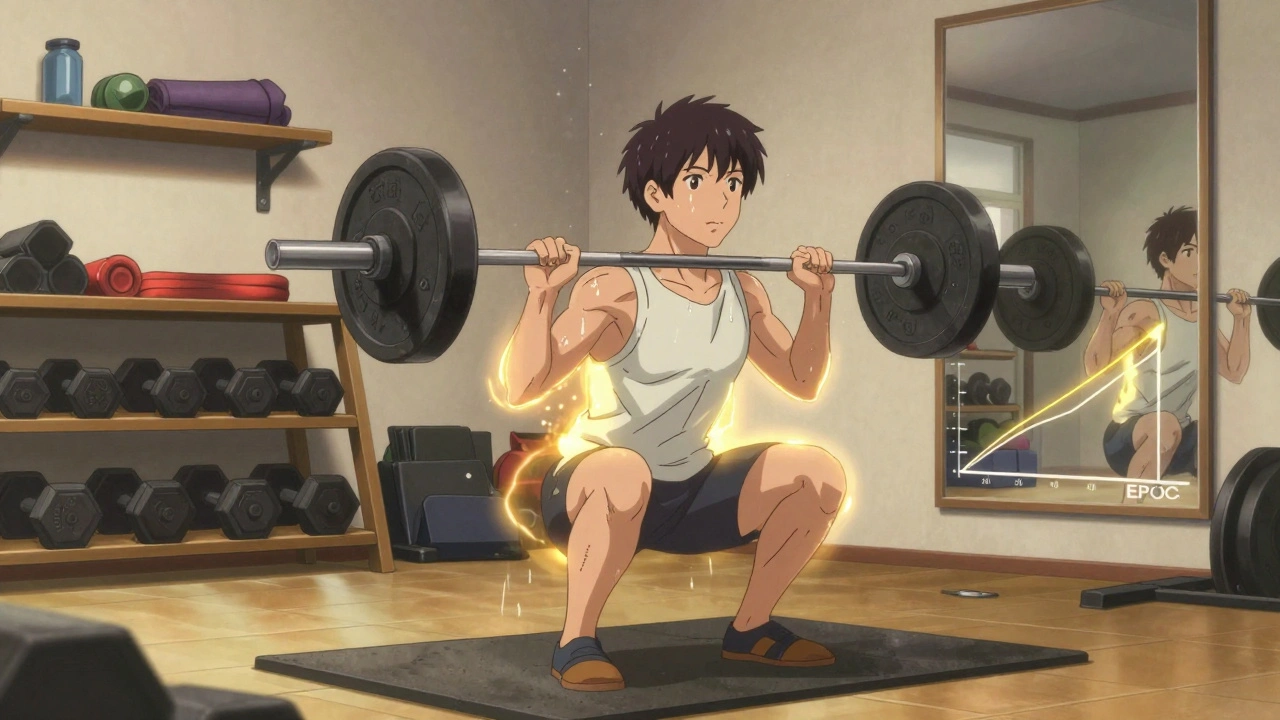
A 30-minute weight session might only burn 90-150 calories. That’s less than half of what cardio burns in the same time. So why bother? Because strength training doesn’t just burn calories during the workout - it changes how your body burns calories all day, every day. Muscle tissue is metabolically active. Every kilogram of muscle burns about 13-15 calories at rest. Fat? Only 4.5-5. That means if you gain 2kg of muscle and lose 2kg of fat, your body is burning an extra 150-200 calories daily without lifting a finger. That’s like eating an extra apple every day - for free. Plus, strength training triggers something called EPOC - excess post-exercise oxygen consumption. After a hard lifting session, your body keeps working to repair muscle, restore oxygen levels, and balance hormones. That means you’re burning extra calories for up to 48 hours after you finish. A 2024 study from the Cleveland Clinic confirmed this effect is stronger with compound lifts like squats, deadlifts, and push-ups.Here’s What the Science Says About Fat Loss
A 2022 study in the journal Obesity tracked 120 overweight adults over six months. One group did only cardio (150 minutes per week). Another did only strength training (120 minutes). The third group did both. Here’s what happened:- Cardio-only group: Lost 9.7% body fat - but also lost 0.3kg of muscle.
- Strength-only group: Lost 7.1% body fat - but gained 2.3kg of muscle.
- Combined group: Lost 12.4% body fat - and gained 1.8kg of muscle.
Why People Get Frustrated With Strength Training
A lot of people quit strength training because the scale doesn’t move - or even goes up. That’s normal. When you start lifting, your muscles store more water. You’re building new tissue. Your body is repairing itself. That can mean a 1-2kg weight gain in the first few weeks. If you’re only watching the scale, you’ll think it’s not working. But if you look in the mirror, your clothes fit better. Your arms feel tighter. Your waistline shrinks. That’s body recomposition - losing fat while gaining muscle. It’s slower than cardio at first, but it’s more sustainable. And it’s what keeps people from regaining weight later. Reddit threads from r/Fitness and r/loseit show this pattern clearly. Of the people who combined cardio and strength training, 68% lost more than 15% body fat. Only 42% of those who did cardio alone hit that mark. And 82% of strength trainees said their clothes fit better - even when the scale didn’t budge.The Real Secret: Combine Them - But Do It Right
The American College of Sports Medicine recommends this simple plan for weight loss:- 150 minutes of moderate cardio per week - that’s 30 minutes, five days a week.
- 120 minutes of strength training per week - that’s 2-3 full-body sessions.
- Each strength session: 8-12 reps per exercise, using a weight that challenges you by the last rep.

What About HIIT?
High-Intensity Interval Training (HIIT) - short bursts of all-out effort followed by rest - is a smart middle ground. A 20-minute HIIT session can burn as many calories as 40 minutes of steady jogging. And it creates a bigger EPOC effect than steady-state cardio. One 2023 study in the European Journal of Applied Physiology found HIIT burned 25-30% more calories than traditional cardio and triggered 12-15% more post-workout calorie burn. You don’t need to do HIIT every day. Try one or two sessions per week. For example: 30 seconds sprinting on a bike, 60 seconds easy pedaling. Repeat 8 times. That’s it. You’ll be done in 20 minutes.Why Most People Fail
People don’t fail because they don’t have time. They fail because they don’t have a plan. They pick one modality and stick with it - even when it stops working. Or they do too much too soon and burn out. Or they skip protein and wonder why they’re losing muscle instead of fat. The biggest mistake? Thinking weight loss is just about burning calories. It’s not. It’s about changing your body’s composition. You want to lose fat, not muscle. You want to keep your metabolism high. You want to be strong enough to carry groceries, play with your kids, or hike without getting winded.The Bottom Line
Cardio gets you moving. Strength training keeps you moving - for life. Neither is enough alone. The most effective weight loss strategy combines both. Do cardio to burn calories and improve heart health. Do strength training to build muscle, boost your metabolism, and reshape your body. Add protein. Be consistent. And don’t just watch the scale - watch how your clothes fit and how you feel. The science is clear: the best exercise for weight loss isn’t cardio or strength training. It’s both - done right, over time.Is cardio or strength training better for losing belly fat?
Neither targets belly fat specifically - fat loss happens all over the body, not just where you exercise. But combining both cardio and strength training gives you the best shot at reducing overall body fat, including belly fat. Cardio burns more calories in the short term, while strength training helps preserve muscle and keeps your metabolism high so you keep burning fat even when you’re not working out.
Can I lose weight with strength training alone?
Yes, but it’s slower and less effective than combining it with cardio. Strength training builds muscle and increases your resting metabolism, which helps burn fat over time. However, because it burns fewer calories during the workout, you’ll need to be very strict with your diet to see significant weight loss. Most people lose fat faster when they add cardio to their routine.
Why does my weight go up when I start lifting weights?
It’s normal. When you start strength training, your muscles store more water and glycogen to support recovery. You’re also building new muscle tissue, which is denser than fat. So even if you’re losing fat, your weight might stay the same or go up slightly. That doesn’t mean you’re not making progress. Look at how your clothes fit, take measurements, and check your body fat percentage - not just the scale.
How often should I do cardio and strength training to lose weight?
Aim for 150 minutes of moderate cardio (like brisk walking or cycling) spread over five days, and two to three strength training sessions per week that hit all major muscle groups. That’s about 30 minutes of cardio daily and 40 minutes of lifting 2-3 times a week. You can adjust based on your schedule, but don’t skip strength training - it’s key for long-term results.
Do I need to do HIIT to lose weight?
No, but it can help if you’re short on time. HIIT burns more calories in less time and boosts post-workout calorie burn more than steady-state cardio. One or two HIIT sessions per week can speed things up, but you don’t need to do them every day. Overdoing HIIT can lead to burnout or injury. Balance it with steady cardio and strength training for best results.
What if I hate cardio?
You don’t have to run or cycle if you hate it. Try dancing, swimming, hiking, stair climbing, or even vigorous gardening. Any activity that raises your heart rate for 10+ minutes counts as cardio. The key is finding something you enjoy enough to stick with. If you like lifting weights, focus on circuit training - moving quickly between strength exercises with little rest. That’s cardio too.





Comments
Ali Bradshaw
Been lifting for 8 years and doing cardio on weekends. The scale barely budges but my jeans are loose and I can climb stairs without puffing. This post nails it. Muscle isn't just for looks-it's for living.
Rupa DasGupta
I tried strength training and gained 3lbs in 2 weeks 😭 thought I was failing... then my waist shrunk 2 inches. Now I laugh at the scale. 💪😂
Deborah Jacobs
My grandma started lifting at 68. She’s got more grip strength than my 25-year-old brother. Muscle isn’t vanity-it’s independence. You don’t want to be the person who can’t open a jar at 70. This isn’t just fitness. It’s future-proofing.
Marvin Gordon
Cardio is the gateway drug to fitness. You start running because you want to lose weight. Then you realize you feel better, sleep better, think clearer. That’s when you discover strength training. And then you never go back. It’s not about burning calories-it’s about becoming someone who doesn’t need to chase results anymore.
ashlie perry
They say combine cardio and strength but no one tells you how to actually do it without spending 2 hours a day. Also who has time for 150 mins cardio? I work 2 jobs and have 3 kids
Philip Kristy Wijaya
Let me be the first to say this is the most dangerously oversimplified fitness advice I've ever read. The entire premise assumes human biology is a linear equation. You ignore circadian rhythms, cortisol dysregulation from chronic cardio, the fact that muscle gain is genetically capped for most, and the 87% of people who plateau because they're not adjusting macros. You're not teaching adaptation-you're selling a cult. And HIIT? That's just cardio with extra steps and a higher injury rate. You're not helping. You're marketing.
Also, protein intake recommendations are based on sedentary athletes. If you're in a calorie deficit and training hard? You need 2.5g/kg minimum. You missed that. And the Cleveland Clinic study? They funded it. Conflict of interest. Don't trust studies that sound like ads.
Harry Nguyen
Of course the American College of Sports Medicine says combine both. They're paid by the gym equipment industry. Real Americans don't have time for 5 days of cardio. We work. We fix things. We lift actual weight. That's our cardio. You want fat loss? Eat less sugar. Stop pretending exercise is the hero here.
Lucy Kavanagh
Interesting how this ignores the fact that most British people don't even know what a deadlift is. We do walking. Proper walking. Not that American treadmill nonsense. And we don't need protein shakes. We have tea and biscuits. My mum lost 20lbs on tea and a daily 4-mile walk. No gym. No weights. Just grit.
Lynette Myles
Cardio is a government conspiracy to keep you weak. Strength training builds bone density and blocks EMF radiation absorption. The scale lies because it's calibrated for fat, not muscle. You're being manipulated by Big Fitness. Trust your body, not studies funded by Nike.
Jimmy Jude
There is no 'best' way. There is only the path of the warrior. Cardio is the path of the slave-running from your pain. Strength is the path of the king-building a temple within. The scale is a mirror of your soul's surrender. You don't lose fat. You transcend it. When you lift, you are not building muscle. You are forging your destiny. The body is just the vessel. The will is the fire.
And if you're not crying after your workout, you didn't go hard enough.
Ada Maklagina
I do 20 min HIIT 3x a week and 2 strength days. Lost 18lbs in 4 months. Clothes fit. Energy up. No more 3pm crashes. Also I started eating eggs for breakfast. Game changer.
Norene Fulwiler
As someone from a culture where food is love, I get why people struggle. We don't just eat to live-we eat to connect. But I learned to swap rice for cauliflower rice, and my mom still hugs me when I eat it. Strength training made me feel strong enough to say no-to the fried food, to the guilt, to the idea that I have to be small to be worthy. I'm not losing weight. I'm becoming whole.