
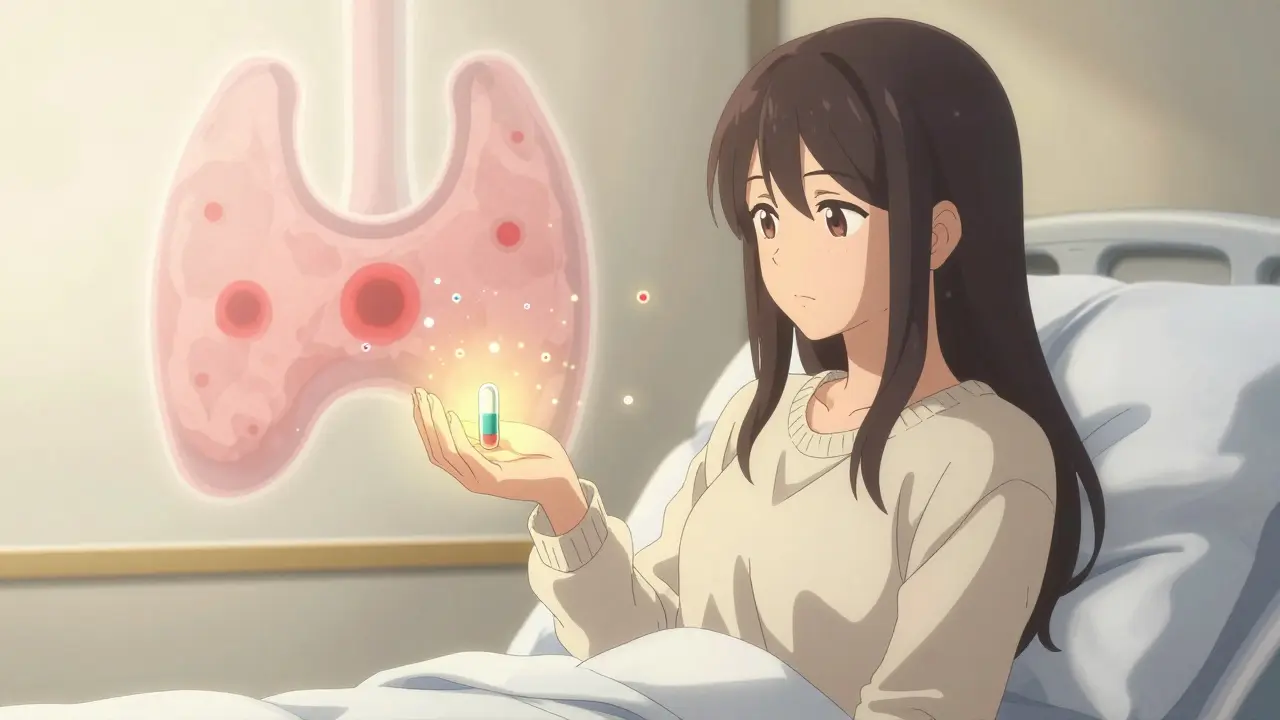
Thyroid cancer is one of the fastest-growing cancer diagnoses in the U.S., with nearly 44,000 new cases each year. But here’s the surprising part: most people diagnosed with it live long, healthy lives. The key? Knowing the type, understanding the treatment options, and avoiding unnecessary interventions. This isn’t just about surgery or radiation-it’s about making smart, personalized choices based on real data, not fear.
What Are the Main Types of Thyroid Cancer?
Not all thyroid cancers are the same. They’re named after the cells they come from, and that determines how they behave and how they’re treated.Papillary thyroid carcinoma (PTC) makes up 70 to 80% of cases. It grows slowly, often stays inside the thyroid, and responds extremely well to treatment. Even when it spreads to nearby lymph nodes, the 10-year survival rate for people under 45 is over 98%. It’s the most common type-and often the least dangerous.
Follicular thyroid carcinoma (FTC) accounts for 10 to 15% of cases. It’s similar to PTC but more likely to spread through the bloodstream to the lungs or bones. Still, if caught early, it’s highly treatable.
Medullary thyroid carcinoma (MTC) is rarer, at 3 to 5%. It starts in the C-cells, which make calcitonin, not thyroid hormone. Some cases are inherited, linked to genetic mutations like RET. This type doesn’t absorb iodine, so radioactive iodine therapy won’t work. Surgery is the main treatment.
Anaplastic thyroid carcinoma (ATC) is the rarest-less than 2%-but also the most aggressive. It grows fast, spreads quickly, and is often diagnosed at stage IV. Survival rates drop sharply if treatment is delayed. The good news? New targeted drugs like dabrafenib and trametinib have doubled median survival for patients with BRAF mutations.
Why Radioactive Iodine Therapy Is Used (and When It’s Not)
Radioactive iodine therapy (RAI), or I-131, has been used since the 1940s. It works because thyroid cells-both healthy and cancerous-absorb iodine. When you swallow a capsule or liquid containing I-131, the radiation destroys any remaining thyroid tissue after surgery.But RAI isn’t for everyone. It only works on cancers that still act like normal thyroid cells-so it’s effective for papillary and follicular cancers, but useless for medullary and anaplastic types.
For low-risk patients-those with tumors under 1 cm and no spread-studies show no benefit from RAI. The HiLo trial found that 30 mCi doses work just as well as 100 mCi for ablation, cutting radiation exposure by 70%. Many doctors now skip RAI entirely for small, low-risk tumors.
Preparing for RAI used to mean going weeks without thyroid hormone, causing fatigue, brain fog, and weight gain. Now, most patients get injections of recombinant human TSH (Thyrogen®), which stimulates thyroid cells without making you hypothyroid. It’s easier, safer, and more comfortable.
Still, RAI has downsides. Some patients report dry mouth, taste changes, or even secondary cancers years later. A 2019 study found 58% of patients had dry mouth six months after treatment. For those with advanced disease, it’s life-saving. For others, it’s an over-treatment.
Thyroidectomy: What Surgery Really Involves
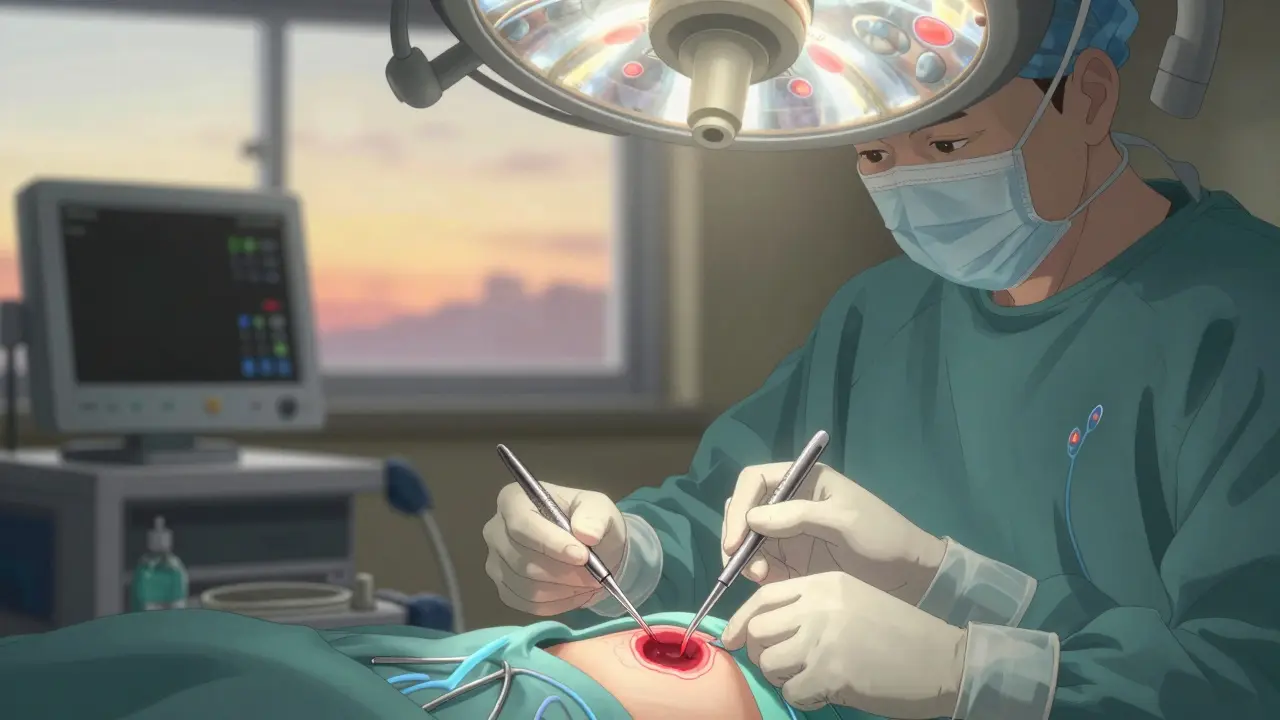
Surgery is the foundation of thyroid cancer treatment. The type of surgery depends on the cancer’s size, type, and spread.Lobectomy removes one lobe of the thyroid. It’s often enough for small, low-risk papillary cancers. Recovery is quick-most people go home the same day. The incision is 4 to 6 cm, and complications like nerve damage are rare.
Total thyroidectomy removes the entire gland. This is standard for larger tumors, cancers that have spread, or when RAI is planned. The incision is 6 to 8 cm. Surgeons now use nerve monitors to protect the vocal cords, cutting injury rates from 12% down to under 5%.
Completion thyroidectomy is done if a patient had a lobectomy first, and later tests show cancer was more extensive than thought. It’s a second surgery, but less complex than the first.
Some patients ask about scarless options like transoral or robotic surgery. These are possible, but not better. A 2020 meta-analysis found robotic approaches had higher complication rates (12.4% vs. 8.9%) and no proven survival benefit. Open surgery still gives surgeons the clearest view and best control.
After surgery, you’ll need lifelong thyroid hormone replacement (levothyroxine). The dose isn’t just to replace function-it’s often raised to suppress TSH and lower cancer recurrence risk. For intermediate-risk patients, doctors aim for a TSH level between 0.5 and 2.0 mIU/L.
What Happens After Treatment?
Recovery isn’t just about healing the neck. Many patients struggle with ongoing symptoms-even after their cancer is gone.A 2023 survey of over 1,200 thyroid cancer survivors found 68% still felt fatigued or mentally foggy despite taking their hormone pills. That’s not normal hypothyroidism. It’s something deeper, possibly tied to how the body adjusts to synthetic hormone.
Another common issue: calcium levels. The parathyroid glands sit right behind the thyroid. During surgery, they can get damaged or temporarily shut down. About 22% of total thyroidectomy patients need long-term calcium and vitamin D supplements. Checking calcium levels weekly after surgery isn’t optional-it’s essential.
Voice changes are also common. Hoarseness usually clears up in weeks, but 31% of patients report lasting changes. That’s why nerve monitoring during surgery matters so much.
Follow-up care includes regular blood tests (TSH, thyroglobulin), neck ultrasounds, and sometimes whole-body scans. For most, these visits become less frequent over time. But staying on schedule is critical-recurrence can happen years later.
When Less Is More: The Shift Away from Overtreatment
For years, the default was aggressive: remove everything, give radiation, push hormone suppression. But new data is changing that.Dr. Leonard Wartofsky and others have shown that tiny papillary cancers under 1 cm-called microcarcinomas-often never grow. In Japan, where active surveillance is common, only 3.8% of these tumors progressed over 10 years. That’s why the 2015 American Thyroid Association guidelines now recommend observation for low-risk cases, not surgery.
Dr. David Ain says up to 30% of thyroid cancer patients get overtreated. That means unnecessary surgery, radiation, and lifelong hormone therapy for cancers that would never harm them.
But here’s the balance: if you have a tumor over 1 cm, lymph node spread, or a family history of thyroid cancer, you need treatment. The goal isn’t to avoid all treatment-it’s to avoid the wrong treatment.
What’s New in Thyroid Cancer Treatment?
The field is moving fast. In 2021, the FDA approved selpercatinib for RET-mutant medullary thyroid cancer. It’s a targeted pill that blocks the specific mutation driving the cancer. For some, it shrinks tumors without surgery.For anaplastic cancer, the combination of dabrafenib and trametinib (used for melanoma) has pushed median survival from 5.3 months to over 10 months. That’s huge for a disease that used to be a death sentence.
Researchers are now testing drugs that can “redifferentiate” cancer cells-making them absorb iodine again. Selumetinib showed promise in trials, with 54% of RAI-resistant patients regaining iodine uptake.
Future tools include liquid biopsies-blood tests that detect cancer DNA. They could replace painful scans and catch recurrence earlier.
What You Need to Know Before Making a Decision
If you’re facing a thyroid cancer diagnosis, here’s what to ask:- What type of cancer do I have? (Papillary? Follicular? Medullary?)
- What’s the size? Has it spread beyond the thyroid?
- Do I need a lobectomy or a total thyroidectomy?
- Will I need radioactive iodine? Is my cancer likely to absorb it?
- Can I try active surveillance instead of surgery?
- What are the risks of nerve damage or low calcium?
- Who will manage my thyroid hormone levels after surgery?
Don’t rush. Get a second opinion. Ask for a copy of your pathology report. And remember: thyroid cancer is not one disease. Your treatment should be as unique as your diagnosis.
Is radioactive iodine always necessary after thyroid surgery?
No. For small, low-risk papillary thyroid cancers under 1 cm with no spread, radioactive iodine offers no survival benefit. Studies like the HiLo trial show that low doses (30 mCi) work just as well as high doses (100 mCi) for ablation-and many patients don’t need it at all. Guidelines now recommend avoiding RAI unless there are high-risk features like large tumors, lymph node involvement, or aggressive subtypes.
How long does recovery take after a thyroidectomy?
Recovery depends on the type of surgery. For a lobectomy, most people return to normal activities in 3-5 days. For a total thyroidectomy, expect 2-4 weeks. Driving is restricted for 7-10 days, and heavy lifting should be avoided for 3 weeks. Voice changes and neck stiffness are common but usually improve within weeks. Full healing of the incision takes about 6-8 weeks.
Can thyroid cancer come back after treatment?
Yes, but it’s uncommon for low-risk patients. Recurrence happens in about 5-10% of cases, usually within the first 10 years. Most recurrences are in the neck lymph nodes and are treatable with surgery or RAI. Regular follow-up with blood tests (thyroglobulin) and ultrasounds helps catch it early. Even if it returns, survival rates remain high if caught in time.
Why do some people still feel tired after taking thyroid hormone?
Many patients report ongoing fatigue, brain fog, or muscle weakness even with normal TSH levels. This isn’t fully understood, but it may relate to how the body converts T4 to T3, or individual differences in hormone sensitivity. Some benefit from adding T3 medication, though this isn’t standard. It’s important to discuss these symptoms with your doctor-they’re real and common, even if labs look fine.
What’s the difference between a lobectomy and a total thyroidectomy?
A lobectomy removes only one side of the thyroid (one lobe), while a total thyroidectomy removes the entire gland. Lobectomy is often enough for small, low-risk cancers and avoids lifelong hormone replacement in about half of patients. Total thyroidectomy is needed for larger tumors, aggressive types, or if radioactive iodine is planned. It guarantees complete removal but requires lifelong thyroid hormone pills.
Comments
Stephen Rock
Most of this is just rebranded fear-mongering with a side of medical jargon. I’ve seen three people go through this and two of them ended up with permanent voice issues and calcium crashes. The system loves to operate-it makes money. You don’t need to remove a 6mm tumor if it’s not growing. Watch it. Wait. Breathe.
They call it ‘low-risk’ like that’s a comfort. It’s a euphemism for ‘we’re not sure if it’s dangerous but we’re gonna cut anyway.’
Roisin Kelly
They’re lying. Radioactive iodine doesn’t just kill thyroid cells-it wrecks your salivary glands, your gut, your immune system. And the ‘new’ TSH injections? Totally funded by pharma. You think they’d let you skip it if it wasn’t profitable? Wake up. The FDA’s been bought. This isn’t medicine-it’s a cash grab dressed in white coats.
Malvina Tomja
While I appreciate the attempt at clinical clarity, the underlying assumption-that patient autonomy is best served by algorithmic risk stratification-is fundamentally flawed. The data may suggest ‘observation’ for microcarcinomas, but the psychological burden of living with an unexcised malignancy is rarely quantified in RCTs. One cannot reduce existential dread to a p-value.
Furthermore, the normalization of TSH suppression as therapeutic strategy ignores the iatrogenic hypothyroidism cascade: fatigue, dyslipidemia, cognitive slowing, depression. This is not treatment. It’s chronic pharmacological management of iatrogenic disease.
Samuel Mendoza
RAI is useless for most people. Stop it. Lobectomy is enough. Done.
Glenda Marínez Granados
So we’re telling people to ‘watch and wait’ on a cancer that can kill you… while the same people are being told to get a colonoscopy at 45 because ‘it might turn into something.’ 😅
Meanwhile, my aunt got a total thyroidectomy for a 4mm nodule and now she’s on 4 pills a day and still feels like a zombie. So… congrats? We’re all just guinea pigs in a $30 billion industry.
Also, ‘active surveillance’ sounds like a corporate buzzword for ‘we’re too lazy to cut it.’
Yuri Hyuga
This is such an important, nuanced piece-thank you for laying it out so clearly 🙏
So many people panic when they hear ‘cancer’ and rush into surgery without understanding the real risks vs. benefits. The shift toward personalized care? That’s the future. Not一刀切 (one-size-fits-all).
If you’re reading this and you’re facing a diagnosis-breathe. Get a second opinion. Ask for the pathology report. You’re not just a case number. Your body deserves a thoughtful plan-not a protocol.
And if you’re a survivor struggling with fatigue? You’re not alone. That’s real. Talk to your doctor. There are options. Keep fighting 💪❤️
MARILYN ONEILL
Why do they even make you take pills for life? It’s so dumb. They cut your thyroid out and then say ‘oh here’s a fake one’ like that’s normal. And now you’re supposed to be fine? I had my thyroid out and I still feel like crap. Why? Because they don’t know what they’re doing. They just push the pills and call it a day.
Also why are they doing surgery on little tiny things? That’s just stupid. My cousin had a 3mm thing and they cut her whole thyroid. She’s 28 and she’s on 5 meds. This is not medicine. This is a scam.
Steve Hesketh
Brother and sister, this is the kind of truth we need to hear more of.
I’m from Nigeria, and here, most people don’t even get diagnosed until it’s late. We don’t have access to TSH injections, or genetic testing, or even basic ultrasounds. So when I read this, I felt a mix of gratitude and grief.
Gratitude because you’re showing how far we’ve come in the West. Grief because so many still suffer because they can’t get the care you’re talking about.
If you’re reading this and you’re in the US or Europe-don’t take your access for granted. Ask questions. Push back. Advocate. And if you know someone facing this? Give them this article. It could save their life-or at least their quality of life.
We are not alone. We are seen. We are worthy of thoughtful care.
Love you all. Keep fighting.
Peace 🙏
shubham rathee
the whole thing is a lie they use rai to kill your immune system so you get more cancer later and then they sell you more drugs its a cycle the parathyroid damage is intentional because then you need calcium pills forever and the hormone replacement is just to keep you dependent its all designed to make money not to heal you
why do you think they dont want you to know about active surveillance its because they cant make money off watching
MAHENDRA MEGHWAL
While the article presents a comprehensive overview grounded in contemporary clinical guidelines, it remains imperative to acknowledge the limitations of evidence-based medicine in the context of individual variability. The reliance on population-level statistics-such as 98% 10-year survival for PTC-may inadvertently minimize the lived experience of patients who endure chronic sequelae despite ‘favorable’ prognostic indicators.
Furthermore, the normalization of levothyroxine suppression therapy warrants critical scrutiny, as it introduces a pharmacological intervention that may not align with physiological homeostasis. The absence of long-term data on the impact of sustained TSH suppression on bone density, cardiac function, and metabolic health constitutes a significant gap in the current paradigm.
Therefore, while the recommendations are reasonable, they must be contextualized within a framework of patient-centered, not protocol-driven, care.
Kevin Narvaes
so like… i got my thyroid out and now i’m on pills and i still feel like a zombie and my hair is falling out and my brain is mush but the docs say ‘your labs are perfect’ so… what the f even is wrong with me? like why am i still tired? why do i cry for no reason? why does my skin feel like sandpaper?
they cut it out and now they’re like ‘here’s a fake one’ but it’s not even close
and rai? i did it and now i can’t taste anything and my mouth is always dry and my dentist says i’m gonna lose all my teeth
who the hell thought this was a good idea