

Macrolide Therapy ECG Risk Estimator
Patient Profile
Monitoring Recommendation
Imagine a patient coming into a clinic for a common respiratory infection. The doctor prescribes a standard course of antibiotics, but there is a hidden risk: for a small number of people, these drugs can actually interfere with the heart's electrical system. When we talk about macrolide therapy, we aren't just talking about fighting bacteria; we're talking about managing a specific cardiovascular risk known as QT prolongation. If left unchecked, this can lead to a dangerous heart rhythm called Torsades de Pointes (TdP), which can be fatal if not treated immediately.
The core of the problem is that while macrolides are incredibly effective, they can slow down the time it takes for the heart's ventricles to recharge between beats. This "recharging" phase is measured on an electrocardiogram (ECG) as the QT interval. When this interval gets too long, the heart becomes unstable. But does every single person taking a Z-Pak need a heart scan? Probably not. The real challenge for healthcare providers is figuring out who actually needs monitoring and who is safe to proceed without an ECG.
The Core Risk: How Macrolides Affect Your Heart
To understand why we monitor the heart, we first need to look at what these drugs actually do. Macrolides are a class of antibiotics, including azithromycin, clarithromycin, and erythromycin, used to treat a wide range of bacterial infections. They work by stopping bacteria from making proteins, but they have a side effect: they can inhibit the hERG potassium channel in the heart. This channel is basically a "door" that lets potassium out of the heart cells to reset the electrical charge.
When Erythromycin blocks these channels, the reset takes longer. In fact, research shows erythromycin has a significantly higher risk of causing this issue compared to Azithromycin. While the absolute risk of a life-threatening arrhythmia is low-roughly 1 to 8 cases per 10,000 patient-years-the risk isn't evenly distributed. It spikes dramatically if a patient already has a prolonged QT interval. If a patient's QTc (the corrected QT interval) exceeds 500 ms, the risk of a dangerous arrhythmia jumps to between 3% and 5%.
Who Specifically Needs ECG Monitoring?
Not every prescription warrants a trip to the cardiology lab. However, certain "red flags" make ECG monitoring essential. The British Thoracic Society (BTS) has set a high bar for long-term use, mandating baseline screening to ensure patients don't start therapy with a QTc over 450 ms for men or 470 ms for women.
If you aren't on long-term therapy, you should still be screened if you fall into these high-risk categories:
- Advanced Age: Patients over 65 have a significantly higher relative risk (RR 2.3).
- Biological Sex: Women are naturally more prone to drug-induced long QT syndrome (RR 2.9).
- Drug Interactions: Using other medications that also prolong the QT interval-such as certain antipsychotics or antiarrhythmics-increases the risk fourfold.
- Existing Conditions: People with renal failure or electrolyte imbalances (like low potassium or magnesium) are far more vulnerable.
In a real-world scenario, consider a 68-year-old woman with mild kidney issues. If she is prescribed clarithromycin for a severe lung infection, she is the "perfect storm" of risk factors. Without a baseline ECG, a doctor might miss that her QTc is already 480 ms, pushing her into a danger zone the moment the antibiotic hits her system.
| Patient Profile | Drug Type | Risk Level | Monitoring Recommendation |
|---|---|---|---|
| Healthy Adult (<65) | Azithromycin (Short course) | Low | Generally not required |
| Female, >65, or Renal Impairment | Any Macrolide | Moderate | Baseline ECG recommended |
| Chronic Respiratory Patient | Any Macrolide (Long-term) | High | Mandatory Baseline + 1 month follow-up |
| Patient on Multiple QT-prolonging Drugs | Erythromycin/Clarithromycin | Very High | Strict ECG surveillance |

Hospital vs. Outpatient: The Safety Gap
There is a jarring difference in how these risks are managed depending on where you are treated. In an ICU setting, the REMAP-CAP guidelines are strict. If a patient is moved from the ICU to a general ward and is no longer on continuous cardiac monitoring, they must have a QT evaluation. If the interval has prolonged, the drug is stopped immediately.
In primary care, however, things are much looser. A survey of primary care physicians found that while nearly 80% knew about the risks, only about 22% actually ordered baseline ECGs. Why? Because it's often seen as impractical. An ECG costs money and time-roughly £28.50 per test in the UK-and if you screened every single person getting a macrolide, the cost would be hundreds of millions of dollars. This creates a dangerous gap where high-risk patients in outpatient settings are often missed.
How to Implement a Safe Monitoring Workflow
For clinicians and patients, the goal is to balance safety with efficiency. You don't need to treat every infection like a cardiac event, but you should follow a risk-stratified approach. The American Heart Association now suggests a 9-point scoring system that looks at age, sex, and kidney function to decide if an ECG is necessary.
If an ECG is required, the workflow should look like this:
- Baseline Screening: Perform an ECG before the first dose. If QTc is >450ms (men) or >470ms (women), reconsider the drug choice.
- The 500ms Hard Stop: If the QTc ever hits 500 ms, the risk of TdP becomes critical. The medication should generally be discontinued.
- Follow-up: For those on long-term therapy, a second ECG at the one-month mark is vital to catch any delayed reactions.
- Symptom Watch: Patients should be told to report any dizziness, fainting, or palpitations immediately, as these can be early signs of an arrhythmia.
New technology is helping close the gap. Some clinics are now using point-of-care QTc devices that give results in minutes rather than days, reducing the delay in starting life-saving antibiotics from over five days to less than one.
The Trade-off: Safety vs. Practicality
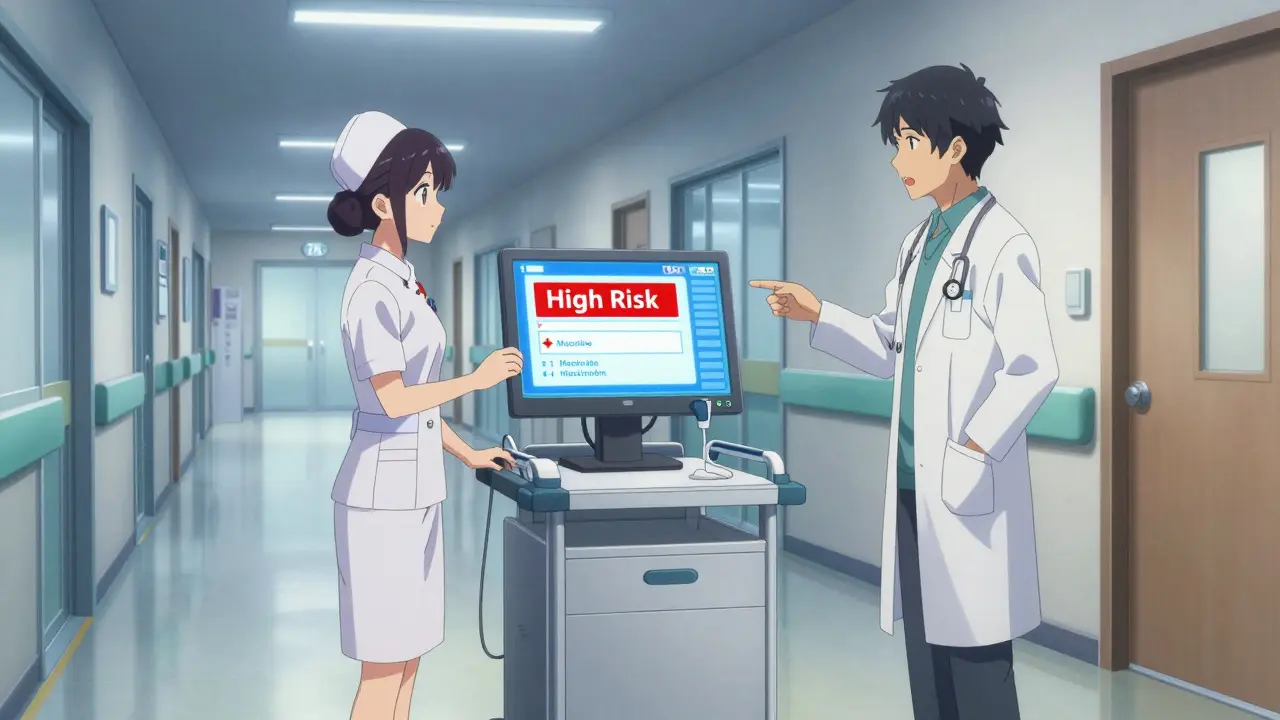
It is tempting to say "everyone should get an ECG," but the medical system isn't built for that. The resource burden is too high. Instead, the industry is moving toward "intelligent alerts." Many hospitals now use EHR systems like Epic that automatically flag a macrolide prescription if the patient's profile suggests a high risk of QT prolongation.
This targeted approach is the only viable path forward. By focusing on the 14 established risk factors-like being female or over 65-doctors can prevent the most dangerous complications without slowing down care for the general population. In the end, the goal isn't zero risk (which is impossible), but manageable risk.
What is the difference between QT and QTc?
The QT interval is the actual time it takes for the heart to recharge. However, because heart rate changes the length of this interval, doctors use the "QTc" (corrected QT), which adjusts the measurement based on the patient's heart rate to provide a standardized value regardless of whether the heart is beating fast or slow.
Are all macrolides equally dangerous for the heart?
No. Erythromycin generally carries the highest risk of causing QT prolongation. Azithromycin is often considered to have a lower risk profile, although it still carries FDA warnings and can be dangerous for patients with existing heart conditions or those taking other QT-prolonging drugs.
What is Torsades de Pointes (TdP)?
Torsades de Pointes is a specific, polymorphic ventricular tachycardia that occurs in the setting of a prolonged QT interval. It looks like a "twisting of the points" on an ECG and can either resolve on its own or degenerate into ventricular fibrillation, which leads to sudden cardiac arrest.
When is a QTc value considered "too long"?
Generally, a QTc over 450 ms in men and 470 ms in women is considered prolonged. However, the critical threshold is 500 ms; once the QTc exceeds this value, the risk of a life-threatening arrhythmia increases significantly, and medication is typically stopped.
Can I take macrolides if I have a history of Long QT Syndrome?
If you have congenital or acquired Long QT Syndrome, macrolides are generally avoided or used with extreme caution. You should ensure your doctor is aware of your condition so they can choose an alternative antibiotic class that doesn't affect the hERG potassium channels.
Next Steps and Troubleshooting
For Patients: If you are over 65, female, or taking multiple medications (especially for mental health or heart rhythm), ask your doctor: "Do I have any risk factors for QT prolongation before taking this antibiotic?" If you feel dizzy or faint during treatment, stop the medication and contact your provider immediately.
For Clinicians: If you are in a primary care setting without an on-site ECG, use a risk-stratification tool (like the AHA 9-point system). If a patient is high-risk, consider alternatives to macrolides or refer them to a clinic for a quick baseline scan before starting the regimen.
For Hospital Staff: Ensure that patients transitioning from ICU to wards have a documented QT evaluation if continuous monitoring is removed. This simple step prevents the "monitoring gap" that often leads to adverse events during discharge or transfer.





Comments
Caroline Duvoe
just common sense really 🙄 idk why this needs a whole guide 💅
Mayur Pankhi Saikia
The sheer lack of rigor in primary care is... predictable!!! One must wonder if the practitioners even grasp the basic electrophysiology of the hERG channel, or if they simply follow a manual like mindless automatons... truly pathetic!!!
Emma Cozad
Typical US healthcare system fail lol. We got the best tech but doctors too lazy to run a basic ecg because of some stupid budget cut... absolute joke
Sue Stoller
This is such a helpful breakdown! 🌟 It's so important for us to advocate for our own health and ask the right questions. Thanks for sharing this! ✨😊
RAJESH MARAVI
Wait so you're telling me we should trust doctors to check our hearts? lmao they cant even diagnose a cold right... probably just want to charge more for the test anyway!! 🤡
Rick Brewster
the duality of man is present here... the tension between the clinical necessity of the heart rhythm and the cold hard currency of the state... its all just a simulation of control anyway and we are but pawns in a larger pharmacological game’s board’
Chidi Prosper
I completely agree that a risk-stratified approach is the only way to make this sustainable. We need to push for better integration of these scoring systems into standard practice to ensure no one falls through the cracks.
Odicha ude Somtochukwu
It is truly a commendable effort to provide such detailed guidance,,, as safety should always be the paramount priority in medical care!!! May we all strive for a world where patient wellbeing transcends all other considerations!!!
Dave Edwards
Oh please, as if a 9-point score is enough to save anyone 🙄 I've seen people with "perfect" baselines crash anyway. This is just a way for hospitals to avoid lawsuits while pretending to care 🙄
Saptatshi Biswas
The disregard for the systemic failures in these protocols is absolutely appalling! How dare we minimize the impact of drug-induced arrhythmias when the regulatory bodies are clearly complicit in this negligence! This is a catastrophe waiting to happen!
vimal purwal
While I understand the financial constraints mentioned, I must insist that the safety of the patient should never be compromised for the sake of a few pounds or dollars, and it is my professional opinion that a more aggressive screening policy should be adopted regardless of the initial cost, because the cost of a single fatal event far outweighs the cost of preventative ECGs across a population.
Sarah Watters
Funny how they mention "new technology" helping. Probably just another way for big pharma to track our biometrics in real time under the guise of "patient safety." I'll pass on the point-of-care devices.
Anastasios Kyriacou
who cares if it costs 28 quid... just do the test if ur old lol
Nicole Antunes
It is quite reassuring to see a structured workflow for this. It allows patients to feel more empowered in their healthcare journey. (^_^)
Mel Glick
The point about the ICU-to-ward gap is spot on! I've seen so many transitions where critical data just vanishes into a void because the handoff was sloppy. We need to stop pretending the system is seamless and actually fix the communication breaks!