
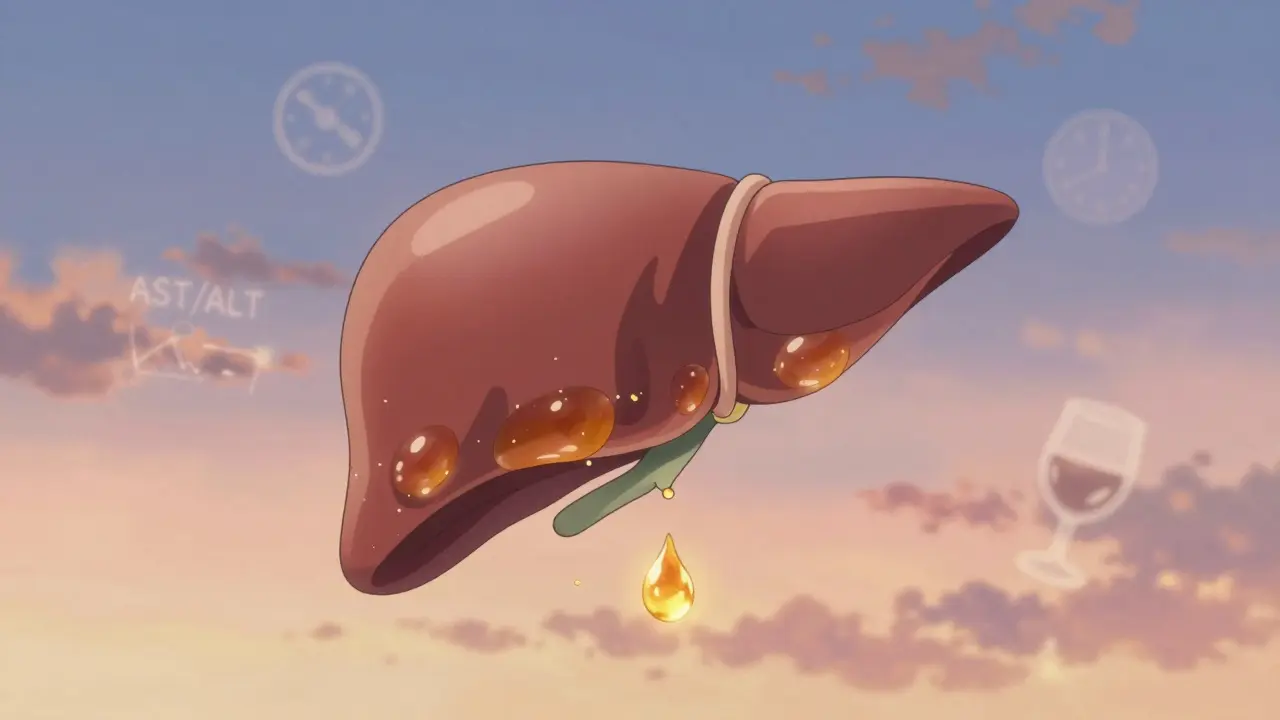
Most people don’t realize their drinking is slowly damaging their liver until it’s too late. You might feel fine. You might not even have symptoms. But if you’re drinking regularly-more than a few drinks a day-your liver is under stress. And over time, that stress turns into damage. Alcoholic liver disease doesn’t happen overnight. It creeps in, stage by stage, often without warning. By the time you feel sick, the damage may already be serious. But here’s the truth: if you catch it early, you can stop it. And in many cases, reverse it.
Stage 1: Fatty Liver (Hepatic Steatosis)
This is where it all starts. Almost everyone who drinks heavily develops fatty liver. It’s not rare. It’s common. In fact, up to 90% of people who drink more than 4 units of alcohol a day (about 32 grams of pure alcohol) will have fat building up in their liver within just a few days. That’s right-three to five days of heavy drinking can trigger it.
At this stage, your liver is swollen with fat. It’s not inflamed. It’s not scarred. It’s just full of oil. And here’s the good news: it’s completely reversible. If you stop drinking for 4 to 6 weeks, your liver can clean itself up. Studies show that 85% of people who quit at this point see their liver return to normal. No medication. No surgery. Just abstinence.
Most people don’t even know they have it. There are no symptoms. No pain. No jaundice. You might feel a little tired, but you’ll blame it on work or stress. Blood tests might show slightly elevated liver enzymes-AST and ALT-but even that’s not always obvious. The AST-to-ALT ratio is often less than 2, which is a subtle clue doctors look for. But unless you get tested, you won’t know.
This is the window. The last chance to walk away without long-term consequences. If you’re diagnosed with fatty liver and you keep drinking, you’re playing Russian roulette with your liver.
Stage 2: Alcoholic Hepatitis (Alcohol-Associated Hepatitis)
When drinking continues, the fat turns into inflammation. That’s alcoholic hepatitis. It’s not just fatty anymore-it’s angry. Your liver cells are dying. Immune cells swarm in. The organ swells. This stage usually develops after years of heavy drinking-typically 5 to 10 years at 60 to 80 grams of alcohol daily. But sometimes, it happens after a single binge. Drink 100 grams of alcohol in 24 hours (that’s about 7-8 standard drinks), and your liver can go into crisis mode.
Symptoms start showing up now. Jaundice-yellow skin and eyes-is the most common sign. About 85% of people with moderate to severe alcoholic hepatitis turn yellow. You might feel nauseous. Lose your appetite. Have a fever. Your belly could swell with fluid (ascites). In severe cases, you might get confused or drowsy-that’s hepatic encephalopathy, a sign your liver can’t clean toxins from your blood anymore.
Doctors use a score called the Maddrey Discriminant Function (mDF) to measure how bad it is. If your score is 32 or higher, you have severe alcoholic hepatitis. That means you have a 30-40% chance of dying within a month. Even if your score is lower, you’re still at risk. The only thing that saves you here is stopping alcohol completely. And fast.
Treatment for severe cases often includes steroids like prednisolone. The STOPAH trial showed it cuts 28-day death rates from 20% to under 18%. But here’s the catch: only about 40% of patients actually respond. The rest? Their liver keeps failing. That’s why abstinence isn’t just recommended-it’s life-or-death. If you keep drinking, your chance of dying from this stage is near 100% within a year.
And here’s something many don’t know: half the people who get alcoholic hepatitis have never been told they had liver problems before. It shows up out of nowhere. That’s how sneaky this disease is.
Stage 3: Cirrhosis
This is the point of no return-or so people used to think. Cirrhosis means your liver is covered in scar tissue. More than 75% of its normal structure is gone. It’s hard, shrunken, and can’t work properly. It develops in 10-20% of long-term heavy drinkers. But once it’s here, you’re in the danger zone.
At this stage, the liver can’t regenerate like it used to. The damage is permanent. But here’s the twist: stopping alcohol doesn’t mean you’re doomed. If your cirrhosis is still “compensated”-meaning your liver is still doing enough to keep you alive-you can stabilize it. Studies show that with complete abstinence, 50-60% of people with early cirrhosis avoid further damage. Their 5-year survival jumps from 30% to 70-90%.
But if you keep drinking, your liver will keep failing. That’s when it becomes “decompensated.” That means complications hit hard: fluid builds up in your belly (ascites), you vomit blood from swollen veins in your esophagus (variceal bleeding), or your brain starts to fog up from toxin buildup (hepatic encephalopathy). At this point, half of patients die within two years without a transplant.
Doctors now use tools like FibroScan to check liver stiffness instead of doing risky biopsies. It’s fast, painless, and 85-90% accurate at spotting advanced scarring. Blood tests, imaging, and scores like the Glasgow Alcoholic Hepatitis Score help predict survival.
Medications help manage symptoms. Propranolol reduces the risk of bleeding by 45%. Lactulose cuts brain fog episodes in half. But none of these fix the root problem. Only stopping alcohol-and sometimes, a liver transplant-can save you.
Transplant is the only cure. But most centers require six months of proven abstinence before you’re even put on the list. That’s not punishment. It’s survival. Studies show 70-75% of transplant patients live five years or longer-if they stay sober.

Why Some People Progress Faster Than Others
Not everyone who drinks heavily gets cirrhosis. Why? Because alcohol isn’t the only factor.
Women are more vulnerable. They develop liver damage after consuming far less alcohol than men. That’s because of how their bodies process it-less enzyme to break it down, more fat in the liver. A woman who drinks 20 grams of alcohol daily (about 1.5 drinks) has the same risk as a man drinking 40 grams.
Genetics matter too. Some people carry a gene variant called PNPLA3 that makes them far more likely to develop fatty liver and scarring-even with moderate drinking. Others have metabolic syndrome-high blood pressure, belly fat, diabetes-which speeds up liver damage. If you already have fatty liver from obesity and you start drinking, your liver deteriorates 3 times faster.
And if you have hepatitis B or C? That’s a double hit. Alcohol and viruses team up to destroy your liver faster than either would alone.
Even moderate drinking-just 20-40 grams a day-can make existing liver disease worse. One study found that people with non-alcoholic fatty liver disease who drank lightly still saw their scarring worsen by 0.3 units per year. Abstainers? Only 0.1 units.
What Happens When You Quit
Abstinence isn’t just about avoiding more damage. It’s about healing.
After 4-6 weeks without alcohol, fat starts leaving the liver. Inflammation drops. Liver enzymes normalize. In early cirrhosis, scar tissue doesn’t disappear-but it stops spreading. Blood pressure in the liver drops. Fluid leaves the belly. Brain function improves.
Real stories prove it. One man, diagnosed with fatty liver at 38, quit drinking, lost weight, and saw his liver enzymes return to normal within six months. Another, hospitalized twice for alcoholic hepatitis, stopped drinking after his third admission-and survived 12 years with stable cirrhosis.
On the flip side, those who keep drinking? Most die within 3-5 years. One study found that continued drinking after cirrhosis diagnosis cuts median survival to just 1.8 years. Abstinence? It extends it to 12 years or more.
And it’s not just the liver. Quitting alcohol improves sleep, mood, energy, and relationships. It lowers your risk of cancer, heart disease, and stroke. Your whole body thanks you.

What to Do If You’re Worried
If you drink regularly and feel off-tired, bloated, yellowed, confused-get checked. Don’t wait for symptoms. Ask for a liver function test. Ask for a FibroScan. Ask if your drinking could be hurting your liver.
If you’re diagnosed with fatty liver, treat it like a wake-up call. Not a diagnosis. A chance.
If you have alcoholic hepatitis, stop drinking today. Don’t wait until tomorrow. Talk to your doctor about steroids if your score is high. And get help for addiction. Alcohol use disorder is a medical condition-not a moral failing.
If you have cirrhosis, stop drinking now. No exceptions. Join a support group. Find a specialist who understands both liver disease and addiction. Combined care-liver doctor plus addiction counselor-boosts your chance of staying sober to 65%, compared to 35% with liver care alone.
The future is changing. New blood tests called ALive are in trials and can detect early scarring without a biopsy. Fecal transplants are being tested to restore gut health and reduce inflammation. These aren’t magic cures-but they’re signs that science is catching up.
But none of it matters if you don’t stop drinking.
Your liver doesn’t care how much you’ve suffered. It doesn’t care if you’re a “social” drinker or if you’ve been drinking since college. It only responds to one thing: whether you give it a chance to heal.
You still have time. Even if you’re past the first stage. Even if you’ve been told it’s too late. Stopping now can still save your life.
Can you reverse alcoholic liver disease?
Yes-but only if you stop drinking and catch it early. Fatty liver reverses completely in 4-6 weeks of abstinence. Alcoholic hepatitis can improve significantly if you quit immediately, especially in mild cases. Cirrhosis can’t be undone, but stopping alcohol stops further damage and can stabilize your condition, increasing survival by 2-3 times.
How long does it take for alcohol to damage your liver?
Fat can build up in your liver after just 3-5 days of heavy drinking. Inflammation (alcoholic hepatitis) usually takes years, but binge drinking can trigger it suddenly. Cirrhosis typically develops after 10+ years of heavy use, but some people develop it in as little as 5 years, especially women or those with genetic risks.
Is alcoholic liver disease the same as cirrhosis?
No. Alcoholic liver disease is the umbrella term for the whole spectrum: fatty liver, alcoholic hepatitis, and cirrhosis. Cirrhosis is the final, most severe stage. You can have alcoholic liver disease without cirrhosis-but cirrhosis always comes from untreated alcoholic liver disease.
Can you drink again after recovering from alcoholic hepatitis?
No. Even small amounts of alcohol can trigger another flare-up and speed up scarring. Doctors strongly advise complete, lifelong abstinence after any diagnosis of alcoholic hepatitis or cirrhosis. The risk of relapse is high, but the cost of drinking again is often fatal.
Does alcohol affect women’s livers differently?
Yes. Women develop liver damage after consuming less alcohol than men. Their bodies process alcohol slower, store more fat in the liver, and have less of the enzyme that breaks it down. A woman who drinks 20 grams of alcohol daily has the same risk as a man drinking 40 grams. This is why women are 2-3 times more likely to develop severe liver disease at lower drinking levels.
What’s the best way to protect your liver from alcohol damage?
The only proven way is to stop drinking. No supplement, diet, or pill can undo alcohol damage. If you drink, cut back now. If you have any signs of liver trouble-fatigue, jaundice, swelling-get tested immediately. Early detection and total abstinence are the only reliable defenses.
Final Thought: It’s Not About Willpower-It’s About Survival
People think alcohol-related liver disease is a punishment. It’s not. It’s biology. Your liver is doing its job-trying to process a toxin it wasn’t meant to handle in large doses. It’s not weak. It’s not broken. It’s just overwhelmed.
And here’s the truth: you don’t have to be an alcoholic to have alcoholic liver disease. You just have to drink too much, too often. And you don’t have to hit rock bottom to save your life. You just have to stop.
There’s no shame in asking for help. There’s only shame in ignoring the signs until it’s too late.



Comments
Todd Nickel
It’s wild how the liver can take such a beating and still function until it just… snaps. I had a friend who drank 6 beers a night for 15 years, never felt sick, never had jaundice, never even thought about his liver-until his AST was 280 and his ALT was 190. He thought he was fine because he didn’t ‘look’ like an alcoholic. Turns out, the liver doesn’t care about your self-image. It just accumulates damage like a slow-motion car crash. The fact that fatty liver reverses in 6 weeks if you quit is almost unbelievable-like your body has this built-in reset button you didn’t know existed. I’ve started asking my drinking buddies to get bloodwork done before the next BBQ. Not to judge, but because no one talks about this until it’s too late.
Phoebe McKenzie
STOP DRINKING. THAT’S IT. NO EXCUSES. YOU’RE NOT A ‘SOCIAL DRINKER’ IF YOU’RE HAVING 3+ DRINKS DAILY-YOU’RE A SELF-DESTRUCTIVE WASTED SLOB. YOUR LIVER ISN’T ‘STRESSED,’ IT’S BEING TORTURED BY YOUR EGO AND DENIAL. I’VE SEEN 3 PEOPLE DIE FROM THIS. ONE WAS 34. YOU THINK YOU’RE IN CONTROL? YOU’RE ONE BINGE AWAY FROM A HOSPITAL BED AND A TRANSPLANT LIST YOU DON’T DESERVE. QUIT. NOW. OR DIE LIKE A COWARD.
Bill Medley
Scientifically accurate and clinically significant. The distinction between reversible steatosis and irreversible cirrhosis is critical for public health messaging. Abstinence remains the only evidence-based intervention with proven survival benefit. Early detection via FibroScan and AST/ALT ratio should be integrated into primary care protocols for high-risk populations.
Richard Thomas
I think about the liver like a silent partner in your life-never complains, always shows up, even when you’re drunk at 3 a.m., even when you skip sleep, even when you eat garbage. It never says ‘thank you,’ but it also never says ‘enough.’ And that’s the tragedy. We don’t realize how much we’ve taken from it until it’s too late. I used to think recovery meant willpower. Now I think it’s about humility. It’s about finally listening to the body you’ve been ignoring. I’m not saying this to preach-I’m saying it because I’m still here, and I don’t know why I got the chance when others didn’t. Maybe it’s because I stopped trying to prove I could handle it, and started trying to survive it.
Andy Heinlein
bro i was diagnosed with fatty liver last year at 29 and i quit cold turkey. no more beer, no more wine, no more ‘just one’-and like 3 months later my liver enzymes are normal. i feel like a new person. sleeping better, not as bloated, even my skin looks less angry. it’s not magic, it’s biology. your body wants to heal, you just gotta get outta its way. you got this. you’re not alone.
Ann Romine
In my culture, alcohol is tied to celebration, grief, rites of passage. We don’t have a word for ‘alcoholic liver disease’-we say ‘he got sick from too much drinking.’ But this post made me realize it’s not about excess-it’s about the body’s breaking point. My grandmother died of cirrhosis at 58. She drank one glass of wine every night after dinner. She thought it was healthy. No one told her otherwise. We need better language. Not shame. Not judgment. Just clarity.
Austin Mac-Anabraba
Let’s be honest: the entire narrative here is built on the assumption that people have access to healthcare, time off work, financial stability, and emotional support. What about the single mother working two jobs who drinks to sleep because her kid has PTSD from domestic violence? What about the veteran with TBI who can’t get therapy but finds relief in whiskey? This isn’t a moral failure-it’s a societal failure. Abstinence is ideal, but it’s not always feasible. We need harm reduction, not guilt. You can’t heal a liver if you’re still healing from trauma.
gerard najera
Stop drinking.