
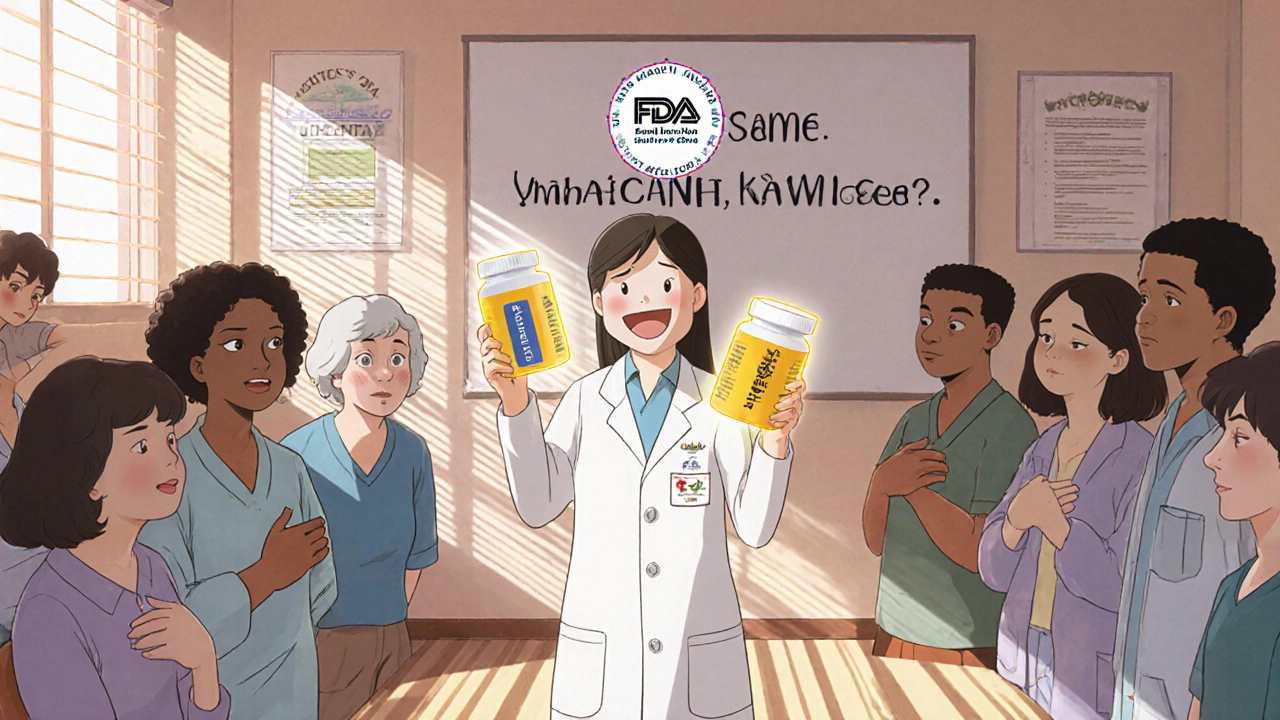
Most people don’t realize that generic drugs are the same as brand-name medicines - just cheaper. Yet, nearly half of Americans still think generics are weaker, less safe, or don’t work as well. That’s not true. And it’s costing people their health - and the system billions.
Why Generic Drugs Are Just as Good
The U.S. Food and Drug Administration (FDA) requires every generic drug to have the exact same active ingredient, strength, dosage form, and route of administration as its brand-name version. That means if you take a generic version of metformin for diabetes or lisinopril for high blood pressure, your body gets the same medicine, in the same amount, the same way.
The FDA doesn’t just accept claims - they test them. Every generic must pass a bioequivalence study. This means researchers measure how much of the drug enters your bloodstream (called Cmax and AUC) and compare it to the brand-name version. The results must fall within 80% to 125% of the brand’s levels. That’s not close - that’s identical in how your body uses it.
Over 90% of all prescriptions filled in the U.S. are for generics. That’s over 6.8 billion prescriptions a year. And the FDA has approved more than 2,100 educational resources - videos, fact sheets, toolkits - to help explain this to patients. These aren’t marketing materials. They’re science-backed, peer-reviewed tools used by clinics, pharmacies, and community health workers across the country.
The Real Difference: Cost, Not Quality
The biggest difference between brand-name and generic drugs? Price. Generics cost, on average, 80% to 85% less. In 2022 alone, they saved the U.S. healthcare system $377 billion. That’s not a small number. That’s enough to cover the cost of care for millions of people who otherwise skip doses or skip pills entirely because they can’t afford them.
For someone on a fixed income, switching from a $300 brand-name statin to a $15 generic could mean the difference between taking their medicine every day or rationing it. A 2021 study tracking 3.2 million patients found that when people switched to generics, medication adherence went up by 22%. That’s not just savings - that’s fewer hospital visits, fewer heart attacks, fewer strokes.
And it’s not just in the U.S. The European Medicines Agency, Health Canada, the World Health Organization, and 35 other regulatory agencies all use the same bioequivalence standards. If a generic is approved in the U.S., it’s held to the same standard as one approved in Germany or Australia.
Why People Still Don’t Trust Them
So why do so many patients hesitate? The answer isn’t science - it’s appearance.
Generic pills often look different. Different color. Different shape. Different markings. That’s because trademark laws prevent generics from copying the exact look of brand-name drugs. But patients don’t know that. When someone switches from a blue oval pill to a white round one, they think it’s a different medicine. A University of Michigan survey found that 23% of patients questioned whether their new pills were real because they looked different.
Then there’s the nocebo effect - the opposite of placebo. If you’re told a drug is generic, you’re more likely to report side effects, even if you’re taking the exact same medicine. A 2021 study in Annals of Internal Medicine showed that when patients knew they were on generics, they stopped taking them 18.7% more often than when they didn’t know.
And some doctors don’t help. Even though 97% of pharmacists trust generics, not all prescribers do. A 2022 study in JAMA Internal Medicine found that when a doctor said, “This generic is just as good,” patient acceptance jumped from 52% to 89%. But if the doctor didn’t say anything - or worse, said, “I prefer the brand” - patients stayed skeptical.
What Works in Community Health Settings
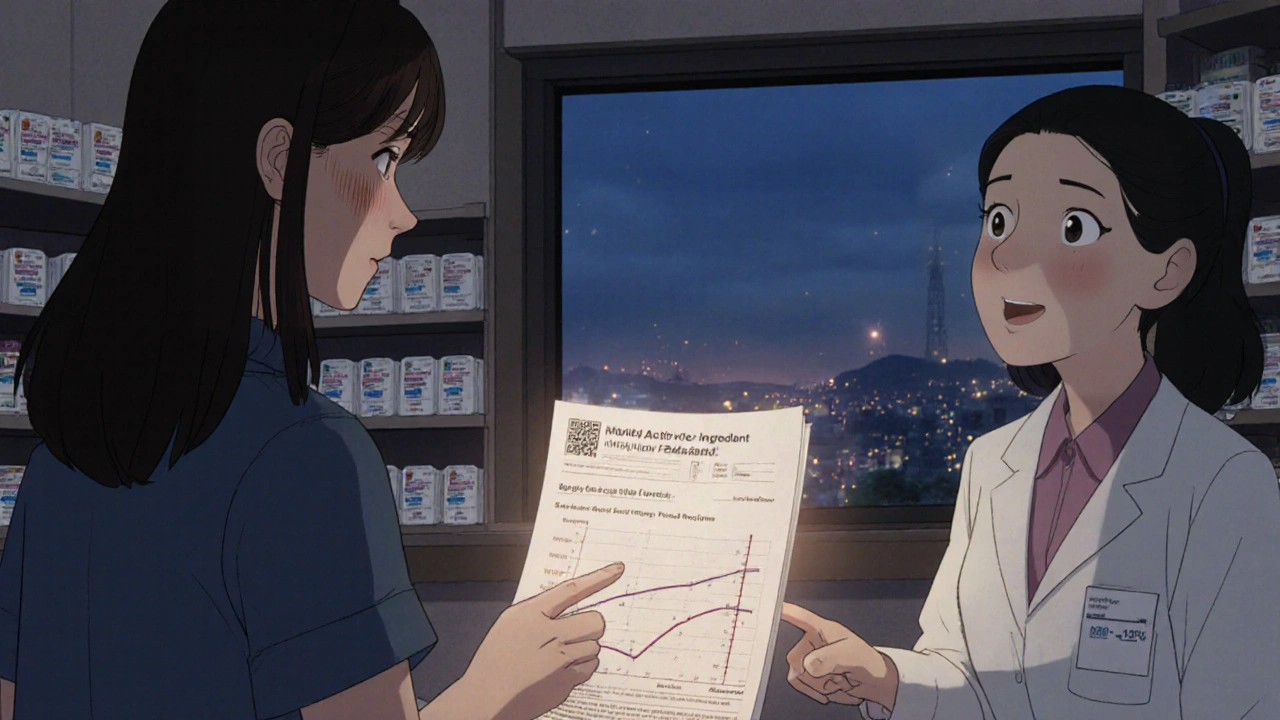
Community health centers are on the front lines. They’re where people with limited income, little health literacy, and no insurance go for care. That’s why the FDA created the Generic Drugs Stakeholder Toolkit - free, ready-to-use materials for clinics, pharmacies, and outreach workers.
One key tool? The Teach-Back method. Instead of just saying, “This is a generic,” you ask: “Can you tell me in your own words why this pill is safe?”
At the Community Health Center of Burlington, staff started using this method in 2021. Within six months, patient acceptance of generics rose by 37%. Why? Because people weren’t just told - they were heard. They repeated back what they understood. If they got it wrong, the provider corrected it right then.
Other effective tactics:
- Showing patients side-by-side pictures of brand and generic versions with labels: “Same active ingredient.”
- Using simple language: “The FDA checks these pills just like the brand-name ones.”
- Explaining that generics are made in the same factories - sometimes even the same ones - as brand-name drugs.
These aren’t fancy tricks. They’re basic communication - the kind that works when you’re talking to someone who’s scared, tired, or overwhelmed.
Where the Gaps Still Exist
Not all drugs are treated the same. Generics make up 95% of cardiovascular prescriptions. But for central nervous system drugs - like antidepressants, antiseizure meds, or ADHD medications - adoption drops to 68%.
Why? Because some conditions are sensitive. A 2023 study in Epilepsy & Behavior found a slightly higher chance of seizure recurrence when switching from brand to generic antiepileptic drugs. But the American Academy of Neurology says this is an extreme exception - affecting less than 1% of patients. They still recommend generics as the standard.
Another gap? Rural areas. Only 78% of prescriptions filled in rural communities are generics - compared to 93% in cities. Why? Fewer pharmacists. Less access to education. Longer distances to clinics. The FDA’s 2022 Health Equity Handout now specifically targets these communities, with materials translated into Spanish, Somali, and Vietnamese.
And now, starting January 1, 2025, Medicare Part D plans will be required to give all beneficiaries standardized educational materials about generics. That’s 60 million people. It’s the biggest push yet.
What’s Coming Next
The pipeline is full. Between 2023 and 2028, 287 brand-name drugs will lose patent protection. That means hundreds of new generics will hit the market - including complex ones like inhalers, injectables, and topical creams. These aren’t simple pills. They’re harder to copy. And harder to explain.
The FDA is already preparing. Their new “Generics 101” video series, launched in 2023, is aimed at Medicare beneficiaries. Early results show a 31% improvement in knowledge among viewers over 65. That’s huge.
And the Association for Accessible Medicines has distributed over 2.7 million brochures through 14,300 community health centers. These aren’t just handouts - they’re part of a national effort to make sure no one skips their medicine because they think it’s “lesser.”
By 2027, the generic drug market is projected to grow to $184 billion. That’s not just business. That’s better health for millions.
What You Can Do
If you’re a patient: Ask. If your prescription is switched to a generic, ask your pharmacist: “Is this the same medicine?” They’ll show you the FDA’s fact sheet. They’ll explain the bioequivalence. They’ll tell you it’s safe.
If you’re a caregiver or community health worker: Use the FDA’s free toolkit. Teach-back. Show pictures. Normalize the conversation. Don’t assume people know.
If you’re a provider: Say it out loud. “I’m prescribing this generic because it’s just as effective - and it will save you money.” That one sentence changes everything.
Generic drugs aren’t second-choice medicines. They’re the standard. They’re safe. They’re proven. And they’re the reason so many people can afford to stay healthy.
Are generic drugs really as effective as brand-name drugs?
Yes. The FDA requires every generic drug to have the same active ingredient, strength, dosage form, and route of administration as the brand-name version. They must also pass strict bioequivalence testing, proving they deliver the same amount of medicine into your bloodstream at the same rate. Thousands of studies and 40 years of real-world use confirm they work just as well.
Why do generic pills look different?
By law, generic drugs can’t look exactly like brand-name drugs because of trademark rules. That means the color, shape, or markings might be different - but the medicine inside is the same. If you’re confused, ask your pharmacist to show you the FDA fact sheet that compares the two.
Can I trust generics if they’re so much cheaper?
Absolutely. Generics cost less because manufacturers don’t have to repeat expensive clinical trials - the original brand already did that. The FDA inspects every manufacturing facility - whether it makes brand or generic drugs - and holds them to the same quality standards. The lower price is about savings, not compromise.
Do pharmacists prefer generics?
Yes. A 2021 survey by the American Pharmacists Association found that 97% of pharmacists have full confidence in generic drugs. Many take generics themselves. Pharmacists are often the best source of reassurance when patients have doubts - they see the science every day.
Why do some doctors still recommend brand-name drugs?
Some doctors may be used to prescribing a specific brand, or they’ve seen rare cases where switching caused issues - especially with complex drugs like antiseizure medications. But the vast majority now support generics. When doctors clearly explain that generics are equivalent, patient acceptance increases from 52% to 89%.
Are there any drugs where generics aren’t recommended?
For the vast majority of drugs, generics are recommended. The only rare exceptions involve certain narrow-therapeutic-index drugs - like some antiseizure or blood thinner medications - where even tiny differences in absorption could matter. But even then, studies show most patients do fine on generics. If your doctor suggests sticking with a brand, ask why - and request the evidence.
How can I get free educational materials about generics?
The FDA offers a free Generic Drugs Stakeholder Toolkit with videos, infographics, and fact sheets in English and Spanish. Community health centers, pharmacies, and public libraries often have printed copies. You can also visit the FDA’s website and download them directly - no cost, no registration needed.

Comments
DIVYA YADAV
The FDA is just another branch of the deep state trying to control what we put in our bodies. You think they really test these generics? Ha! They get the same pills from the same Chinese factories that make fake Rolex watches. Look at the packaging - different colors, different shapes, different markings. That’s not science, that’s propaganda. I’ve seen people collapse after switching to generics. No one talks about it because the pharma giants own the media. This whole ‘80% cheaper’ thing? That’s the bait. The real drug is in the side effects they don’t tell you about.
Kim Clapper
While I appreciate the statistical rigor of the FDA’s bioequivalence thresholds, I must respectfully interrogate the epistemological assumptions underpinning the assumption that bioequivalence equates to therapeutic equivalence. The human body is not a closed system, and the placebo/nocebo dynamic, while empirically documented, is not accounted for in pharmacokinetic models. Furthermore, the conflation of ‘cost savings’ with ‘public health benefit’ constitutes a value-laden fallacy. Are we optimizing for economic efficiency or physiological integrity? The data, while compelling, remains reductionist.
Leah Doyle
OMG this is so important!! I had no idea generics were this regulated!! I switched my blood pressure med last year and saved $200/month 😭 My grandma used to say ‘if it looks different, it’s not the same’ - but now I show her the FDA charts and she’s like ‘well I’ll be darned!’ 🙌
Alexis Mendoza
It’s funny how we trust a car with 100,000 miles more than we trust a pill that costs less. We’ll drive a used Honda but refuse a generic statin because it’s white instead of blue. What does that say about us? We fear the unknown, even when the science says it’s the same. Maybe the real problem isn’t the drug - it’s our trust in systems we don’t understand.
Madison Malone
I work at a free clinic and this is literally our daily reality. People cry when they find out they can get their antidepressant for $4 instead of $400. We use the teach-back method - ‘Can you tell me why this pill is safe?’ - and 9 out of 10 times, they say it back perfectly. It’s not about intelligence. It’s about being heard. Thank you for putting this out there.
Graham Moyer-Stratton
Generics are fine. But the FDA is a joke. They approve everything. China makes 80% of our pills. You think they care about your blood pressure? They care about the next shipment. Trust the system? Nah. Pay for the brand or deal with the consequences.
tom charlton
As a community health educator for over 18 years, I can attest that the greatest barrier to generic adoption is not misinformation - it’s silence. When a provider doesn’t explain the switch, patients assume the worst. The FDA toolkit is invaluable, but its impact is limited without trained personnel to deliver it. We need funding for frontline workers, not just pamphlets. This isn’t a public health issue - it’s a communication crisis.
Jacob Hepworth-wain
My mom’s on a generic for her diabetes. She was scared at first. I showed her the FDA page. We looked up the factory - same one that makes the brand. She laughed and said ‘so it’s like buying a plain t-shirt instead of the logo one?’ Exactly. Now she tells everyone. Simple. Real. No jargon needed.
anant ram
Dear friends, I am writing to you with a heavy heart, and also with great hope, because I have seen, in my own village in Uttar Pradesh, how a single pill - a generic one - saved a man from kidney failure. He could not afford the brand, but he could afford the generic. He is alive today. The FDA is right. The science is right. The cost difference is not a trick. It is justice. Please, do not let fear steal your health. Ask questions. Get the facts. Share them. One person at a time.
king tekken 6
ok so i read this whole thing and i think the fda is just lying to us. like seriously. how can a pill that costs 15 bucks be the same as one that costs 300? it’s impossible. i think they put less of the active ingredient in the generic and then they just say ‘oh but it’s in the 80-125% range’ - that’s a loophole! also i heard the same factory makes the brand and the generic but they use different machines for the generic. like a cheap one. i saw a video on tiktok. it was real. also i think the nocebo effect is just the body screaming ‘this is fake’
Bruce Hennen
Incorrect. The FDA’s bioequivalence standard is 80-125% AUC and Cmax, not ‘identical.’ The word ‘identical’ is misleading. Also, the 22% adherence increase is correlational, not causal. Confounding variables include increased patient engagement during generic transition, not the drug itself. Furthermore, the claim that generics are ‘the standard’ ignores pharmacovigilance data showing higher adverse event reports for generics in certain drug classes. Precision matters.
Jake Ruhl
EVERYTHING IS A LIE. THEY SWITCHED MY ANTIDEPRESSANT TO A GENERIC AND I FELT LIKE I WAS LIVING IN A DREAM WHERE EVERYTHING WAS SLIGHTLY OFF. I THOUGHT I WAS GOING CRAZY. THEN I FOUND OUT IT WAS THE PILLS. THE FDA DOESN’T CARE. THEY’RE WORKING WITH BIG PHARMA. I SAW A DOCTOR ON YOUTUBE WHO SAID GENERICS ARE MADE IN BASEMENT LABS IN CHINA WITH DUST IN THEM. I’M NOT TAKING ANY MORE. I’M MOVING TO CANADA. THEY HAVE REAL MEDICINE THERE. I SWEAR TO GOD I’M NOT CRAZY. I’M JUST AWAKE.
Chuckie Parker
Generics are fine for Americans. But if you're a real American, you don't need a generic. You pay full price. You support American jobs. You buy American medicine. The FDA is just trying to make us weak. Buy the brand. Be strong. America First. Always.
George Hook
I’ve been a pharmacist for 27 years. I’ve filled millions of prescriptions - brand and generic. I’ve seen patients switch, and I’ve seen them stay. The truth? Most people don’t notice a difference. But the ones who do? They’re not reacting to the drug. They’re reacting to the fear. I always hand them the FDA fact sheet. I say, ‘This is the same medicine. The only thing different is the price.’ And I let them decide. That’s all I can do. The rest? That’s on the system.