

INR Stability Calculator
Calculate Your Time in Therapeutic Range
Your Time in Therapeutic Range (TTR) shows what percentage of time your INR has been within the safe range for your specific condition.
If you're on warfarin, you know how unpredictable your INR levels can be. One week you're perfectly in range, the next you're flying high above 4.0 or dipping below 2.0-no clear reason why. This isn't just frustrating. It's dangerous. Too high, and you risk bleeding. Too low, and you could get a clot. For many people, no amount of diet tweaking or dose changes fixes it. But there’s a quiet, low-cost solution that’s quietly changing outcomes: low-dose vitamin K supplements.
Why Warfarin and Vitamin K Are a Delicate Balance
Warfarin doesn’t thin your blood directly. It works by blocking vitamin K from activating clotting factors. Think of vitamin K as the switch that turns on your body’s ability to form clots. Warfarin flips that switch off. But here’s the catch: your diet constantly changes how much vitamin K you get. A big salad one day, a serving of kale the next, a handful of natto (fermented soy) for lunch-it all throws your INR off. Even small shifts in vitamin K intake can cause big swings in your INR.That’s why so many people on warfarin struggle with instability. Studies show 30% to 50% of patients have frequent INR excursions outside the safe range of 2.0 to 3.0. For someone with a mechanical heart valve, that range is even tighter: 2.5 to 3.5. One study found patients with unstable INR were eating just 109 micrograms of vitamin K a day-less than half of what stable patients consumed.
The 150 mcg Solution That Works
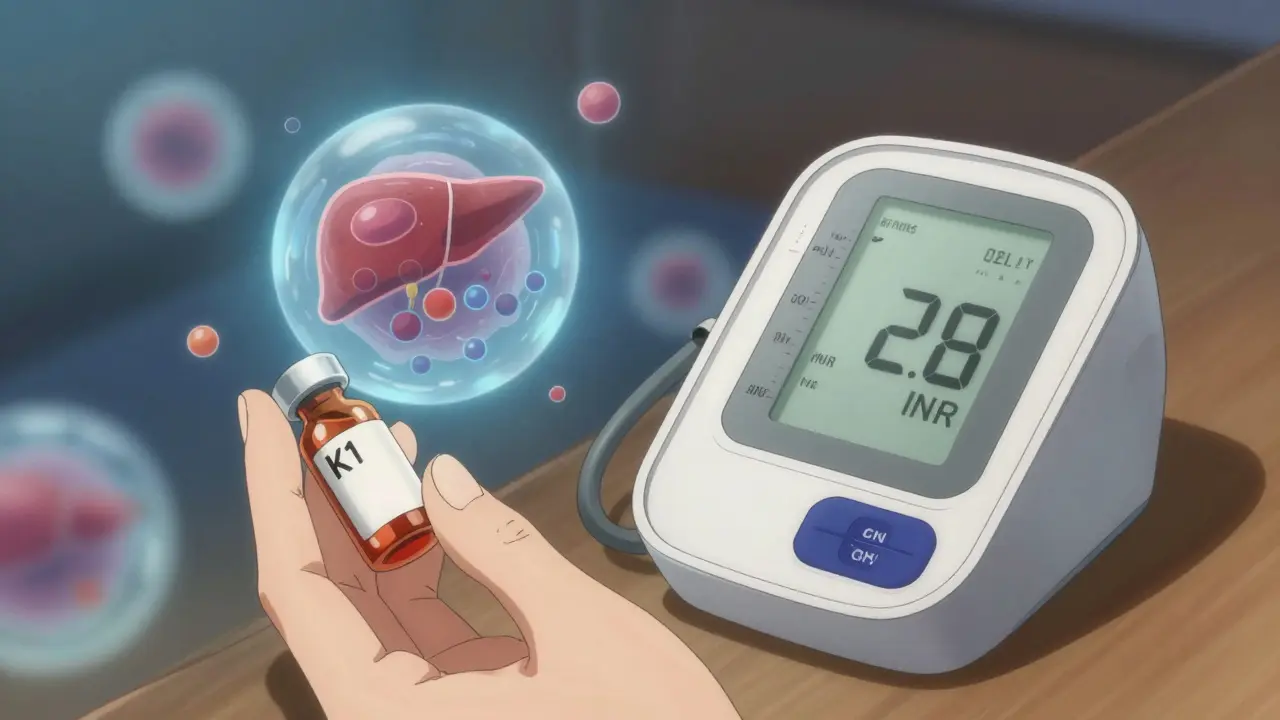
The breakthrough came from research showing that giving a small, consistent daily dose of vitamin K1-150 micrograms-helps smooth out those wild swings. That’s not a huge amount. It’s about 1.5 times the daily recommended intake for women (90 mcg) and slightly above the male recommendation (120 mcg). But it’s far below any toxic level. The European Food Safety Authority says you’d need to eat 10 milligrams per kilogram of body weight daily to risk harm. You’d need to swallow 600 of these 150 mcg pills to get there.What happens when you take 150 mcg daily? Your body gets a steady supply of vitamin K. That means your liver doesn’t have to react to sudden spikes or drops from food. Warfarin then works more predictably. You’re not fighting your diet anymore-you’re working with it.
One major trial published in Thrombosis and Haemostasis found that patients taking 150 mcg of vitamin K daily had 4% fewer extreme INR spikes (above 4.5 or below 1.5) than those on placebo. That might sound small, but it means roughly 15 fewer dangerous INR readings per patient per year. Another study showed 54% of patients on vitamin K achieved stable control, compared to just 21% on placebo.
It’s Not a Magic Bullet-Here’s Who Benefits Most
This isn’t for everyone. If you’ve just had a heart valve replacement, especially in the mitral position, or if you’ve had a recent clot or cancer, vitamin K supplements aren’t recommended. These groups were excluded from trials because their needs are too complex.But if you’ve been on warfarin for years, follow your diet carefully, take your pill at the same time every day, and your INR still jumps around? You might be a perfect candidate. The key sign? A Time in Therapeutic Range (TTR) below 65%. That’s the gold standard metric doctors use to measure stability. If you’re spending more than a third of your time outside the safe range, vitamin K supplementation could help.
Real patient stories back this up. One man with a mechanical aortic valve had a TTR of 42% over 18 months. After starting 150 mcg vitamin K daily, his TTR jumped to 71% in six months. He went from 17 dose changes to just two. Another patient on Reddit said her INR went from averaging 55% TTR to 78% after six months on vitamin K.
What Happens When You Start?
Don’t expect results overnight. Vitamin K doesn’t fix things in a week. It takes 4 to 8 weeks for your body to adjust. During the first few weeks, your INR might dip lower than usual. That’s normal. Your doctor will likely need to increase your warfarin dose slightly-by 0.5 to 1.5 mg on average-to compensate. This isn’t a sign it’s not working; it’s proof it is.Monitoring stays critical. You still need regular INR tests. Weekly for the first month after starting, then every two weeks. Your doctor will adjust your warfarin based on those numbers, not guesswork. Many clinics now use standardized protocols to guide this process, including dose adjustment algorithms built into their systems.
Some patients get confused: “Why am I taking a vitamin that helps blood clot while I’m on a blood thinner?” The answer is simple: you’re not trying to stop clotting. You’re trying to make it predictable. Think of it like keeping water levels steady in a bucket with a leaky faucet. If the water flow (vitamin K) is inconsistent, you have to constantly adjust the drain (warfarin). But if you fix the flow, you only need to tweak the drain a little.
How It Compares to Other Options
You might be wondering: why not switch to a DOAC like apixaban or rivaroxaban? Those don’t need INR checks at all. And you’re right-for most people, they’re the better choice. But they’re not an option for everyone. If you have a mechanical heart valve, antiphospholipid syndrome, or severe kidney disease, warfarin is still the only approved option. That’s about 2 million Americans-and 300,000 of them have mechanical valves.Compared to point-of-care INR monitors (like CoaguChek), vitamin K doesn’t require buying a device ($500-$1,000) or learning how to use it. But it doesn’t give you instant feedback either. The monitor tells you right away if your INR is off. Vitamin K works slowly, over weeks, to prevent those spikes from happening in the first place.
And cost? Vitamin K is dirt cheap. A 5 mg bottle of generic vitamin K1 costs about $8 at Walgreens. At 150 mcg per day, you’re spending less than half a cent per dose. That’s less than the price of a coffee.
When It Doesn’t Work-or Makes Things Worse
It’s not foolproof. Some patients don’t improve. In one case study, a woman’s INR became *more* unstable after starting vitamin K. Her TTR dropped from 58% to 49%. Why? Possibly because she was already getting too much vitamin K from her diet-over 500 mcg a day. That’s why trials exclude people who eat huge amounts of leafy greens or natto.Another issue is adherence. If you forget your warfarin but take your vitamin K, you’re setting yourself up for trouble. The supplement only works if you take both consistently. If you skip doses or change your routine, you’ll see the same instability you had before.
Some doctors worry vitamin K masks the real problem: poor medication adherence or drug interactions. If your INR is unstable because you’re drinking grapefruit juice or taking antibiotics, adding vitamin K won’t fix that. It might even delay finding the true cause.

What the Experts Say
The American College of Chest Physicians hasn’t formally recommended vitamin K yet. But they acknowledge the evidence is “promising.” The European Heart Rhythm Association gives it a Class IIb recommendation-meaning it “may be considered” for patients with documented instability. The UK’s NICE guidelines say the same: “on a case-by-case basis.”Dr. Elaine Hylek from Boston University calls it “one of the most promising pharmacological approaches.” Dr. Jacob Siegel at Johns Hopkins says the 4% reduction in dangerous INR spikes translates to real clinical benefit-about 15 fewer events per patient per year. And Dr. Gary Raskob predicts that within five years, combining vitamin K with genetic testing (for VKORC1 mutations) will become standard for patients with unstable INR.
How to Talk to Your Doctor
If you think this might help you, don’t just start taking a supplement. Bring the research. Say: “I’ve been struggling with unstable INR despite sticking to my diet and schedule. I’ve read about low-dose vitamin K (150 mcg daily) helping others. Could we consider trying it?”Ask if your clinic has a protocol. Many now do. If they’re hesitant, ask for a referral to an anticoagulation clinic. These specialists are more familiar with the data.
Make sure you’re tested for baseline TTR. If it’s below 65%, you’re a strong candidate. If you’ve had more than three INRs above 4.0 or below 1.5 in the last six months, you’re likely a good fit.
Bottom Line: A Simple Fix for a Complex Problem
Vitamin K supplementation isn’t new. But its role in stabilizing warfarin therapy is gaining real traction. For the right person-someone with documented INR instability, good adherence, and no contraindications-it’s one of the safest, cheapest, and most effective tools available.It doesn’t replace warfarin. It doesn’t eliminate INR checks. But it turns a chaotic, unpredictable process into something manageable. And for the millions who still rely on warfarin, that’s not just helpful-it’s life-changing.



Comments
rajaneesh s rajan
So let me get this straight - we’re giving people a vitamin to fix a drug’s instability… because the drug was designed to block that same vitamin? Sounds like trying to fix a leaky roof by pouring water on it. 😏
Ryan Pagan
Man, this is one of those rare cases where science actually gives us a cheap, simple win. I’ve seen patients go from 12 INR checks a month to 2 - and their anxiety drops like a rock. No magic, just consistency. 150 mcg daily isn’t a miracle, it’s just good housekeeping for your coagulation system.
And yeah, it’s dirt cheap. I tell people: if you’re spending $80/month on specialty labs and doctor visits, spending 0.5 cents a day on a pill is the dumbest bargain you’ll ever make.
Andy Steenberge
For anyone reading this and thinking ‘I’ll just eat more kale’ - stop. That’s not the fix. The whole point is eliminating the wild swings, not doubling down on them. Consistency beats intensity every time.
And if your doctor says ‘we don’t do that here’ - ask for a referral to an anticoagulation clinic. They’ve been doing this for years. It’s not fringe. It’s just not in the pamphlets they hand you at the pharmacy.
Alex Flores Gomez
yo so like… vitamin K? bro that’s just like… the thing warfarin is trying to kill?? why tf are we giving it to people??
also i just took a nap and now my INR is 6.2. is this the answer??
Paul Adler
This is a thoughtful and clinically grounded approach. The data from Thrombosis and Haemostasis is compelling, and the mechanism - stabilizing vitamin K flux to reduce warfarin sensitivity - is physiologically sound.
It’s worth noting that this isn’t a substitute for proper INR monitoring, but rather a complementary strategy to reduce the variance in outcomes. For patients with mechanical valves, where every 0.1 INR point matters, this could be transformative.
Pawan Kumar
150 mcg? LOL. You think that’s low? My cousin in Kerala eats 3 cups of spinach every morning. His INR’s always 1.8. You’re not fixing the problem - you’re just pretending it doesn’t exist.
Keith Oliver
Look, I’ve been on warfarin since 2015. I’ve tried everything. Blood tests every Monday. CoaguChek at home. Organic kale smoothies. Nothing worked.
Then I started the 150 mcg. First month, my INR dipped to 1.9. Doc upped my warfarin by 1 mg. Now? TTR’s 76%. No more panic calls. No more ‘why is my blood so thick today?’
It’s not sexy. But it works. And that’s more than I can say for 90% of the ‘innovations’ in this field.
Doug Gray
so like… is this just… biohacking? because i feel like if you’re relying on a vitamin to make a pharmaceutical work… isn’t that just… compensating for bad design? 🤔
also i’m pretty sure vitamin K is in every leafy green so… why not just… eat less? idk man.
Sheryl Dhlamini
I cried when my TTR went from 41% to 72%. Not because I’m dramatic - because for five years, I lived in fear. One bad INR meant ER. One bad INR meant hospital. One bad INR meant my husband holding my hand while they drew blood again.
This didn’t just stabilize my numbers. It gave me back my life. And it cost less than my monthly Netflix subscription.
kabir das
Wait… wait… wait… so you’re saying… if you take vitamin K… you’re not supposed to eat kale?? But kale is HEALTHY?? So… is this a conspiracy?? Are they trying to make us eat boring food??
And what about the GMOs?? Are they putting something in the vitamin K pills?? I read on a forum that the FDA banned vitamin K in 1998… but then… it came back??
My neighbor’s dog died after eating spinach… is this related??
LOUIS YOUANES
150 mcg? That’s like… what, 200% of the RDA? Are we just trying to turn people into walking clot machines? This sounds like something Big Pharma would push if they didn’t have a DOAC patent.
Also, why is this only for people with mechanical valves? Are the rest of us just… disposable?
Kristie Horst
It’s fascinating how a solution so simple - consistency - becomes revolutionary in a medical landscape obsessed with complexity.
And yet, we still treat patients like lab rats, throwing new drugs at them instead of asking: ‘What if we just… stopped making their physiology so volatile?’
Thank you for presenting this with such clarity. It’s rare to see evidence-based medicine that doesn’t sound like a sales pitch.
DHARMAN CHELLANI
lol vitamin K? bro you’re just giving them a blood thinner antidote. that’s not fixing the problem, that’s just hiding it. what’s next? giving diabetics sugar to stabilize insulin?
LOUIS YOUANES
Wait, I just read the part about the woman whose INR got worse after starting vitamin K. That’s not a bug - that’s a feature. They didn’t test her baseline intake. Of course it backfired. You don’t throw a match into a gas leak and call it ‘improvement.’
And if your doctor says ‘try it,’ ask for a dietary log first. Otherwise you’re just gambling with your clotting factors.