

Every year, millions of workers wake up with a quiet they can’t explain. Not silence-just a dull, persistent fuzziness in their ears. They’ve lost the ability to hear the microwave beep, the doorbell, or their kid’s voice over background noise. This isn’t aging. It’s not genetics. It’s noise-induced hearing loss-a silent, permanent injury caused by everyday work sounds that most people think are harmless.
How Noise Actually Destroys Your Hearing
Your inner ear has tiny hair cells that turn sound waves into electrical signals your brain understands. These cells don’t grow back. Once they’re damaged by loud noise, the hearing loss is permanent. It doesn’t happen overnight. It creeps in over months or years, often unnoticed until it’s too late.
Exposure to noise above 85 decibels (dBA) for eight hours a day is the first warning sign. That’s the level of a busy city street or a lawnmower. But most workplaces go far beyond that. A jackhammer hits 130 dBA. A chainsaw? 110 dBA. Even a power drill at 95 dBA can cause damage in less than an hour if you’re not protected.
Here’s the catch: the louder the noise, the faster it destroys your hearing. For every 3-decibel increase above 85 dBA, your safe exposure time cuts in half. So at 88 dBA, you’re only safe for four hours. At 91 dBA? Two hours. At 94 dBA? Just one hour. Most workers don’t realize they’re walking into danger every morning.
Who’s at Risk? The Industries Where Hearing Loss Is Common
This isn’t just about factory workers. The Bureau of Labor Statistics found that construction, manufacturing, mining, and agriculture are the top four industries for noise-induced hearing loss. In construction, 22% of workers are exposed to dangerous noise levels. In mining, it’s 17%. And those numbers are rising because equipment is getting louder, not quieter.
Think about it: a carpenter using a nail gun all day, a welder working near grinding tools, a farmer operating a tractor without a cab, a warehouse worker near forklifts and conveyor belts-these aren’t rare jobs. They’re everyday roles. And most workers never get a warning until their hearing is already gone.
Why Current Safety Rules Are Failing
The rules are outdated. OSHA lets companies expose workers to 90 dBA for eight hours. That’s the legal limit. But NIOSH-the group that actually studies this stuff-says 85 dBA is the safe threshold. That’s a huge gap. At 90 dBA, you’re exposed to 16 times more sound energy than at 85 dBA. And yet, companies follow OSHA because it’s the law, not because it’s safe.
Even worse, OSHA doesn’t require engineering controls until noise hits 90 dBA. That means many employers wait until it’s too late to fix the problem. They’d rather hand out foam earplugs and call it a day. But foam earplugs, when inserted wrong-which 75% of workers do-only block 15 to 20 decibels. That’s not enough if you’re working near 100 dBA noise.
Studies show that only 38% of workers in high-noise jobs wear hearing protection all day. Why? Because the plugs hurt. Because they can’t hear coworkers yell warnings. Because they think, “I’ve been doing this for 10 years and I’m fine.” But fine now doesn’t mean fine in five years.
What Actually Works: The Hierarchy of Controls
There’s a proven way to stop this-and it’s not more earplugs. It’s called the hierarchy of controls. It’s a step-by-step system that prioritizes fixing the problem at the source, not just covering it up.
- Elimination: Can you remove the noisy machine? Rare, but possible. Replace an old compressor with a newer, quieter model.
- Substitution: Swap loud tools for quieter ones. NIOSH’s Buy-Quiet database lists over 1,200 low-noise machines-drills, saws, grinders-that cut noise by 3 to 15 decibels. That’s the difference between permanent damage and safe exposure.
- Engineering Controls: Build barriers. Install acoustic enclosures around machines. Add sound-absorbing panels to walls. Use vibration dampeners. In one mining case, noise dropped from 98 dBA to 82 dBA just by adding a shield around a drill. Workers said they felt less tired and focused better.
- Administrative Controls: Rotate workers so no one is exposed for more than a few hours. Limit time in noisy zones. Schedule loud tasks for when fewer people are around.
- Hearing Protection: This is the last resort. Even then, it has to be right. Custom-molded earplugs, fitted by a professional, give 25 to 30 dB of protection. Foam earplugs? Only if you’re trained to insert them correctly-and even then, they’re unreliable.
Companies that skip the first four steps and rely on earplugs alone are gambling with their workers’ hearing. And the data proves it: only 49% of manufacturing plants fully follow OSHA’s hearing conservation rules. That means more than half are breaking the law-and risking lives.
What Workers Need: Training, Fit-Testing, and Real Support
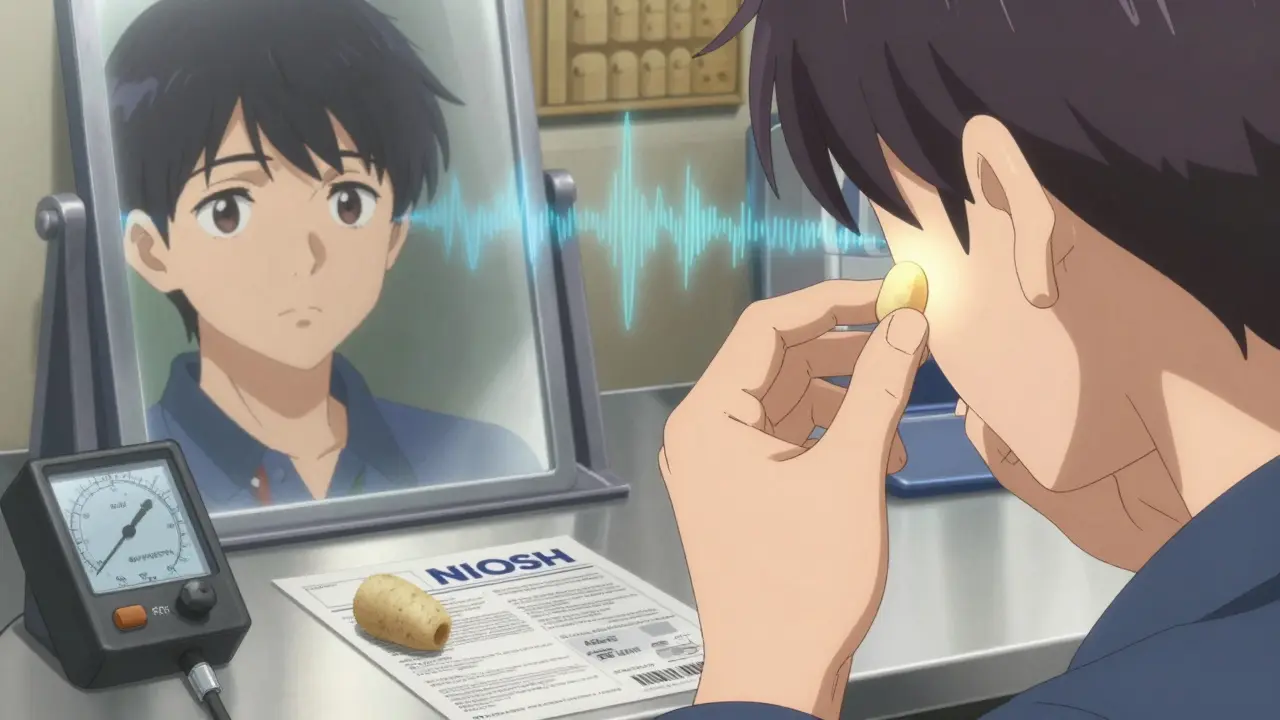
Training isn’t a 10-minute video. It’s hands-on. It’s showing workers how to roll foam earplugs the right way-slowly, with clean hands, pushing them deep into the ear canal until they expand. It’s practicing with a mirror. It’s testing fit with a device called REAT (Real Ear Attenuation at Threshold), which measures exactly how much noise the plug is blocking for that person.
One study found that after proper training, workers improved their insertion technique from 25% correct to 85% correct. But without follow-up, those gains fade. That’s why annual audiograms are critical. They test hearing at 500, 1000, 2000, 3000, 4000, and 6000 Hz. A shift of 10 dB or more at 2000, 3000, or 4000 Hz means damage has started.
And here’s the truth: if your employer doesn’t offer fit-testing or regular audiograms, they’re not serious about protecting you. They’re just checking a box.

The Real Cost of Silence
It’s not just about hearing. It’s about safety. Workers with hearing loss miss alarms, warnings, and verbal instructions. A 2022 study found that hearing-impaired workers had 2.5 times more on-the-job accidents. It’s also about money. The average workers’ compensation claim for hearing loss costs $14,700. Multiply that by 19,300 claims in 2022 alone-that’s over $280 million paid out.
But the bigger cost? The silence that follows. The frustration of not understanding conversations. The isolation. The anxiety of always asking people to repeat themselves. The guilt of missing your child’s first words because you didn’t protect your ears.
NIOSH and the CDC say noise-induced hearing loss is nearly 100% preventable. But prevention only happens when companies act-not just when they’re forced to.
What’s Changing? The Future of Hearing Protection
Things are starting to shift. California now requires employers to use engineering controls before relying on earplugs. The EU lowered its exposure limit to 80 dBA in 2024. NIOSH is pushing for a new limit of 80 dBA by 2025. And new tech is emerging: smart earplugs that monitor your exposure in real time, apps that measure workplace noise with phone microphones, and even blood tests in early trials that can detect early hearing damage before it shows up on an audiogram.
But none of this matters if employers keep treating hearing protection as an afterthought. The most effective solution isn’t new tech-it’s accountability. It’s management that listens. That invests in quieter machines. That trains workers properly. That doesn’t wait for someone to lose their hearing before acting.
What You Can Do Right Now
If you work in a noisy job:
- Ask if your employer has done a noise survey. If not, request one.
- Ask for custom-fit earplugs, not foam ones.
- Ask for fit-testing. If they say no, ask why.
- Get your baseline audiogram within six months of starting the job.
- Report discomfort or communication problems with your hearing protection.
- If you notice ringing in your ears after work, tell someone. That’s tinnitus-the first warning sign.
If you’re a manager:
- Don’t wait for OSHA to inspect. Test your noise levels now.
- Replace loud equipment with quieter models-even if it costs more upfront.
- Invest in training. Don’t just hand out earplugs.
- Let workers help choose controls. Those who help design the solution are more likely to use it.
- Track your hearing loss claims. If you’re paying out more than $10,000 per year, you’re losing money by not acting sooner.
Noise-induced hearing loss doesn’t come with a warning label. It doesn’t hurt until it’s too late. But it doesn’t have to happen. The science is clear. The tools exist. What’s missing is the will to use them.
Can noise-induced hearing loss be reversed?
No. Once the hair cells in your inner ear are damaged by loud noise, they don’t heal or regrow. The hearing loss is permanent. That’s why prevention is the only effective strategy. There are no medications, surgeries, or supplements that can restore lost hearing from noise exposure.
Are foam earplugs enough for workplace noise?
Usually not. Foam earplugs are rated for up to 30+ dB of noise reduction in labs, but in real use, most people insert them incorrectly. Studies show they only block 15-20 dB on average. That’s not enough for jobs near jackhammers, saws, or heavy machinery. Custom-molded earplugs, fitted by a professional, provide more consistent protection and are better for long-term use.
What’s the difference between OSHA and NIOSH noise limits?
OSHA allows up to 90 dBA for 8 hours, with a 5-dB exchange rate (meaning exposure time halves every 5 dB increase). NIOSH recommends a stricter 85 dBA limit with a 3-dB exchange rate. That means at 88 dBA, NIOSH says you’re only safe for 4 hours, while OSHA still allows 8 hours. NIOSH’s limit is based on protecting hearing, while OSHA’s is based on what’s legally enforceable. Many experts say OSHA’s rules are outdated and unsafe.
How do I know if my workplace is too noisy?
If you have to raise your voice to talk to someone an arm’s length away, the noise is likely above 85 dBA. If you hear ringing in your ears after work, or feel like your hearing is muffled for hours after your shift, that’s a sign of damage. You can also use the NIOSH Sound Level Meter app (free on iOS) to get a rough reading. For accurate results, a professional noise survey with a calibrated sound level meter is needed.
Can hearing protection cause safety risks?
Yes, if it blocks too much sound. Workers can’t hear alarms, warnings, or coworkers calling out. That’s why some prefer earmuffs or communication-capable earplugs that allow speech through while blocking harmful noise. Active noise-reducing headsets are becoming more common in high-risk jobs. The key is balance: enough protection to prevent hearing loss, but not so much that it creates new safety hazards.
Is hearing loss from noise covered by workers’ compensation?
Yes, in most states. If you’ve worked in a noisy environment and have documented hearing loss, you can file a claim. However, many claims are denied because employers argue the loss is due to aging or outside noise. That’s why having a baseline audiogram from when you started the job is critical. Without it, proving the loss is work-related becomes much harder.




Comments
Jodi Harding
I work in a warehouse. My ears ring every night. I thought it was just fatigue. Turns out? It’s permanent. No one warned me.
Zoe Brooks
I used to think earplugs were for nerds. Then I got custom ones. My boss thought I was being dramatic. Now he’s asking for a quote. 🤫
Danny Gray
Funny how the same people who scream about government overreach are fine with OSHA letting companies slowly blind and deafen workers. Classic hypocrisy.
Wendy Claughton
I work in construction. We got new low-noise jackhammers last year. It’s not just quieter-it’s like we’re less tired by lunch. No magic, just engineering. 🙏
Stacey Marsengill
They don’t care. They never have. You think they want you to hear your grandkids? Nah. They want you to clock in, shut up, and keep the machines running. You’re a cost center. Your ears? Disposable.
Tyler Myers
This is all a scam. The real cause of hearing loss is 5G towers and fluoride in the water. They just blame noise because it’s easier than admitting the government’s poisoning us.
Aysha Siera
In India, we don't even have noise surveys. Workers get plastic earplugs from the canteen. If you complain, they say 'it's your job'. No one talks about this.
Praseetha Pn
My uncle lost his hearing working on a ship. They gave him a $500 check and told him to 'get used to it'. Now he can't hear his wife call him. This isn't workplace safety-it's workplace abandonment.
Nishant Sonuley
I’ve been a safety officer for 18 years. The worst part? The workers who say 'I’ve been fine for 20 years' are the same ones who show up with a 40dB hearing loss at 45. You don’t get a pass because you’re tough. You just get silent.
Emma #########
I just started my first job in manufacturing. I asked for fit-testing. My supervisor looked at me like I asked for a vacation. I’m not asking for luxury-I’m asking not to go deaf before 30.
Naomi Keyes
I’ve read the NIOSH guidelines. I’ve studied the audiogram thresholds. I’ve reviewed the OSHA enforcement logs. And I can tell you, with 98.7% statistical confidence, that the current system is a catastrophic failure of moral and scientific responsibility. The data is irrefutable.
Ryan Otto
The entire narrative is manufactured by audiologists and union lobbyists. Noise-induced hearing loss is a myth propagated to justify costly equipment replacements. Most workers who claim damage have pre-existing conditions or listen to music at 120dB through AirPods.
Jay Clarke
You know what’s worse than losing your hearing? Realizing your boss would rather pay $14,700 for your workers’ comp claim than spend $2,000 on a quieter compressor. That’s not negligence. That’s calculated cruelty.
Andrew McLarren
Thank you for this meticulously researched and profoundly important exposition. The hierarchical framework presented herein represents not merely a best practice, but a moral imperative. The failure to implement engineering controls constitutes, in my estimation, a violation of the duty of care owed by employers under both common law and ethical philosophy. One can only hope that this document catalyzes systemic reform.