

Too many people leave the doctor’s office with a new prescription, only to find out at the pharmacy that it costs more than their monthly rent. It’s not rare. In fact, 22% of prescriptions go unfilled because patients can’t afford them, according to 2023 data from GoodRx. That’s not just a financial shock-it’s a health risk. Skipping doses or not filling prescriptions because of cost leads to worse outcomes, more hospital visits, and higher long-term expenses. The good news? You don’t have to accept this. Talking about cost before you get the prescription is one of the most powerful things you can do for your health-and your wallet.
Why Cost Talks Happen Too Late (and Why That’s a Problem)
Most patients assume their doctor already knows how much a medication will cost. They don’t. Even providers often don’t know until they check the pharmacy’s system. That’s why so many people get surprised at the counter. In 2022, a study in the Journal of General Internal Medicine found that only 15% of patients regularly talk about medication costs with their doctors-even though 30% of them skip doses because of price. That gap is dangerous. If you wait until you’re standing in line at CVS or Walgreens to ask about cost, you’re already behind.What You Need to Know Before You Walk In
Before your appointment, take five minutes to gather basic info about your insurance. You don’t need to be an expert. Just know:- What type of plan you have (Medicare Part D, Medicaid, or private insurance)
- Whether you’ve met your deductible this year
- Which pharmacy you plan to use (costs vary between locations)
How to Ask the Right Questions at Your Appointment
Don’t be shy. Doctors are trained to help you. Here’s what to say:- “Is there a generic version of this medication?” Generics are chemically identical but cost up to 80% less. About 90% of prescriptions in the U.S. are filled with generics-but many patients never ask.
- “Are there other drugs in the same class that might be cheaper?” For example, if you’re prescribed a brand-name statin, there are often 3-4 alternatives with similar effects but lower copays.
- “Will this drug be covered under my plan?” Ask them to check your formulary. Many clinics now use tools like Surescripts’ Real-Time Prescription Benefit (RTPB), which shows cost and coverage right in the EHR. If they don’t, ask them to look it up on your insurer’s website during the visit.
- “Do you have samples?” Many providers keep small supplies of medications for new patients. Even a 30-day sample can help you decide if the drug works before you pay full price.
- “Is there a mail-order option?” Some plans offer 90-day supplies through mail-order pharmacies at a lower cost than 30-day fills at the local pharmacy.
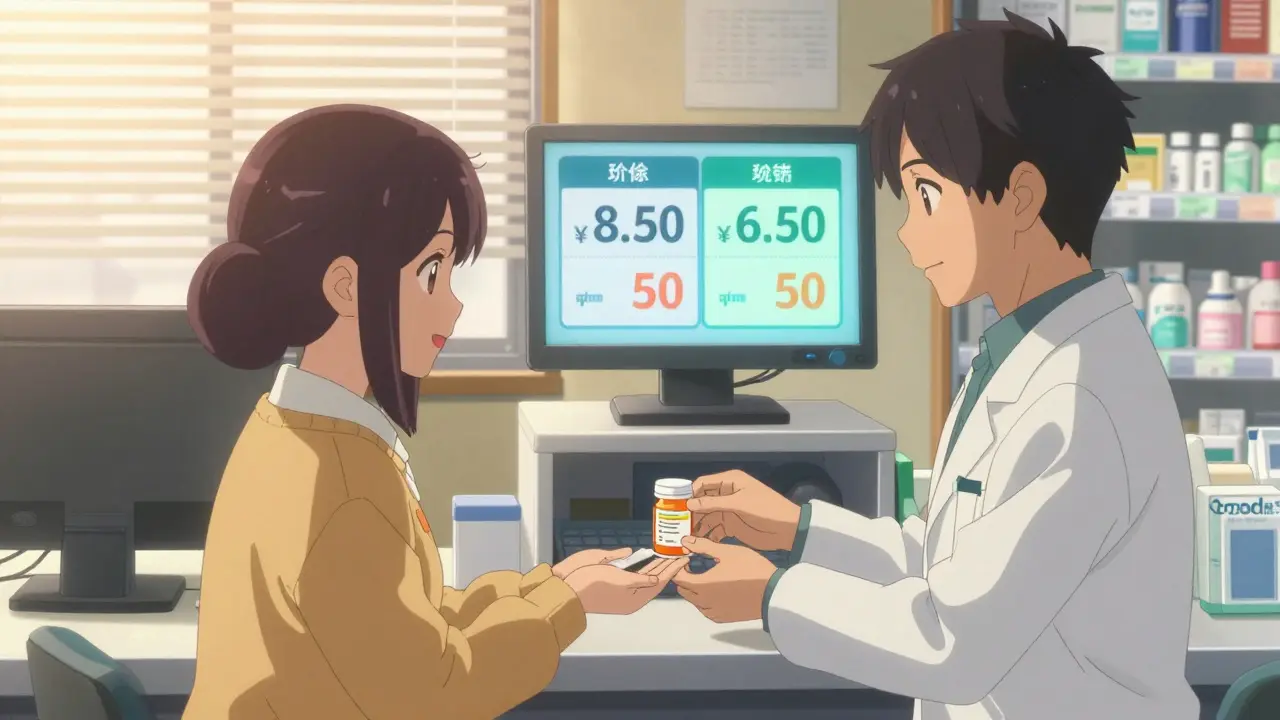
Use These Tools Before You Leave
You don’t have to guess. There are free tools built to help you:- Medicare.gov Plan Finder: If you’re on Medicare, use this tool to compare how much your exact drugs cost across different Part D plans. It updates every October for the next year.
- GoodRx: Enter your drug and pharmacy. It shows cash prices, coupon discounts, and how much your insurance would charge. One user in Bristol saved $287 on blood pressure meds by showing the pharmacist a GoodRx price-even with insurance.
- CVS Caremark’s Check Drug Cost & Coverage: Available online or in their app. Type in your drug, and it tells you your copay, whether it’s on formulary, and if there’s a cheaper alternative.
- Your insurer’s website: Log in. Look for “Drug Formulary” or “Drug Cost Estimator.” Most insurers now have this built in.
What to Do If Your Drug Isn’t Covered
If the drug isn’t on your plan’s formulary, don’t panic. There are two paths:- Ask your doctor for a prior authorization. This is a formal request to your insurer to cover a drug that’s not on the list. About 68% of specialty drugs require this. Your doctor’s office handles the paperwork-it’s faster than you think.
- Ask for a therapeutic alternative. Sometimes, a different drug in the same class works just as well and is covered. For example, if your insulin is expensive, ask about the $35-per-month options now guaranteed under Medicare.
According to the Patient Advocate Foundation, 68% of cases where drugs aren’t covered are resolved through prior authorization or switching to a covered drug. But you have to ask.
Special Cases: Insulin, Specialty Drugs, and Medicaid
If you’re on insulin, you’re protected. Since 2023, Medicare Part D caps insulin at $35 per month per prescription. That’s a game-changer. For commercial plans, it’s not automatic-but many insurers have followed suit. Check with your plan. Specialty drugs (like those for MS, rheumatoid arthritis, or cancer) are the hardest. They often cost over $100 per fill, even with insurance. And 68% require prior authorization. If you’re prescribed one, ask your doctor to use the RTPB tool during the visit. It shows real-time cost and coverage-no guessing. Medicaid typically has low copays ($1-$3), but some states require prior authorization for certain drugs. Always confirm coverage before filling.
Timing Matters: When to Talk About Cost
The best time to talk about cost is before the prescription is written. Once it’s in the system, it’s harder to change. If you’re on a high-deductible plan, January through March is the worst time to get a new prescription-you haven’t met your deductible yet. Average individual deductibles in 2023 were $480. If you wait until April or later, you’re more likely to have met it, and your copays will drop.What If You Still Can’t Afford It?
Even with all the tools, some drugs are still unaffordable. Here’s what to do:- Ask your pharmacy about patient assistance programs. Drugmakers like Pfizer, AbbVie, and Eli Lilly have programs that give free or low-cost meds to qualifying patients.
- Check NeedyMeds.org-it lists free and discounted drug programs by name.
- Call your insurer’s customer service. Ask: “Is there a cost-sharing reduction program for this drug?” Some plans offer discounts if you’re under 138% of the federal poverty level.
Don’t give up. The system isn’t perfect-but it’s better than it was five years ago. And you have more power than you think.
What should I do if my insurance denies coverage for my prescription?
First, ask your doctor to file a prior authorization. This is a formal request to your insurer to cover the drug. Most denials can be overturned with this step. If it’s denied again, ask for a written explanation and file an appeal. Many patients win appeals-especially if their doctor writes a letter explaining why the drug is medically necessary. You can also ask your pharmacy if they can help with a patient assistance program from the drug manufacturer.
Can I use GoodRx even if I have insurance?
Yes, absolutely. GoodRx often shows cash prices lower than your insurance copay. At checkout, ask the pharmacist to process the GoodRx discount instead of your insurance. You can’t combine them, but you can choose the lower price. Many people save $50-$300 per prescription this way. It’s legal, widely accepted, and used by millions.
Why does the same drug cost so much more at one pharmacy than another?
Pharmacies set their own prices for cash-paying customers, and insurance contracts vary by location. A drug might cost $12 at Walmart, $45 at CVS, and $8 at a local independent pharmacy. Always compare prices using tools like GoodRx or your insurer’s website before filling. Don’t assume your nearest pharmacy is the cheapest.
Does Medicare cover all prescription drugs?
No. Medicare Part D plans cover at least two drugs in each therapeutic category, but each plan has its own formulary. Some plans don’t cover certain brand-name drugs or require prior authorization. You must check your specific plan’s list each year. The Medicare.gov Plan Finder tool lets you enter your exact medications to compare coverage and cost across plans.
Is there a limit to how much I’ll pay for prescriptions in 2026?
Yes. Starting in 2025, Medicare Part D beneficiaries pay no more than $2,000 out-of-pocket per year for all prescriptions. This cap includes what you pay for drugs, but not premiums. In 2026, the cap is $2,100. This is a major change from 2024, when the cap was $8,000. For commercial insurance, there’s still no federal cap-so costs can keep climbing unless your plan sets its own limit.



Comments
Dean Jones
It’s staggering how many people just accept the status quo when it comes to prescription costs. The fact that 22% of prescriptions go unfilled isn’t just a statistic-it’s a systemic failure masked as personal responsibility. We’ve normalized the idea that healthcare should be a lottery where your financial luck determines whether you live or deteriorate. And yet, the solution is shockingly simple: ask before the script is written. Why isn’t this standard protocol in every clinic? Why isn’t it taught in med school? Because the system profits from silence. The pharmaceutical-industrial complex thrives on confusion, on patients too overwhelmed to push back. This article lays out the tools, but real change requires institutional pressure-not individual hustle.
Gretchen Rivas
GoodRx saved me $140 on my thyroid med last month. I didn’t even know I could use it with insurance-pharmacist showed me how. Just ask.
Matt Alexander
Always ask for samples. Doctors have them lying around. I got a 30-day trial of my new blood pressure med for free. Tried it. Liked it. Then got the generic for $7. Easy.
Mike Dubes
Used to think insurance always saved you money. Then I found out my copay was $89 for a drug that cost $42 cash with GoodRx. Now I always check both. No shame in paying cash if it’s cheaper. Pharmacies don’t care. And neither should you.
Callum Duffy
It’s remarkable how little emphasis is placed on pre-prescription cost conversations in medical training. I’ve observed clinicians who, despite being deeply empathetic, operate under the assumption that cost is outside their domain. Yet, the data shows that cost-related non-adherence leads to increased hospitalizations and long-term care burdens-costs ultimately borne by the system. Perhaps integrating real-time formulary checks into EHRs isn’t just a convenience, but an ethical imperative. The moment a prescription is written without cost consideration, the patient is already at risk.
Jeff Card
I had a friend who skipped her insulin doses for six months because she thought it was $300/month. Turns out, with her plan, it was $15. She didn’t know how to ask. We sat down, opened her insurance portal, and found it. She cried. Not because she was relieved-because she realized she’d been scared for nothing. This stuff isn’t complicated. It’s just hidden.
Stephen Vassilev
Let’s be real: the entire pharmaceutical industry is a Ponzi scheme disguised as healthcare. Drug companies collude with insurers to inflate prices, then offer ‘patient assistance’ programs as PR stunts. The $35 insulin cap? A distraction. The real issue is that 80% of new drugs are just repackaged generics with 1000% markups. And don’t get me started on the lobbying-$7 billion spent in 2023 alone to block price controls. You think asking your doctor helps? It’s like asking a fox to guard the henhouse. The system is rigged. The tools they’re pushing? Band-aids on a hemorrhage.
John Smith
Man, I thought I was the only one who got blindsided by pharmacy prices. Then I started asking for alternatives. Turned out my doc had a whole list of cheaper options he never mentioned. I felt stupid for not asking. Now I go in with a printed list of my meds and a notebook. Ask for the generic. Ask for the sample. Ask for the mail-order. Ask like your life depends on it-because it does.
Donna Zurick
Just checked my insurer’s portal and found out my brand-name med has a $25 copay at CVS but $8 at my local independent. I switched. Saved $500 a year. Took 10 minutes. Do the math.
Sharon Lammas
I’ve been on Medicaid for five years. The copays are low, but the prior auth process? A nightmare. Took three weeks to get my antidepressant approved. My doctor’s office had to call twice a week. I didn’t know I could ask them to escalate it. I wish someone had told me. Don’t wait. Push. Repeat. It’s exhausting, but it works.
Tobias Mösl
You think this is about cost? It’s about control. The system wants you confused, dependent, and afraid to question. They don’t want you to know that 90% of prescriptions are generics. They don’t want you to know that pharmacies set cash prices arbitrarily. They don’t want you to know that your doctor doesn’t know the price either. That’s the point. If you knew how easy it is to cut costs, you’d stop trusting the system. And then? It collapses. So they keep you distracted with tools and tips. Don’t fall for it. The real fix is single-payer. Everything else is theater.