
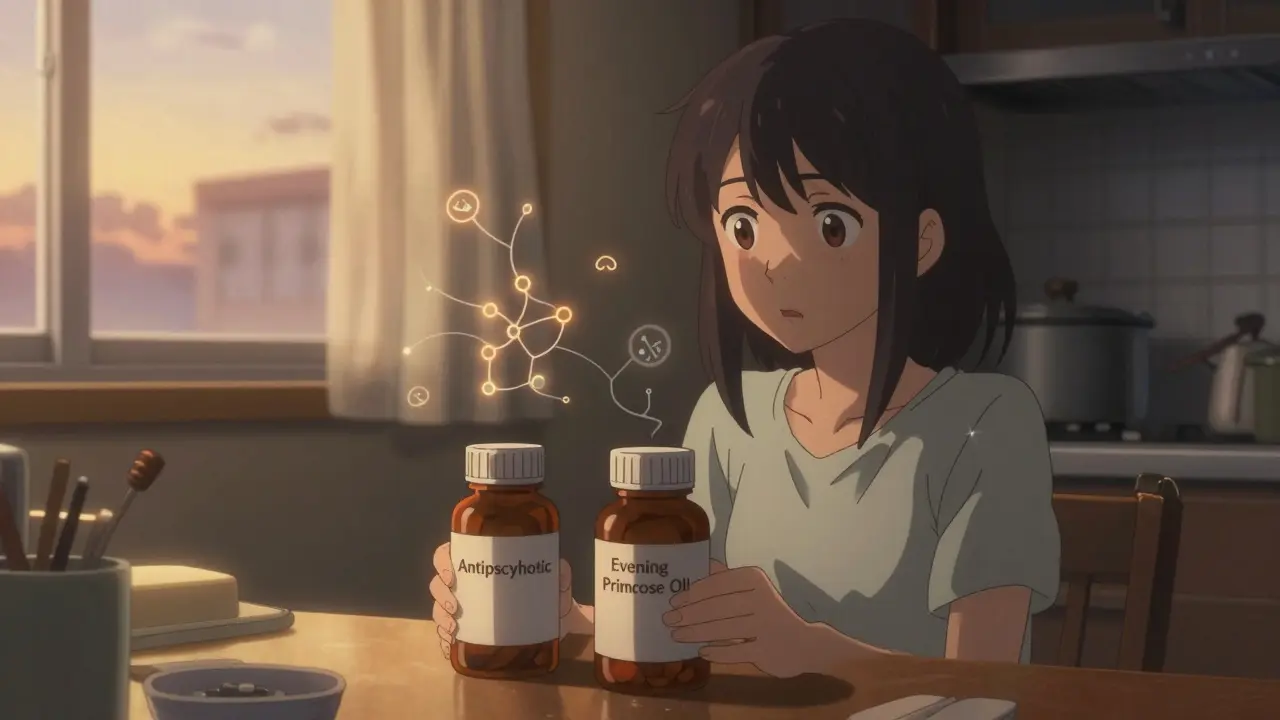
Evening Primrose Oil & Antipsychotic Interaction Checker
Check your medication interactions
Select the antipsychotic medications you are currently taking to see potential interactions with evening primrose oil (EPO)
Results
Select your medications to see your interaction risk level
When you're managing a mental health condition like schizophrenia or bipolar disorder, every pill, capsule, and supplement matters. You're already juggling medications that keep your symptoms in check. So when someone tells you to try evening primrose oil for PMS, eczema, or joint pain, it’s natural to wonder - is this safe? Especially when your doctor warns you about seizures.
The truth? There’s no clear answer. One study says EPO might protect against seizures. Another says it could trigger them. Your pharmacist warns you. Your neighbor swears by it. And your neurologist just says, "Be careful." This isn’t just confusing - it’s dangerous if you make the wrong call.
What Even Is Evening Primrose Oil?
Evening primrose oil (EPO) comes from the seeds of a yellow-flowered plant called Oenothera biennis. It’s been sold for decades as a natural remedy. Most capsules contain 8-10% gamma-linolenic acid (GLA), an omega-6 fatty acid that your body turns into prostaglandin E1 - a compound with anti-inflammatory effects. That’s why people take it for breast pain, dry skin, and arthritis.
But here’s the catch: GLA doesn’t just affect your skin or joints. It interacts with brain chemistry. Studies show it can influence sodium channels, synaptic signals, and even GABA activity - all of which play roles in how seizures start. That’s why the question of seizure risk isn’t just theoretical. It’s biological.
The Seizure Controversy: Two Sides of the Same Coin
In the early 1980s, a handful of case reports linked EPO to seizures in people with epilepsy. Those stories stuck. Since then, major health organizations like Mayo Clinic and Walgreens have listed seizures as a possible side effect. Their warnings are clear: Don’t take EPO if you have epilepsy or schizophrenia.
But in 2007, researcher BK Puri from Imperial College London reviewed every single study on the topic. He found no solid evidence that EPO causes seizures. In fact, he found the opposite: in animal models, the very same fatty acids in EPO - linoleic acid and GLA - actually reduced seizure activity. His paper concluded the seizure link was "spurious" and should be removed from warning labels.
So why do some doctors still warn against it?
Because science doesn’t always move in sync with policy. While Puri’s work was solid, it didn’t change institutional guidelines overnight. The Epilepsy Foundation still calls it a "theoretical concern." The American Academy of Neurology rates the evidence as "Class IV" - the lowest level. That means there’s no strong proof, but they can’t rule it out either.
Why Antipsychotics Make This Even Riskier
Antipsychotics like quetiapine, olanzapine, chlorpromazine, and flupentixol already lower the seizure threshold. That’s why doctors monitor patients closely, especially when starting or changing doses. Now add EPO into the mix - and things get murkier.
DrugBank (updated April 2025) lists specific interactions: EPO increases seizure risk when taken with amifampridine, brexpiprazole, lumateperone, and pimavanserin. Familiprix’s 2023 drug database singles out Largactil (chlorpromazine) and Fluanxol (flupentixol) as high-risk combinations.
Why? Because these drugs affect dopamine and sodium channels. EPO’s fatty acids also interfere with sodium flow in brain cells. Together, they might push your brain past its seizure threshold - not because EPO alone is dangerous, but because it stacks with other risks.
One case reported in 2023 described a patient who had a seizure under anesthesia after taking EPO. But they were also on multiple medications. Was it EPO? The drugs? Or the anesthesia? We don’t know. That’s the problem - real-world data is messy.

What Do Real People Experience?
Online forums tell a different story than medical guidelines.
On Drugs.com, a woman with epilepsy took EPO for two years for PMS - no seizures. Another user with schizophrenia said her neurologist banned it outright. Reddit’s r/Epilepsy thread in March 2024 showed 57% of 142 respondents reported no change in seizure frequency. But 32% said they had more seizures after starting EPO.
HealthUnlocked’s epilepsy forum had 43 posts in 2023. Of those:
- 19 users said EPO had no effect
- 15 reported more seizures - especially when combined with quetiapine
- 9 couldn’t tell if EPO was to blame
WebMD’s 1,842 reviews give EPO a 3.2 out of 5 for safety in neurological conditions. That’s not terrible - but it’s not reassuring either.
What’s Being Done Right Now?
The confusion isn’t going away. A major study launched in January 2024 - NCT05678901 - is tracking 300 epilepsy patients over 18 months to see if EPO truly affects seizure frequency. It’s being run by Imperial College London and Johns Hopkins. Results won’t come until late 2025.
In the meantime, the European Medicines Agency said in March 2024: "Current evidence does not support a causal relationship between EPO and seizures - but more research is needed on drug combinations." The NIH has already allocated $2.3 million to study this exact issue.
Meanwhile, supplement makers are playing it safe. As of Q1 2024, 68% of EPO products on the market carry some kind of epilepsy warning. Some say "consult your doctor." Others say "do not use if you have epilepsy." There’s no standard.

What Should You Do?
If you’re on antipsychotics and thinking about EPO:
- Don’t stop or start anything without talking to your doctor. This isn’t a decision to make based on a Reddit post or a supplement label.
- Know your exact meds. If you take chlorpromazine, flupentixol, quetiapine, or any of the newer antipsychotics listed in DrugBank, the risk is higher.
- Track your seizures. If you’ve never had one, that’s good. But if you’ve had even one before, you’re already at higher risk. EPO might push you over the edge.
- Check the dose. Most EPO capsules are 500mg, but some are 1,000mg or more. Higher doses mean more GLA - and possibly more biological impact.
- Consider alternatives. For PMS or skin issues, there are other supplements with less controversy - like vitamin B6, magnesium, or fish oil. Talk to your pharmacist about safer options.
There’s no blanket answer. For some, EPO is harmless. For others, it’s a trigger. The difference? Your brain chemistry, your meds, your history, and your dose.
Bottom Line
The science is split. The guidelines are mixed. The market keeps selling it. And people are still getting seizures.
Until the 2025 study delivers clear answers, the safest move is caution. If you’re on antipsychotics - especially ones known to lower seizure threshold - don’t take EPO unless your doctor explicitly says it’s okay. And even then, monitor closely. Keep a seizure diary. Note any changes in frequency, intensity, or triggers.
Supplements aren’t harmless just because they’re natural. They’re chemicals. And in your brain, they can interact in ways you can’t predict.
Can evening primrose oil cause seizures in people without epilepsy?
There’s no strong evidence that EPO causes seizures in people with no history of neurological conditions. Most reports of seizures involve individuals already at risk - such as those with epilepsy, schizophrenia, or those taking medications that lower the seizure threshold. If you’ve never had a seizure and aren’t on antipsychotics or seizure-lowering drugs, the risk is considered very low. But isolated cases exist, and the mechanism isn’t fully understood.
Is it safe to take evening primrose oil with olanzapine or risperidone?
The interaction data for olanzapine and risperidone is limited. While DrugBank and Familiprix specifically flag chlorpromazine and flupentixol, they don’t list olanzapine or risperidone as confirmed high-risk. However, both drugs are known to lower seizure threshold. Since EPO may have similar effects, combining them could increase risk - even if not proven. Most doctors recommend avoiding EPO with any antipsychotic unless there’s a clear benefit and close monitoring.
Why do some supplement labels warn about seizures while others don’t?
The FDA doesn’t require supplement labels to include specific warnings unless the product is classified as a drug. Manufacturers decide their own labeling. As of Q1 2024, 68% of EPO products include a seizure warning, but the wording varies. Some say "consult your doctor," others say "avoid if you have epilepsy." This inconsistency makes it hard for consumers to know what’s truly risky. Always look for brands that cite sources - and if in doubt, assume it’s a risk.
What are safer alternatives to evening primrose oil for PMS or eczema?
For PMS, magnesium (300-400 mg/day) and vitamin B6 (50-100 mg/day) have strong evidence and minimal interaction risks. For eczema, fish oil (rich in omega-3s) and topical ceramide creams are better choices. Unlike EPO, omega-3s don’t interfere with sodium channels or antipsychotic metabolism. Always check with your doctor before switching - especially if you’re on multiple medications.
How long does it take for evening primrose oil to affect seizure threshold?
GLA, the active component in EPO, reaches peak levels in the blood about 2.7 to 4.4 hours after ingestion, depending on when you take it. But its effects on brain chemistry - like sodium channel modulation - may take days or weeks to build up. Most seizure reports occur after several weeks of consistent use. That’s why sudden changes aren’t common - it’s a slow, cumulative effect. If you start EPO, monitor for changes over the first 4-6 weeks.




Comments
Kal Lambert
Been on olanzapine for 8 years. Took EPO for eczema last winter. No issues. But I also don't have epilepsy or prior seizures. Your risk profile matters more than the label.
Melissa Stansbury
I had a seizure after starting EPO while on quetiapine. Not a joke. My neurologist said it was likely the combo. I stopped both. No more episodes. Don't gamble with your brain. Even if it's "natural."
My sister still takes it for PMS. She says she's fine. But she's never been on antipsychotics. Different story.
cara s
It's fascinating how regulatory inertia operates in pharmacology. The 2007 Puri meta-analysis was methodologically rigorous, yet institutional guidelines remain anchored in anecdotal case reports from the 1980s. This is not science-it's institutional memory. The FDA's lack of regulatory authority over supplements creates a vacuum where fear, not evidence, dictates labeling. 68% of products carry warnings not because the data supports it, but because litigation avoidance outweighs scientific nuance. We're treating a biochemical interaction like a moral hazard.
Amadi Kenneth
They don't want you to know the truth. EPO is a Trojan horse. The pharmaceutical industry doesn't profit from natural oils. So they created this "seizure risk" myth to scare people away. Meanwhile, they're pushing synthetic drugs that cause 10x more side effects. Check the FDA's own adverse event reports. They're hiding data. I've got screenshots. The real danger? They're using your fear to sell you more pills.
Shameer Ahammad
It is a matter of profound concern that individuals with psychiatric conditions are being advised to self-administer unregulated botanical extracts without oversight. The biochemical interactions between gamma-linolenic acid and sodium-channel modulators are not trivial. The assertion that "it's natural" is a fallacy of composition. Every molecule has pharmacokinetic properties. The absence of regulation does not equate to safety. One must exercise intellectual rigor when navigating pharmacological decision-making, particularly in the context of neuropharmacology.
Alexander Pitt
My psychiatrist told me flat out: "Don't touch EPO if you're on anything that lowers seizure threshold." No gray area. I trusted her. You should too. The science might be messy, but the advice is clear.
Manish Singh
As someone from India where herbal remedies are common, I’ve seen this play out. My uncle took EPO for arthritis while on chlorpromazine. He had a minor seizure. Doctors here didn’t even blink-they just said "stop it." No drama. No debate. Just common sense. We don’t need a 2025 study to know: if your meds already lower your seizure threshold, don’t add another variable. Your brain isn’t a lab experiment.
Nilesh Khedekar
they say e.p.o. is safe but then they put warnings on the bottle like its a bomb. why? because they know its dangerous but they cant say it outright. the fda lets them sell it as a supplement so they dont have to prove anything. but they still wanna cover their asses. so they write "consult your doctor" like its a magic phrase. its all a scam. i think they're testing us. seeing who ignores the warnings. i stopped taking it after my cousin had a seizure. she was on flupentixol. coincidence? i dont think so.
Robin Hall
There is a disturbing pattern here. The pharmaceutical-industrial complex has a vested interest in maintaining ambiguity around botanical supplements. By allowing contradictory warnings, they create a market for more expensive, patented alternatives. The fact that 68% of EPO products carry seizure warnings while the NIH allocates $2.3 million for research suggests that the system is not designed to resolve uncertainty-it is designed to profit from it. One must question the incentives behind the current regulatory framework.
jared baker
My mom took EPO for years with no issues. She's on Seroquel. No seizures. No problems. Maybe it's just not a big deal for everyone. I'd still check with your doc, but don't freak out. Not everyone's brain reacts the same.