
Hyperthyroidism-Stimulant Risk Calculator
Heart Rate Risk Assessment
Hyperthyroidism makes your body 30-40% more sensitive to adrenaline-like chemicals. Stimulants can increase heart rate by 300-500%. This calculator estimates your risk based on current heart rate and stimulant type.
Results
Based on your inputs:
Estimated heart rate after stimulant: bpm
When your thyroid is overactive, even small things can feel overwhelming. Your heart races for no reason. You can’t sit still. You feel anxious, even when nothing’s happening. Now imagine adding a stimulant like Adderall or Ritalin on top of that. It’s not just a bad idea-it’s dangerous.
Why Hyperthyroidism and Stimulants Don’t Mix
Hyperthyroidism means your body is flooded with too much thyroid hormone. That alone speeds up your metabolism, raises your heart rate, and makes you jittery. Stimulant medications like Adderall and methylphenidate do the same thing-only worse. They force your brain to release more norepinephrine and dopamine, which spikes your heart rate, blood pressure, and nervous system activity.Together, they create a perfect storm. A 2021 study in the Journal of Clinical Endocrinology & Metabolism found that hyperthyroidism makes your body 30-40% more sensitive to adrenaline-like chemicals. Adderall, which can boost norepinephrine by 300-500%, hits a system already on fire. The result? Resting heart rates jump from 70 bpm to 140 bpm or higher. That’s not just uncomfortable-it’s a direct path to atrial fibrillation, heart palpitations, or even cardiac arrest.
The Anxiety Trap
Anxiety isn’t just a side effect-it’s a red flag. People with untreated hyperthyroidism already have higher levels of stress hormones. Add stimulants, and that anxiety doesn’t just get worse. It becomes paralyzing. Thyroid UK’s 2023 data shows that 78% of hyperthyroid patients on stimulants report severe panic attacks, compared to just 22% of those not taking them.One Reddit user, who goes by ‘AnxiousThyroidWarrior,’ described taking Adderall and feeling like her heart was going to burst. She ended up in the ER with a heart rate of 140 bpm. That’s not an outlier. On Drugs.com, 68% of hyperthyroid patients who reviewed Adderall said their symptoms got worse. Common complaints? Panic within 30 minutes of taking the pill. Passing out from heart palpitations. Feeling like you’re dying even when you’re sitting on the couch.
Adderall vs. Ritalin: Not All Stimulants Are Equal
Not every stimulant carries the same risk. Adderall, which contains amphetamine salts, is far more dangerous than methylphenidate (Ritalin) for people with hyperthyroidism. A 2022 meta-analysis in the Journal of Clinical Psychiatry found Adderall increases heart rate 28% more than methylphenidate at the same dose.Why? Adderall releases large bursts of norepinephrine all at once. Methylphenidate works differently-it blocks the reuptake of dopamine and norepinephrine, so the effect is slower and more controlled. That’s why some doctors might consider low-dose methylphenidate (5-10 mg) for patients with mild, controlled hyperthyroidism. Even then, it’s a tightrope walk.
And Vyvanse? It’s a prodrug, meaning it breaks down slowly in the body. That gives it a gentler onset, reducing peak heart rate spikes by 15-20% compared to immediate-release Adderall. But it’s still an amphetamine. And for someone with hyperthyroidism? That’s not safe.
The Hidden Diagnosis: ADHD or Thyroid?
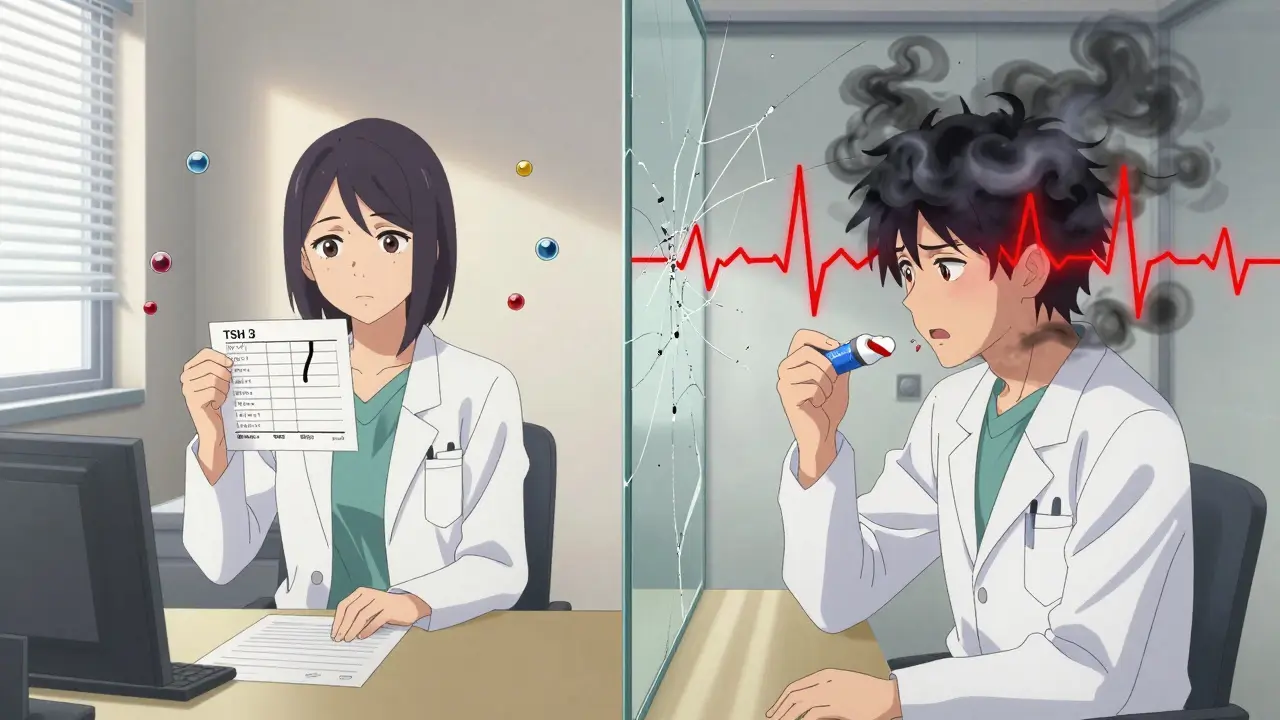
Here’s the scary part: many people with hyperthyroidism are misdiagnosed with ADHD. The symptoms overlap perfectly-restlessness, trouble focusing, irritability, weight loss, sleep problems. A 2022 Paloma Health survey found that 41% of adults diagnosed with ADHD had undiagnosed thyroid issues. When they treated the thyroid condition, their ADHD-like symptoms disappeared.The American Thyroid Association says it clearly: Rule out thyroid problems before diagnosing ADHD. If you’ve been on stimulants for months and still feel awful, your thyroid might be the real culprit. Getting a simple TSH blood test could save you from a dangerous medication combo-and maybe even save your life.
What Happens If You’re Already on Both?
If you’re taking Adderall and have hyperthyroidism, don’t stop cold turkey. That can trigger withdrawal or rebound anxiety. But you need to act fast.First: Get your thyroid levels checked. TSH, free T3, free T4. If they’re off, your endocrinologist will adjust your thyroid medication-usually levothyroxine. Then: Talk to your doctor about switching off stimulants. The Endocrine Society’s 2022 guidelines say Adderall is contraindicated in all hyperthyroid patients. That means no exceptions.
For those who truly need ADHD treatment, non-stimulants like atomoxetine (Strattera) are the safest bet. Strattera increases norepinephrine without triggering the same adrenaline surge. It raises heart rate by only 2-3 bpm, even in hyperthyroid patients. No ER visits. No panic attacks. Just steady focus.

Monitoring and Safety Protocols
If your doctor decides to try a stimulant despite the risks (which they shouldn’t), strict monitoring is non-negotiable.- Baseline ECG and 24-hour Holter monitor before starting
- Heart rate checked daily-anything over 110 bpm at rest is a warning sign
- Blood pressure tracked twice a day
- Thyroid labs every 3 months, even after stabilization
- Never take stimulants with calcium or iron supplements-they interfere with thyroid meds
And if you feel chest pain, dizziness, or sudden anxiety after taking your pill? Stop. Call your doctor. Go to urgent care. Don’t wait. The American Heart Association says hyperthyroid patients on stimulants have a 3.2-fold higher risk of atrial fibrillation. That’s not a small number. That’s a life-or-death statistic.
The Bigger Picture
This isn’t just about one drug or one condition. It’s about how medicine misses the basics. We’ve got 114 million prescriptions for levothyroxine in the U.S. every year. And 25 million for Adderall. The overlap is huge. Yet, only 27% of psychiatrists now check thyroid levels before prescribing stimulants-up from 12% in 2018, but still far too low.Pharmaceutical companies are finally updating labels. The FDA added thyroid warnings to Adderall in 2021. The American Academy of Pediatrics now requires thyroid testing in kids with atypical ADHD symptoms. But patients still fall through the cracks.
Meanwhile, new drugs are coming. Centanafadine, in Phase III trials, shows 40% less heart rate elevation than Adderall. That’s promising. But until then, the safest choice is simple: treat the thyroid first. Don’t add fuel to the fire.
What You Can Do Today
- If you have hyperthyroidism and take stimulants: Talk to your doctor about stopping them and switching to a non-stimulant like Strattera.
- If you’ve been diagnosed with ADHD but never had thyroid testing: Ask for a TSH blood test. It’s cheap, fast, and could change everything.
- If you’re on levothyroxine: Don’t take it with calcium, iron, or antacids. Wait at least 4 hours between doses.
- If you feel your heart racing, shaking, or panicking after taking a stimulant: Stop. Document it. Show your doctor.
You don’t need to suffer in silence. Your symptoms aren’t ‘just anxiety’ or ‘bad ADHD.’ They could be your thyroid screaming for help. Listen to it.
Can I take Adderall if I have hyperthyroidism?
No. Adderall is contraindicated in patients with hyperthyroidism according to the Endocrine Society and FDA guidelines. It significantly increases the risk of dangerous heart rhythms, high blood pressure, and severe anxiety. Even low doses can trigger cardiac events in people with overactive thyroids.
Can stimulants cause hyperthyroidism?
Stimulants don’t directly cause hyperthyroidism, but they can worsen it or mask its symptoms. Some studies, including one published in Thyroid in 2021, show stimulants can lower T4 levels in children, making thyroid management harder. More importantly, they make existing hyperthyroid symptoms feel worse-so a person might think they just need a higher dose of stimulant, when they actually need thyroid treatment.
What are the safest ADHD medications for someone with hyperthyroidism?
Atomoxetine (Strattera) is the safest option. It’s a non-stimulant that works differently-blocking norepinephrine reuptake without triggering adrenaline surges. It raises heart rate by only 2-3 bpm, even in hyperthyroid patients. Other options include guanfacine (Intuniv) or clonidine (Kapvay), which are blood pressure medications repurposed for ADHD and carry minimal cardiac risk.
How do I know if my anxiety is from my thyroid or my medication?
If your anxiety started or got worse after taking a stimulant, and you have other signs like weight loss, shaky hands, or a racing heart at rest, your thyroid is likely involved. Get a TSH test. If your TSH is low and your free T4 is high, your thyroid is overactive. Treating that often eliminates the anxiety-no stimulant needed. If your thyroid is normal, then the stimulant itself is probably the cause.
Can I still take thyroid medication if I’m on stimulants?
You should never take stimulants if you have hyperthyroidism. But if you’re on levothyroxine for hypothyroidism and need ADHD treatment, you can take both-only if your thyroid levels are stable. Even then, avoid Adderall. Use Strattera instead. And separate your thyroid pill from stimulants by at least 4 hours to avoid absorption issues.
What symptoms should I watch for if I’m on both?
Watch for heart rate over 110 bpm at rest, chest pain, dizziness, sudden panic attacks, trembling, or fainting. These aren’t normal side effects-they’re warning signs. If you experience any of these, stop the stimulant and seek medical help immediately. The risk of atrial fibrillation or heart failure is real and increases rapidly when these two conditions overlap.



Comments
Astha Jain
thoese stimulants are wild fr fr i had a friend take adderall while her thyroid was acting up and she ended up in the er like a week later lmao
Valerie DeLoach
There’s something deeply systemic here - we treat symptoms like problems to be medicated, not signals to be understood. Hyperthyroidism isn’t just a lab value; it’s a whole-body cry for balance. Stimulants don’t fix attention - they drown out the body’s warning system with artificial noise. And yet, we keep prescribing them like they’re candy. We’ve lost the art of listening to physiology. Maybe the real ADHD isn’t in the brain - it’s in the way medicine ignores context.
Jake Rudin
It’s not just Adderall… it’s the entire diagnostic culture… we’re so quick to label, to pathologize, to pharmaceuticalize… and yet… the most basic, simplest, cheapest test… TSH… is often skipped… Why? Because it’s not profitable… because it requires time… because doctors are rushed… because insurance won’t cover it unless you jump through 17 hoops… and because… well… we’ve forgotten that medicine used to be about people… not pills…
Lydia H.
I used to think my anxiety was just 'bad ADHD' until my heart started doing backflips after my morning Adderall. Got my TSH checked - free T4 was through the roof. Stopped the stimulant, started levothyroxine. Three weeks later, I slept through the night for the first time in years. No magic pill. Just… listening. Seriously, if you're on stimulants and feel like you're vibrating out of your skin - get tested. It’s not dramatic. It’s survival.
Tracy Howard
Can we just acknowledge that American medicine is a corporate circus? You’ve got Big Pharma pushing stimulants like they’re energy drinks, while thyroid care is treated like a footnote. Meanwhile, in Canada, we’ve got doctors who actually ask, 'Have you had your thyroid checked?' before writing a script. It’s not rocket science - it’s basic hygiene. But no, let’s just keep pumping out Adderall like it’s the new Starbucks latte.
Erwin Kodiat
My cousin was misdiagnosed with ADHD for 5 years. Took Adderall daily. Lost 30 pounds. Couldn’t sleep. Thought she was just 'high-strung.' Turned out her TSH was 0.02. After treatment? She became a completely different person - calm, focused, present. No stimulants needed. It’s heartbreaking how many people are being pushed down the wrong path because the system doesn’t check the basics. This post? Important. Vital. Please share it.
Christi Steinbeck
Y’all need to hear this: If you’ve been on stimulants for years and still feel like you’re running on fumes - it’s not you. It’s your thyroid. Get tested. Seriously. It’s a $15 blood test. It takes five minutes. It could save your heart. Your mind. Your life. Stop blaming yourself. Stop blaming the meds. Look at the root. You deserve to feel stable. You deserve to be safe. Don’t wait until you’re in the ER.
Aman Kumar
The pharmacological hubris of modern psychiatry is staggering. The conflation of neurochemical modulation with therapeutic efficacy ignores the endocrine axis entirely. Stimulants, particularly amphetamine derivatives, induce catecholamine surges that synergize catastrophically with thyrotoxicosis. The resultant adrenergic storm is not merely an adverse event - it is a predictable iatrogenic catastrophe. One must question the epistemic integrity of a discipline that prioritizes behavioral compliance over physiological integrity.
Phil Hillson
bro i took Adderall last year when i had a thyroid flare and i thought i was gonna die i swear to god i felt like my chest was cracking open and i just sat there crying because i thought i was having a heart attack and i was like 22 and i hadnt even done anything bad yet
Jacob Hill
Just want to say - Strattera changed my life. I was on Ritalin for a while, but even that made me shaky and anxious. Switched to Strattera, got my thyroid under control, and now I can actually sit still without feeling like I’m going to explode. It’s not a magic bullet, but it’s the closest thing to peace I’ve had in years. And yes - I take my levothyroxine 4 hours before breakfast. Always.
Malikah Rajap
Hey, I just wanted to say thank you for this. I’ve been so scared to bring up my thyroid with my psychiatrist because I thought they’d just say ‘you’re overreacting’… but reading this made me feel seen. I’ve been having panic attacks after my afternoon dose, and I thought it was ‘just anxiety.’ But now I’m scheduling my TSH test tomorrow. You’re right - it’s not just ADHD. It’s my body screaming. And I’m finally listening.
Jackson Doughart
The data is unequivocal. The physiological synergy between thyrotoxicosis and amphetamine exposure is well-documented in endocrinological literature. The fact that this remains under-recognized in primary care and psychiatric practice speaks to a systemic failure in interdisciplinary communication. A simple TSH panel, performed prior to stimulant initiation, could prevent thousands of cardiac events annually. It is not merely prudent - it is an ethical imperative.
sujit paul
Let’s be real - this isn’t about thyroid or ADHD. It’s about the New World Order controlling our minds through pharmaceuticals. They don’t want us to be calm. They want us anxious, dependent, docile. TSH tests? They’re hiding the truth. Thyroid dysfunction is a natural defense mechanism against chemical manipulation. The real enemy isn’t Adderall - it’s the system that profits from your fear. Get off the grid. Eat seaweed. Meditate. Reject the pills. Your body knows the truth.
Lewis Yeaple
Per the Endocrine Society Clinical Practice Guideline (2022), the use of amphetamine-based stimulants in patients with hyperthyroidism is categorically contraindicated due to the significant increase in risk of atrial fibrillation, supraventricular tachycardia, and sudden cardiac death. Furthermore, the American Heart Association has issued a Class I recommendation against such co-administration. Any deviation from this standard constitutes a breach of the standard of care. Patients and clinicians must be unequivocally informed.