
Genetic Drug Metabolism Checker
Check if your medications are affected by genetic variations. Enter a drug name or select from the list below to see if there are known genetic interactions that could affect your treatment.
Have you ever taken a medication that didn’t work-or made you feel worse? Maybe you were on an antidepressant for months with no improvement, or you got sick after starting a common painkiller. If so, your genes might be the reason. Genetic testing for drug metabolism isn’t science fiction anymore. It’s a real tool that’s helping doctors stop guessing and start knowing how your body handles medicine.
What Does Drug Metabolism Have to Do With Your Genes?
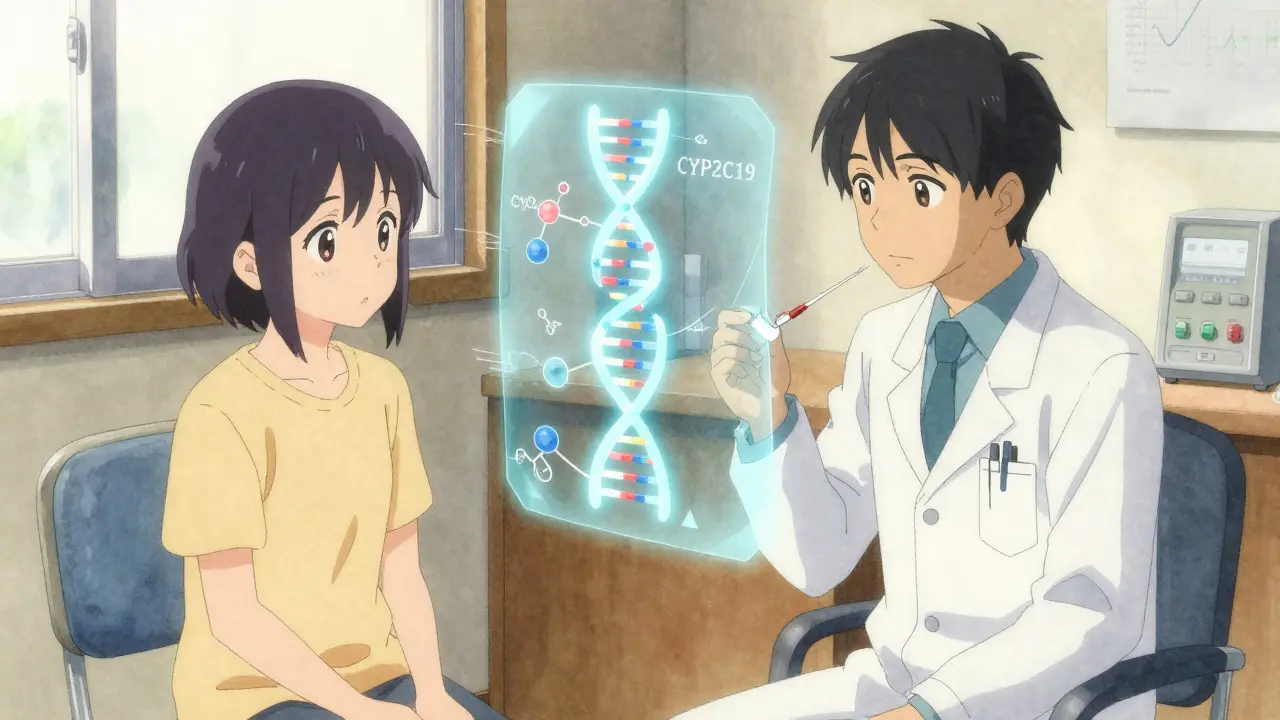
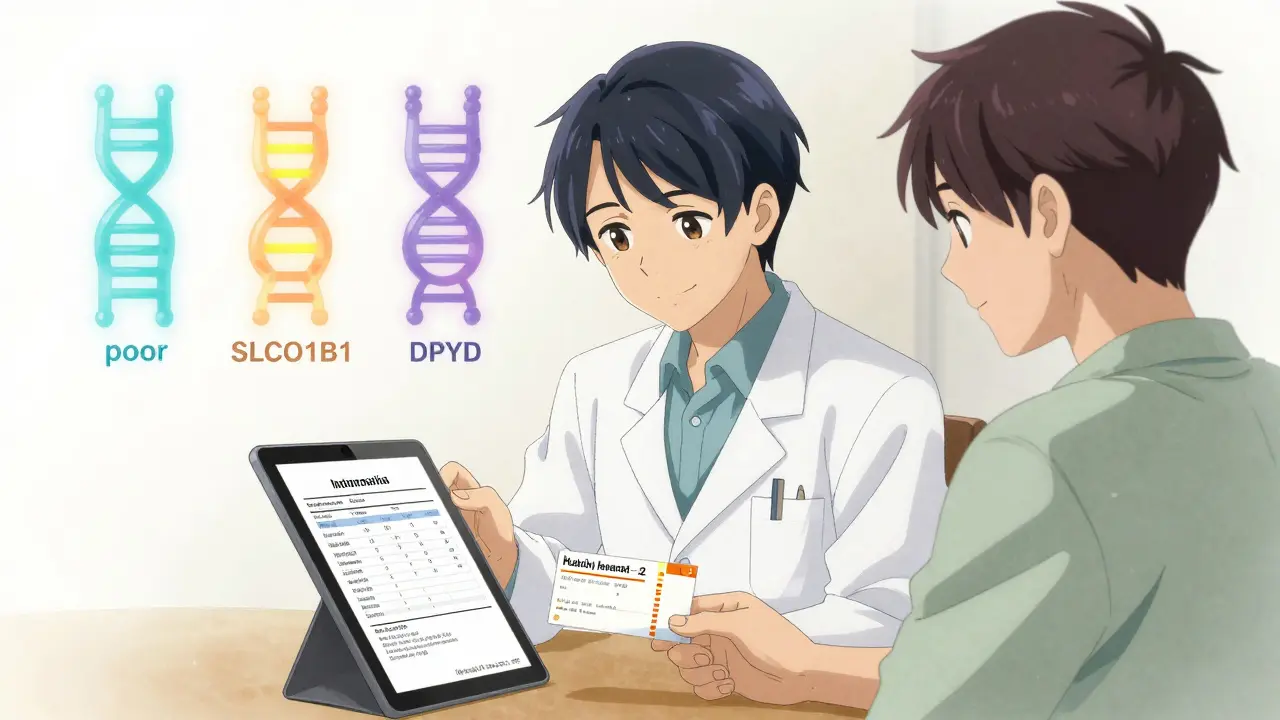
Your body breaks down drugs using enzymes, mostly from a family called cytochrome P450. These enzymes act like molecular scissors, cutting apart medications so they can be cleared from your system. But not everyone has the same scissors. Your genes decide whether your scissors are slow, normal, or unusually fast. For example, the CYP2D6 gene handles about 25% of all commonly prescribed drugs-everything from antidepressants like fluoxetine to painkillers like codeine. If you have two slow versions of this gene, you’re a poor metabolizer. That means codeine won’t turn into its active form, so you get no pain relief. But if you have two extra copies, you’re an ultrarapid metabolizer. The same drug turns into too much active substance too fast, risking overdose. Other key genes include:- CYP2C19: Critical for clopidogrel (Plavix), a blood thinner. Poor metabolizers have a 50% higher chance of heart attack or stroke.
- DPYD: Affects 5-fluorouracil, a chemo drug. People with certain variants can develop life-threatening toxicity from standard doses.
- SLCO1B1: Determines statin side effects. Those with risk variants are 4.5 times more likely to quit statins due to muscle pain.
What Can This Testing Actually Do?
It’s not about predicting every drug reaction. Right now, it’s most useful for a handful of high-stakes medications where small changes in metabolism can mean big consequences. Take abacavir, an HIV drug. Before genetic testing, about 5-8% of patients developed a deadly allergic reaction called hypersensitivity syndrome. Now, doctors test for the HLA-B*57:01 gene variant first. If it’s present, they don’t prescribe abacavir. The reaction? Nearly eliminated. That’s not just helpful-it’s life-saving. In depression treatment, a 2022 JAMA study found that patients who got genetic testing had 30% fewer prescriptions with predicted drug-gene conflicts. But here’s the catch: while fewer bad interactions happened, symptom improvement wasn’t dramatically better after 24 weeks. So the test helps avoid harm, but doesn’t guarantee you’ll feel better. For statins, the data is clearer. One study showed patients with prior muscle pain who got tested and switched to safer alternatives were 60% more likely to stick with their medication after three months. Without testing, only 33% stayed on track.Who Should Consider Getting Tested?
You don’t need to test for everything. But if any of these apply to you, it’s worth talking to your doctor:- You’ve had a bad reaction to a medication-even if it was years ago.
- You’re starting a drug with known gene links: antidepressants, blood thinners, chemo, or statins.
- You’ve tried multiple medications for the same condition (like anxiety or pain) and none worked well.
- You’re on three or more prescriptions at once. More drugs = more chances for gene-drug clashes.
- You’re planning long-term treatment for a chronic illness (e.g., heart disease, depression, cancer).
How It Works (And What You’ll Actually Get)
Testing is simple. A cheek swab or blood sample goes to a lab. In 7-14 days, you get a report that says whether you’re a poor, intermediate, normal, rapid, or ultrarapid metabolizer for each gene tested. But here’s where things get messy. Not all reports are created equal. Some just list variants. Others give clear advice: “Avoid this drug,” “Use half the dose,” or “Try this alternative.” The FDA has a list of 300+ drug-gene pairs with evidence, but most commercial tests cover way more genes than have proven clinical value. You might see results for 50 genes-but only 10 of them matter for your care. That’s why results alone aren’t enough. You need a provider who understands what the numbers mean. A 2023 JAMA Internal Medicine study found that 41% of doctors misinterpreted pharmacogenetic results without specialized training.Cost and Insurance
Out-of-pocket costs range from $250 to $500 for a broad panel. Some insurers cover it if you’re on a high-risk drug-like clopidogrel or 5-fluorouracil. But coverage is patchy. Medicare only covers a few specific tests. Private insurers vary wildly. If you’re paying yourself, ask if the test includes genetic counseling. A good lab will explain what the results mean for your specific medications-not just dump a PDF on you.
The Real Limitations
This isn’t a magic bullet. Here’s what you need to know:- Only about 300 of the 1,500+ commonly prescribed drugs have reliable gene links. Most others? Still guesswork.
- Genes aren’t destiny. Some people with high-risk variants tolerate drugs fine. Others without them still get side effects.
- Results can be unclear. About 15-20% of tests show variants of uncertain significance-meaning we don’t know what they mean yet.
- It doesn’t replace monitoring. Even with perfect genetic data, doctors still need to check how you respond over time.
Is It Worth It?
If you’ve been through trial-and-error with meds-especially antidepressants, painkillers, or heart drugs-then yes. The cost of one hospital visit from a bad reaction can be 100 times more than the test. One cancer patient in a MedlinePlus case study had a near-fatal reaction to chemotherapy because her DPYD variant wasn’t known. After testing, her dose was cut in half. She stayed on treatment. She’s alive today. On Reddit, 68% of users who tried testing said it helped them avoid side effects or find a drug that actually worked. But 23% said insurance denied coverage or their doctor didn’t change anything. The bottom line? Genetic testing for drug metabolism isn’t for everyone. But if you’ve had bad drug experiences, or you’re starting a high-risk medication, it could save you time, money, and pain.Next Steps
If you’re thinking about testing:- Ask your doctor if any of your current or planned medications have known gene links.
- Find out if your insurer covers pharmacogenetic testing for those drugs.
- If paying out of pocket, choose a lab that offers clinical interpretation-not just raw data.
- Bring the results to your provider. Don’t assume they know how to read them.
- Keep a copy. Your genes don’t change. This test can help you for life.
Is genetic testing for drug metabolism the same as ancestry testing?
No. Ancestry tests look at markers linked to heritage and traits like eye color. Pharmacogenetic tests focus only on genes that affect how your body processes medications. They use different panels, different labs, and different purposes. Don’t use a 23andMe result to guide your prescriptions.
Can I get tested without seeing a doctor?
Yes-some companies sell direct-to-consumer tests. But without a clinician to interpret results, you risk making unsafe changes. A test telling you to avoid a drug might be correct-but if you stop a blood thinner without a replacement, you could have a stroke. Always involve your healthcare provider.
Will my insurance deny coverage if I test positive for a risky gene?
In the U.S., the Genetic Information Nondiscrimination Act (GINA) prevents health insurers and employers from discriminating based on genetic test results. Your insurance can’t cancel your plan or raise your rates because of this test. However, life insurance and long-term care insurance aren’t covered by GINA.
How often do I need to retake this test?
Never. Your genes don’t change. Once you’ve been tested, the results are valid for life. Keep them on file and share them with new doctors. Many hospitals now store pharmacogenetic data in electronic health records for future use.
Are there any downsides to getting tested?
The main risks are cost, confusion, and false reassurance. If you get tested but don’t act on the results, you gain nothing. If the report says “no risk” but you still have side effects, you might blame the test instead of looking for other causes. Also, some labs overstate the value of genes with weak evidence. Stick to tests focused on drugs with strong clinical guidelines.



Comments
Denise Jordan
I got tested after my doc almost killed me with statins. Turns out I'm a SLCO1B1 nightmare. They switched me and now I don't feel like I'm walking through molasses. Worth every penny.
Adam Kleinberg
This whole genetic testing thing is just Big Pharma's way of making us pay for data they already have from your 23andMe. They'll sell your genes to insurers next. I'm not playing. You think your DNA is safe? It's not.
Gene Forte
Knowledge is power. If you can avoid a life-altering side effect by knowing your body's blueprint, why wouldn't you? This isn't sci-fi. It's science. And it's helping real people live better. Don't let fear stop you from taking control of your health.
Kenneth Zieden-Weber
So let me get this straight. You're telling me my body has a manual... and I didn't get one until I almost died? Seriously? We treat cars better than we treat human biology. I got tested after my third failed antidepressant. Turned out I metabolize SSRIs like a Ferrari on nitrous. Changed my life. Why isn't this standard?
Randall Walker
I got the test... and then my doctor looked at it like it was written in hieroglyphics. Said 'we'll just try something else.' So I paid $400 to confirm what I already knew: doctors don't know how to read this stuff. It's a scam if you don't have a pharmacogenetics specialist on retainer.
Miranda Varn-Harper
I find it deeply concerning that we are moving toward a future where medical decisions are based on genetic determinism. Human physiology is far more complex than a single SNP. This testing reduces patients to data points. It is a dangerous precedent.
Alexander Erb
Literally changed my life. Took me 7 years to find an antidepressant that didn't make me feel like a zombie. Test said I'm a CYP2D6 ultra-rapid. Switched to a non-metabolized med. Now I'm sleeping. Eating. Laughing. 🙌
Donnie DeMarco
yo so i got tested after my doc gave me the same painkiller that made my cousin OD. turns out i'm a CYP2D6 slowpoke. they switched me to tramadol and now i can actually walk. also my insurance covered it. free money people. do it.
Tom Bolt
The notion that a single gene variant can dictate a lifetime of pharmaceutical decisions is not only scientifically reductive-it is ethically precarious. The reduction of human complexity to binary metabolic categories is a form of medical colonialism disguised as innovation.
Shourya Tanay
From a pharmacogenomics perspective, the clinical utility of CYP2D6 and CYP2C19 polymorphisms is well-documented in the PharmGKB database. However, the penetrance of phenotypic expression is modulated by epigenetic and environmental cofactors, which are rarely accounted for in commercial assays. This introduces significant clinical uncertainty.
LiV Beau
I did this test after years of depression. Turns out I’m a CYP2C19 poor metabolizer. My doctor switched me and now I’m not crying every morning. I’m not saying it’s perfect, but it helped. And I’m so glad I did it. 💕
Chris Bird
Why are we letting corporations profit off people's DNA? This is just another way to make money off sick people. I got tested and they told me to avoid 12 drugs. I'm on 10. So now what? I'm just supposed to stop taking my meds? This is not medicine. This is a pyramid scheme.