

Why Lung Cancer Screening Matters More Than Ever
Lung cancer remains the leading cause of cancer death in the United States, accounting for about 22% of all cancer deaths. The reason is simple but devastating: it is often found too late to treat effectively. When diagnosed at a late stage, the five-year survival rate drops to just 6%. But here is the game-changer that many people miss: if caught early through screening, that survival rate jumps to 59%.
Despite this stark difference, only 23% of lung cancer cases are currently diagnosed at an early stage. For years, stigma and outdated guidelines kept high-risk individuals away from life-saving checks. Today, with new guidelines expanding who qualifies and breakthroughs in targeted therapies, the landscape has shifted dramatically. If you or someone you know has a smoking history, understanding these changes could literally save a life.
Who Actually Qualifies for Screening?
The biggest hurdle isn't the test itself-it's knowing if you're eligible. Guidelines have evolved significantly, and different organizations offer slightly different criteria. This can be confusing, so let's break down the major players.
The American Cancer Society (ACS) updated its guidelines in March 2023 to be the most inclusive. They recommend annual screening for adults aged 50 to 80 with a 20+ pack-year smoking history. Crucially, they removed the restriction on how long ago you quit. Whether you smoked yesterday or thirty years ago, if you fit the age and pack-year criteria, you qualify.
A "pack-year" is calculated by multiplying the number of packs smoked per day by the number of years smoked. So, one pack a day for 20 years equals 20 pack-years. Two packs a day for 10 years also equals 20 pack-years.
The United States Preventive Services Task Force (USPSTF), whose recommendations Medicare and most insurers follow, recommends annual screening for adults aged 50 to 80 with a 20 pack-year history who currently smoke or quit within the past 15 years. This update expanded eligibility nearly doubling the eligible population from 6.8 million to 14.5 million people.
| Organization | Age Range | Smoking History | Quit Restriction |
|---|---|---|---|
| American Cancer Society (2023) | 50-80 | 20+ pack-years | None |
| USPSTF / Medicare (2021) | 50-80 (Medicare up to 77) | 20+ pack-years | Within 15 years |
| American College of Chest Physicians | 55-77 | 30+ pack-years | Within 15 years |
Note that Medicare covers screening for beneficiaries aged 50-77. Some commercial insurers may still follow older, stricter guidelines requiring 30 pack-years and ages 55-80, so it pays to check your specific coverage.
The Test: Low-Dose CT Scans Explained
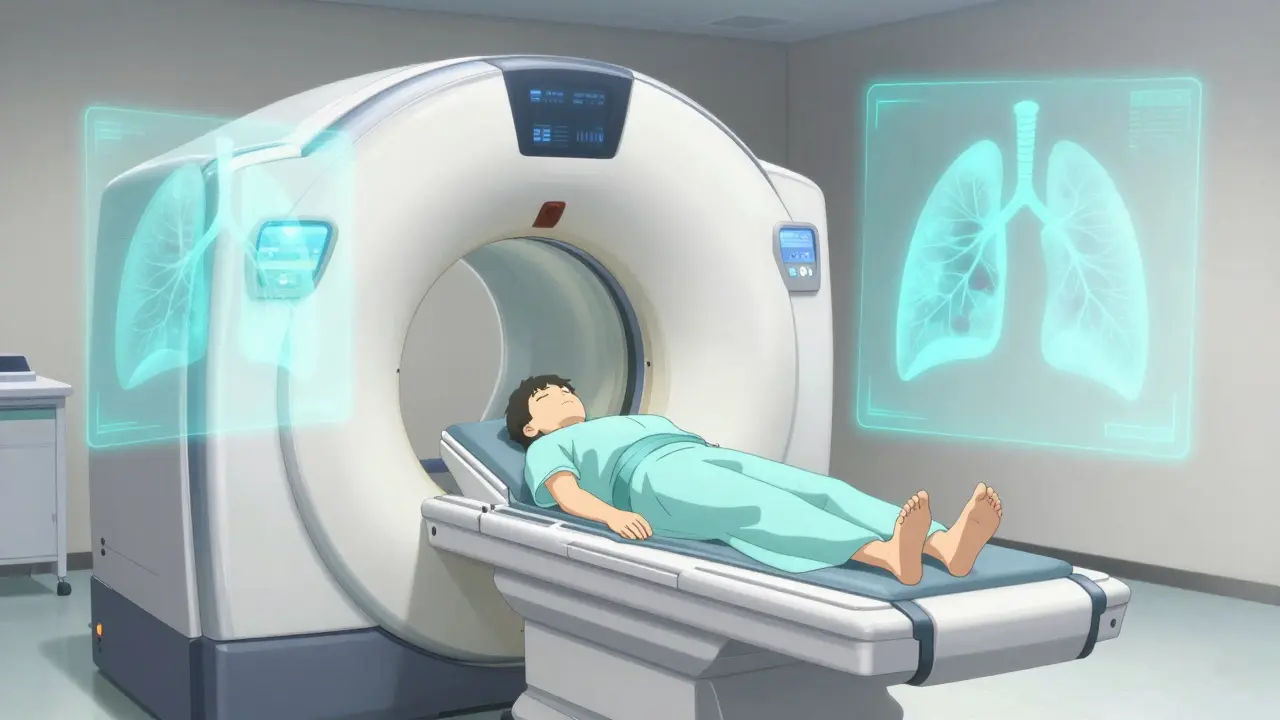
If you qualify, the standard screening tool is a Low-Dose Computed Tomography (LDCT) scan. Unlike standard diagnostic CT scans, LDCT uses 70-80% less radiation, making it safe for annual use. Technical specifications typically involve 120 kVp, 30-50 mAs, and 1.25-2.5 mm slice thickness.
The process is quick and non-invasive. You lie still while the machine rotates around you, capturing detailed images of your lungs. The real value lies in what happens next. A structured program includes:
- Risk Assessment: Using tools like the PLCOm2012 calculator to confirm eligibility.
- Shared Decision-Making: A visit with your doctor (minimum 15 minutes recommended) to discuss benefits and risks.
- The Scan: Performed at an accredited facility.
- Follow-Up: Systematic monitoring of any abnormalities.
It is important to manage expectations. The National Lung Screening Trial reported that 96.4% of positive screens were false positives. This means many people will get a scare that turns out to be nothing. However, the alternative-missing a curable cancer-is far worse. AI-assisted software, such as LungQ approved by the FDA in 2023, is helping reduce unnecessary follow-ups by 22%, improving the accuracy of these screenings.
Targeted Therapy: A New Era of Treatment
Screening doesn't just find cancer earlier; it finds cancer that is more treatable. Historically, lung cancer treatment relied heavily on chemotherapy and radiation. Today, targeted therapy is changing the game. These drugs attack specific genetic mutations driving the cancer's growth, sparing healthy cells and reducing side effects.
Early detection through screening identifies more patients with resectable early-stage disease. For example, osimertinib, a targeted drug for EGFR-mutated non-small cell lung cancer (NSCLC), was approved for adjuvant treatment (after surgery) in December 2020. The ADAURA trial published in the New England Journal of Medicine showed it improved disease-free survival by 83%.
The International Association for the Study of Lung Cancer projects that by 2025, 70% of early-stage lung cancers detected through screening will have actionable genomic alterations eligible for targeted therapy. Compare this to only 30% of late-stage diagnoses where such treatments are viable. This shift means that finding cancer early doesn't just mean surgery; it means precision medicine that keeps you alive longer and healthier.

Barriers to Access and What You Can Do
Even with clear guidelines, access remains a challenge. Only 5.7% of eligible individuals received appropriate annual screening in 2021. Why? Lack of provider awareness, limited access to accredited centers, and patient misconceptions.
Rural areas face a significant disadvantage, having 67% fewer screening facilities per capita than urban areas. Additionally, demographic disparities persist, with screening rates 35% lower among Black eligible individuals compared to White eligible individuals.
To overcome these barriers, take proactive steps:
- Ask Your Doctor: Don't wait for them to bring it up. Bring up your smoking history and ask if you qualify for LDCT screening.
- Check Accreditation: Ensure the facility performing your scan is ACR-accredited. This ensures quality control and proper reimbursement.
- Use EHR Prompts: If you work in healthcare, utilize electronic health record prompts which have been shown to increase screening rates by 32%.
- Integrate Cessation Support: Screening programs should include smoking cessation resources. While 70% of screened smokers want to quit, only 30% receive support. Quitting improves outcomes regardless of screening status.
Future Directions: Personalized Screening
The future of lung cancer care is personalized. The National Cancer Institute is funding the PACIFIC trial to evaluate whether genetic risk markers and environmental exposures can refine screening eligibility beyond smoking history alone. Liquid biopsy technologies are also being explored to detect molecular abnormalities before tumors are visible on CT scans.
By 2030, experts predict that lung cancer screening programs will incorporate genomic risk assessment and targeted therapy eligibility as standard components. This integration could push overall five-year survival rates from the current 23% to over 40%. The path forward requires not just better technology, but better communication and access for those who need it most.
Does quitting smoking make me ineligible for lung cancer screening?
No. Under the 2023 American Cancer Society guidelines, there is no limit on how long ago you quit. If you are aged 50-80 with a 20+ pack-year history, you qualify regardless of when you stopped smoking. However, USPSTF and Medicare guidelines currently require that you quit within the past 15 years. Always check with your insurer or doctor for the most applicable criteria.
What is a pack-year and how do I calculate it?
A pack-year is a unit of measurement for smoking exposure. It is calculated by multiplying the number of packs smoked per day by the number of years smoked. For example, smoking half a pack a day for 40 years equals 20 pack-years (0.5 x 40). Smoking two packs a day for 10 years also equals 20 pack-years (2 x 10).
Is the low-dose CT scan safe?
Yes. LDCT scans use 70-80% less radiation than standard diagnostic CT scans, making them safe for annual screening. The benefits of early detection far outweigh the minimal radiation risk for eligible individuals.
Will my insurance cover lung cancer screening?
Medicare covers annual LDCT screening for beneficiaries aged 50-77 with a 20 pack-year history who currently smoke or quit within 15 years. Most private insurers follow USPSTF guidelines. However, some may still use older criteria. Check with your provider to confirm coverage and ensure the facility is accredited.
How does targeted therapy improve lung cancer treatment?
Targeted therapies attack specific genetic mutations in cancer cells, such as EGFR mutations. Drugs like osimertinib can improve disease-free survival by up to 83% in early-stage NSCLC patients after surgery. Early detection via screening increases the likelihood that a tumor will have actionable mutations, allowing for more effective, less toxic treatment.