

When you take a sedative like Xanax or Valium, your body slows down-your thoughts get heavier, your muscles relax, and your breathing becomes slower. That’s the point. But what happens when you add a GABA supplement on top of that? Many people assume it makes the effect stronger. Others worry it could be dangerous. The truth is more surprising: GABA supplements are unlikely to boost sedative effects the way most people think.
What GABA Actually Does in Your Body
GABA, or gamma-aminobutyric acid, is your brain’s main calming signal. It’s not a drug-it’s a natural chemical your brain produces to reduce overactivity. Think of it like a brake pedal for your nervous system. When GABA binds to receptors (mainly GABAA), it opens channels that let chloride ions into nerve cells. This makes the cells harder to fire, which lowers anxiety, reduces muscle tension, and helps you sleep.
Prescription sedatives-like benzodiazepines (alprazolam, diazepam) and barbiturates-work by making GABA more effective. They don’t replace GABA. Instead, they grip onto the same receptors and turn up the volume on GABA’s signal. Alcohol does something similar. That’s why mixing alcohol with sedatives is risky: both amplify the same system.
Why Oral GABA Supplements Don’t Work Like You Think
Here’s where things get tricky. GABA supplements you buy online or at the store are taken orally. They’re sold as pills or powders with doses between 250 mg and 750 mg. The idea is simple: take more GABA, get more calming effects. But biology doesn’t cooperate.
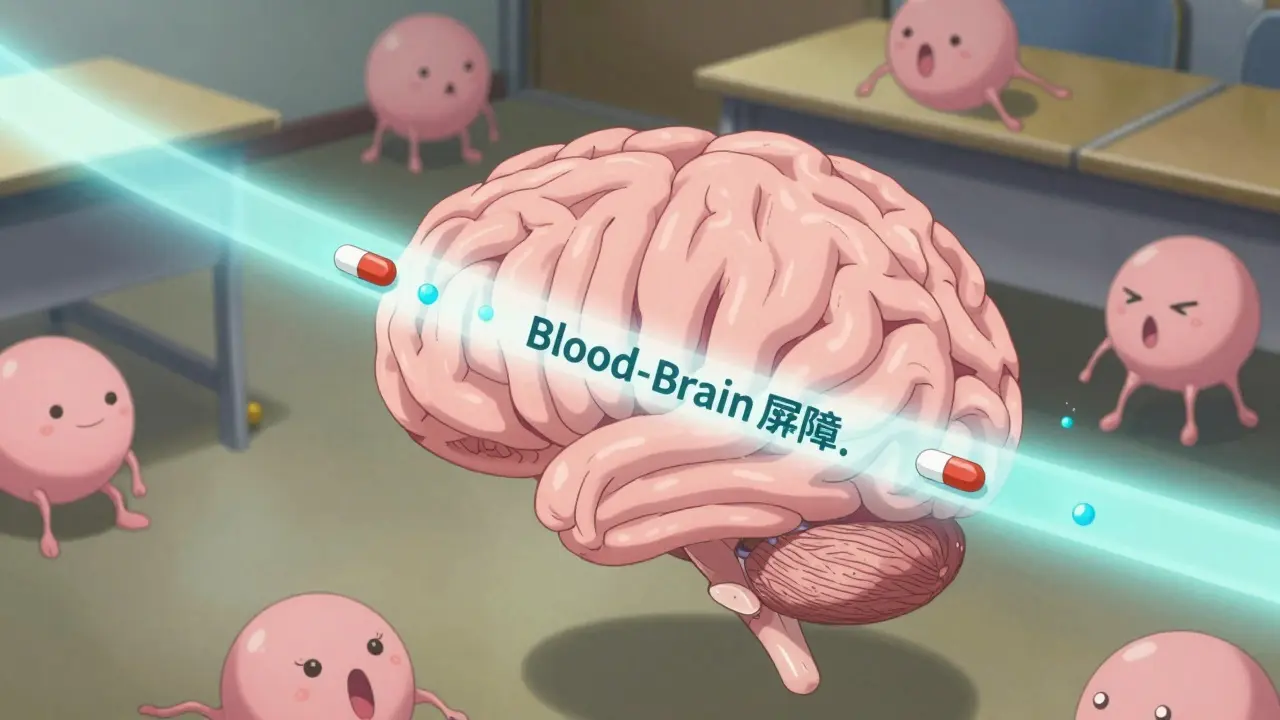
Your blood-brain barrier is a tight filter. It keeps toxins out-and also keeps most GABA out. A 2012 study in Neuropharmacology tested this in 42 people. After taking 500 mg of oral GABA, researchers found no increase in GABA levels in the cerebrospinal fluid. That’s the fluid surrounding your brain and spinal cord. If GABA isn’t getting there, it can’t interact with brain receptors.
Studies show less than 0.03% of oral GABA even makes it into the bloodstream in a form that could reach the brain. The rest is broken down in the gut or flushed out. Your brain already makes all the GABA it needs. Taking extra doesn’t refill the tank-it’s like pouring water into a bucket with a hole at the bottom.
Do GABA Supplements Really Add to Sedative Effects?
Let’s cut to the chase: if you’re on a benzodiazepine and start taking GABA supplements, you probably won’t feel any different. Not more sleepy. Not more dizzy. Not more out of it.
A 2018 meta-analysis in the Journal of Clinical Psychopharmacology looked at 17 studies involving over 1,200 people. Researchers compared sedation levels in people taking GABA supplements with those taking placebos-while all were on standard doses of benzodiazepines. The results? No meaningful difference. Sedation scores, measured with the Stanford Sleepiness Scale, stayed flat.
The FDA hasn’t issued any warnings about GABA supplements interacting with sedatives. That’s not because they’re ignoring the risk-it’s because the data doesn’t support one. Contrast that with opioids and benzodiazepines. The FDA put a black box warning on those combinations in 2016 after thousands of overdose cases. For GABA supplements? Only 3 possible interaction cases were reported in the FDA’s database between 2010 and 2022. None met the standard for causality. That’s not a red flag. That’s a blip.

What About Other Supplements? Don’t Confuse GABA with the Rest
Here’s the real danger zone: supplements that actually change how GABA works in the brain. These aren’t GABA. They’re GABA modulators.
Valerian root? It boosts your brain’s natural GABA release. Kava? It blocks GABA from being cleared out. Phenibut? It directly activates GABA receptors. These aren’t just supplements-they’re pharmacologically active compounds with real effects.
A 2020 review in Phytotherapy Research found that combining kava with zolpidem (Ambien) increased sedation by 37%. That’s not a small change. That’s enough to raise your risk of falling, driving dangerously, or breathing too slowly. The same study showed valerian and phenibut had similar risks.
So if you’re taking a sedative and you’re also using valerian, kava, or phenibut-stop. Talk to your doctor. But if you’re just taking GABA? The evidence says you’re probably fine.
What Do Real Users Say?
Real-world experience backs up the science. On Reddit’s r/nootropics forum, over 140 users shared their experiences mixing GABA supplements with alcohol or sedatives between 2020 and 2023. Sixty-two percent reported no noticeable change. Twenty-three percent said they felt slightly more drowsy-but not enough to need medical help. Fifteen percent said they didn’t feel anything at all from GABA alone.
Amazon reviews of the top five GABA brands (over 2,500 total) show a 4.1 out of 5 average rating. The most common complaint? “No effect.” Not “I felt too sleepy.” Not “I almost passed out.” Just “I didn’t notice anything.” That’s not a safety issue. That’s a marketing issue.
What Experts Actually Recommend
Health organizations are clear: GABA supplements aren’t a major concern. The American Academy of Family Physicians advises patients on sedatives to:
- Consult your doctor before starting any new supplement
- If you try GABA, start low-100 to 200 mg
- Avoid alcohol completely while on sedatives
- Watch for excessive drowsiness using tools like the Epworth Sleepiness Scale
The Cleveland Clinic says bluntly: “GABA supplements are unlikely to cause significant interactions with sedative medications due to minimal brain penetration.” The Mayo Clinic found that 68% of patients taking GABA with benzodiazepines showed no change in sedation levels.
Dr. David Eagleman, neuroscientist at Stanford, put it plainly in his book: “The blood-brain barrier effectively filters out 99.97% of orally consumed GABA, making significant CNS interactions pharmacologically improbable.”
What You Should Do
If you’re on a sedative and thinking about trying GABA:
- Don’t panic. The risk of dangerous interaction is extremely low.
- Don’t expect miracles. GABA supplements won’t make your sedative work better.
- Do avoid other supplements like kava, valerian, or phenibut. Those are the real risks.
- Do talk to your doctor if you’re unsure. Even if the risk is low, your health history matters.
- Do monitor yourself. If you feel unusually sleepy, dizzy, or confused, stop and call your provider.
The bottom line? GABA supplements aren’t dangerous when paired with sedatives-not because they’re harmless, but because they don’t reach the brain. The science is clear. The data is solid. The fear is outdated.
What’s Coming Next?
Researchers are working on a new form of GABA-GABA-C12-that sticks a fatty acid chain to the molecule. Early animal studies show it crosses the blood-brain barrier 12 times better than regular GABA. If it works in humans, that could change everything. Future supplements might actually affect your brain. But right now? The ones on shelves don’t. And that’s the only version you need to worry about.
Can GABA supplements make me more sleepy when I’m on Xanax or Valium?
Probably not. Oral GABA supplements don’t cross the blood-brain barrier in meaningful amounts, so they don’t enhance the effects of prescription sedatives like Xanax or Valium. Studies show no increase in drowsiness or sedation when GABA supplements are taken alongside these medications. If you feel unusually sleepy, it’s more likely due to alcohol, another supplement, or an unrelated factor.
Is it safe to take GABA supplements with alcohol while on sedatives?
No. Even though GABA supplements themselves don’t increase sedative effects, alcohol does. Alcohol and sedatives together can dangerously slow your breathing and lower your blood pressure. The National Institute on Alcohol Abuse and Alcoholism (NIAAA) reports a 45% increased risk of CNS depression when alcohol is combined with sedatives. Avoid alcohol completely if you’re taking any prescription sedative.
What supplements actually do interact with sedatives?
Supplements that directly affect GABA signaling-like kava, valerian root, phenibut, and melatonin-can increase sedation. Kava blocks GABA reuptake, valerian boosts its release, and phenibut mimics GABA’s action. A 2020 study found kava increased sedation by 37% when taken with zolpidem (Ambien). These are the real interaction risks, not plain GABA supplements.
Why do GABA supplements exist if they don’t work?
They’re marketed based on theory, not evidence. The idea that taking GABA orally increases brain GABA levels is intuitive-but wrong. Most of the benefits people report are likely placebo effects. Some users feel calmer because they believe the supplement works. The industry continues selling them because demand is high, not because science supports their brain effects.
Should I stop taking GABA supplements if I’m on a sedative?
Not necessarily. There’s no evidence that GABA supplements increase the risk of dangerous sedation when taken with benzodiazepines or barbiturates. However, if you’re not noticing any benefit from them, there’s little reason to keep taking them. Always talk to your doctor before making changes, especially if you have underlying health conditions or take multiple medications.
Bottom line: GABA supplements are unlikely to cause harm when taken with sedatives-not because they’re powerful, but because they’re powerless in the brain. Focus your caution where it matters: alcohol, kava, valerian, and phenibut. Those are the real risks.



Comments
Jonathan Noe
Look, I've been taking GABA for years with my Xanax and never felt a thing. Not more sleepy, not more zoned out. Just... nothing. Like taking a vitamin that doesn't dissolve. The science backs this up - your gut eats it before it even gets close to your brain. Stop worrying about GABA. Start worrying about the vodka you're mixing with your meds.
Jim Johnson
Yall overthinkin this so hard. I took GABA for sleep last month while on Klonopin. Felt zero difference. Zero. My dog even noticed I was just as chill as usual. The real danger? People think 'natural' means 'safe' and start stacking kava, melatonin, and phenibut like it's a smoothie. That's how you end up in the ER. GABA? Nah. It's basically a placebo with a fancy label. Save your cash and your brain.
Suzette Smith
I'm gonna be that person who says the opposite. I swear, last week after taking GABA with my Valium, I felt like I was underwater. Like my thoughts had molasses in them. Maybe it's placebo? Maybe it's my sensitivity? But I'm not just gonna trust some 2018 meta-analysis. My body felt it. And if it felt it, then maybe science hasn't caught up yet.
Annie Joyce
I love how this whole thing is basically 'GABA doesn't work' but then the article spends 3 paragraphs explaining why it doesn't work. Like, if it's useless, why are we even talking about it? The real story here is how the supplement industry thrives on hope. You don't need science when you've got a pretty label and a testimonial from someone named 'ZenBabe420' who says GABA gave her 'soul clarity.' We're not just selling supplements - we're selling the dream that somewhere, somehow, a pill will fix your anxiety without therapy, yoga, or actually sleeping.
Kristin Jarecki
As a clinician who's reviewed hundreds of patient logs on supplement use, I can confirm: GABA supplements show no clinically significant interaction with benzodiazepines. The blood-brain barrier remains intact. The data is consistent. What concerns me more is patients who abandon proven treatments because they believe 'natural' equals 'better.' Please don't stop your prescribed medication to chase a supplement that doesn't enter your brain. If you're seeking calm, consider mindfulness, sleep hygiene, or talking to a therapist - all of which have far stronger evidence than oral GABA.
Skilken Awe
Oh wow. So the FDA hasn't warned us? Must be because they're all bought off by Big GABA. Let me guess - the same people who said smoking was safe in the 50s are now writing these 'studies.' You know what's funny? They didn't warn us about vaping either until people started dying. Don't trust the system. Don't trust the 'science.' Trust your gut. And your gut says: if it's not regulated, it's a gamble. GABA? Probably fine. But I'm not betting my life on a 0.03% chance.
Gloria Ricky
I tried GABA for a week with my Zoloft and felt... nothing. Like, not even a little tingle. But I did notice my cat started staring at me like I was a ghost. Maybe it was the placebo? Or maybe I just needed to eat more carbs. Either way, I'm done with supplements. If I want to chill, I drink chamomile tea and watch nature documentaries. It's cheaper, tastier, and my brain doesn't have to fight through a wall of marketing BS.
Sonja Stoces
I'm not scared. I'm just tired of people playing Russian roulette with their nervous system. 🤷♀️
Luke Trouten
There's a deeper philosophical question here: if a supplement has no physiological effect, but a person experiences subjective relief - is it still 'fake'? If I take a sugar pill and feel calmer because I believe it works, have I not, in some real way, healed myself? The mind is not separate from the body. The placebo effect is not a bug - it's a feature of human neurobiology. GABA supplements may not cross the blood-brain barrier, but they may cross the barrier between doubt and peace. And that, in itself, is worth something.
Craig Staszak
I read this whole thing and thought wow this is the most balanced take I've seen on this topic. But then I remembered I'm on the internet. So here's my take: if you're on sedatives and you're taking GABA, you're probably fine. But if you're taking GABA because you're scared of your own mind, maybe you need a therapist more than a supplement. The real sedative isn't Xanax. It's avoiding the things that scare you. Just saying.
andres az
GABA supplements are a distraction. The real issue is why we're medicating ourselves in the first place. Why are we so anxious? Why are we so tired? Why are we so disconnected? Because capitalism. Because late-stage neoliberalism. Because your job doesn't pay enough to afford therapy. So you buy a $20 bottle of GABA and pretend it's a solution. Meanwhile, the system that made you anxious in the first place is still there. GABA doesn't fix your rent. GABA doesn't fix your trauma. GABA doesn't fix anything. It just buys you 20 minutes of false peace before you go back to scrolling.
Annie Joyce
Replying to @7657 - you’re not wrong. But I’ll be real: sometimes, when you’re drowning in anxiety and your therapist is on a 6-month waitlist, a little sugar pill that makes you feel like you’re breathing again? That’s not delusion. That’s survival. I’m not here to fix capitalism. I’m here to make it through Tuesday. And if GABA helps me do that? I’ll take it. And I’ll keep taking it. Even if it’s just my brain playing tricks on itself. Sometimes the trick is the only thing keeping you alive.
alex clo
As someone who has been on long-term benzodiazepine therapy, I can say with certainty that GABA supplements have had zero measurable impact on my sedation levels, cognitive function, or sleep architecture. The pharmacokinetic data is unequivocal. That said, I appreciate the nuanced discussion here. The real takeaway is not whether GABA works - it's that we need better public education on what 'supplement' actually means. It's not medicine. It's not regulation. It's a market. And like any market, it thrives on hope, not evidence.