

Why Exercise Can Drop Your Blood Sugar Too Low
Working out is one of the best things you can do for diabetes management. It helps your body use insulin better, lowers blood sugar, and improves energy. But for many people with diabetes - especially type 1 - the fear of crashing during a workout is real. About half of adults with type 1 diabetes avoid exercise because they’re scared of going too low. And it’s not just fear. It’s happened to them before. You start a run, a swim, or even a brisk walk, and suddenly you’re shaking, sweating, dizzy. Your glucose meter reads 62 mg/dL. That’s not just inconvenient. It’s dangerous.
The problem isn’t that exercise is bad. It’s that your body responds to movement in ways that aren’t always predictable. When you move, your muscles grab glucose from your blood - even without insulin. That’s great for lowering high sugar. But if you’ve taken insulin earlier, or if your body is extra sensitive after a previous workout, that glucose grab can go too far. Blood sugar can drop during the workout, or even hours later, sometimes while you’re asleep.
When to Check Your Blood Sugar Before Exercising
Checking your glucose before you start is non-negotiable. Don’t skip it. The American Diabetes Association says to check 15 to 30 minutes before you begin. But here’s what most people miss: you need to check again if you’re doing a long session, or if you’re feeling off. And you need to check after, too. Hypoglycemia doesn’t always happen during exercise. It often shows up 6 to 12 hours later, especially after afternoon or evening workouts.
Here’s what your numbers mean:
- Below 70 mg/dL: Stop. Eat 15 grams of fast-acting carbs (glucose tabs, juice, candy). Wait 15 minutes. Check again. Don’t start exercising until you’re above 90.
- 70-90 mg/dL: You’re in the danger zone. Eat 15-30 grams of carbs before starting. Consider reducing your insulin dose if you’re on a pump or MDI.
- 90-150 mg/dL: Safe to start, but you’ll likely need carbs during longer sessions. Aim for 0.5-1.0 gram of carbs per kilogram of body weight every hour.
- 150-180 mg/dL: Ideal for high-intensity workouts. Some experts, like Dr. Anne Peters, say this range helps prevent drops during sprints, HIIT, or heavy lifting.
And don’t forget insulin-on-board (IOB). If you took a bolus 2 hours ago and still have 2 units of active insulin, that’s like having 3-4 units working during exercise. That’s a recipe for a crash. Use your pump or app to calculate IOB. If it’s over 1.5 units, think twice before starting.
What to Eat Before and During Workouts
Carbs aren’t just for when you’re low. They’re a tool to keep you stable. The amount you need depends on your weight, your workout, and your insulin levels.
For a 70 kg person (about 154 lbs):
- If your glucose is 85 mg/dL before a 45-minute bike ride: eat 35-70 grams of carbs (that’s 0.5-1.0 g/kg). A banana, a slice of toast with peanut butter, or 4 glucose tabs will do.
- If you’re doing 90 minutes of swimming: eat 15-20 grams before, and another 15 grams every 30-45 minutes during.
Choose carbs that digest at the right speed. Fast-acting glucose tabs or juice work best for quick fixes. For longer sessions, pair carbs with a little protein or fat - like a handful of nuts or a small yogurt - to slow absorption and avoid spikes.
And here’s a trick many don’t know: if you’re doing a morning workout and took insulin the night before, your body might still be sensitive. Even if your glucose is 120 mg/dL, you might still need 10-15 grams of carbs before you start. Don’t assume you’re fine just because you’re not low.
Best Types of Exercise for Avoiding Lows
Not all workouts are created equal when it comes to blood sugar. Some cause big drops. Others help you stay stable - or even raise your glucose.
Aerobic exercise - like running, cycling, or swimming - tends to lower blood sugar steadily. The longer and harder you go, the more your glucose drops. This is where most people crash.
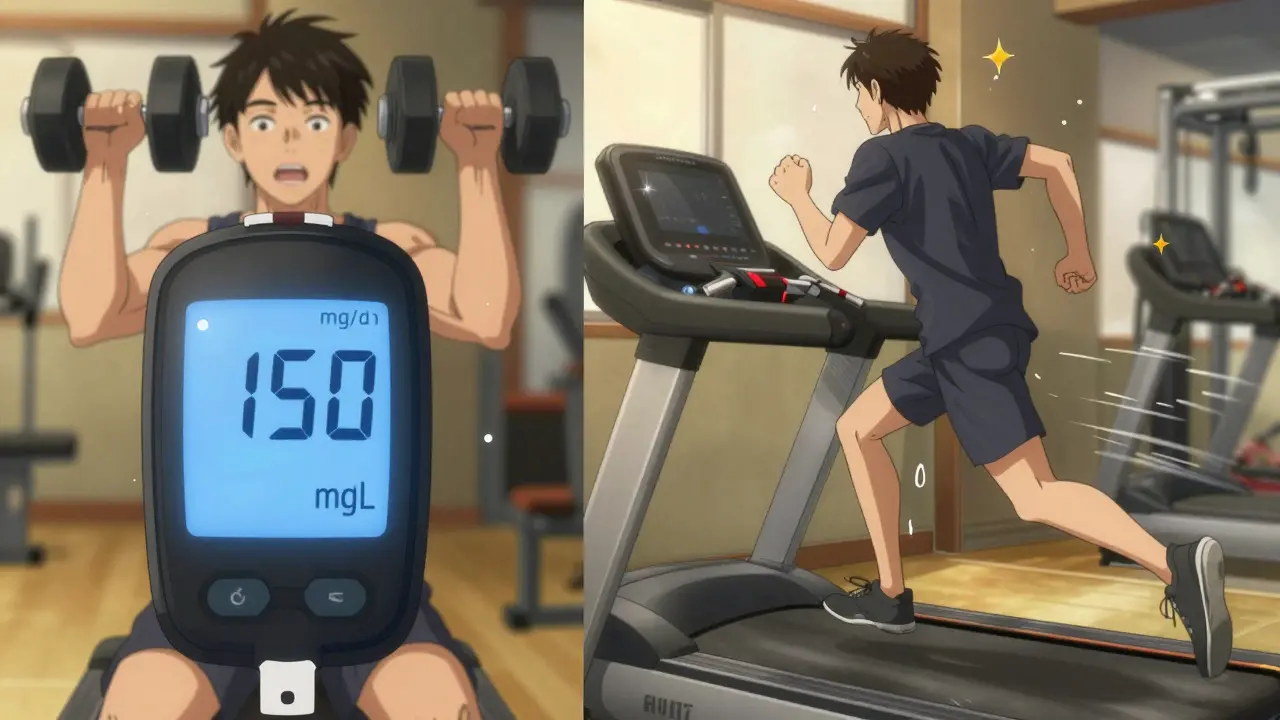
Resistance training - lifting weights, bodyweight exercises - often raises or stabilizes glucose. Why? Because it triggers stress hormones like adrenaline, which push sugar into the blood. A 2018 study showed that doing 45 minutes of strength training before 45 minutes of cardio cut glucose drops in half. Do squats, push-ups, or dumbbell rows first. Then go for your run.
High-intensity interval training (HIIT) - short bursts of all-out effort - is surprisingly protective. A 10-second sprint before your workout can block a drop. One user on Diabetes Daily said adding a 10-second bike sprint before his 30-minute ride cut his lows from four times a week to once every two weeks.
Circuit training - quick sets with little rest - can be risky. It’s a mix of cardio and strength, but the constant movement and lack of recovery can cause unpredictable drops. If you do circuits, check glucose every 20 minutes.
Try this routine: Start with 10-15 minutes of resistance exercises. Then do 20-30 minutes of moderate cardio. Finish with a 10-second all-out sprint. It’s not just effective - it’s backed by science.
How to Adjust Your Insulin for Workouts
If you use insulin, you have tools to prevent lows - but you need to use them right.
For pump users: Reduce your basal rate. The ADA recommends dropping it by 50-75% starting 60-90 minutes before moderate exercise. If you’re doing HIIT or resistance training, a 30-50% reduction might be enough. Don’t turn it off completely - you still need background insulin.
For MDI users (multiple daily injections): Reduce your pre-workout bolus by 25-50%. If you usually take 4 units for breakfast and plan to run after, take 2-3 instead. Or skip the bolus entirely if your glucose is already in the 100-130 range.
And here’s the key: timing matters. If you always work out at 6 p.m., your body learns that pattern. If you suddenly do it at 8 a.m., your insulin sensitivity changes. Stick to consistent times when you can. That’s how you build predictability.
Why Your Blood Sugar Might Crash Hours Later
One of the biggest surprises for people with diabetes? The crash doesn’t always come during the workout. It can hit at 2 a.m.
After exercise, your muscles are hungry. They keep pulling glucose from your blood for up to 72 hours. That’s why you might feel fine after your run, but wake up at 5 a.m. with a reading of 58 mg/dL.
This is called delayed-onset hypoglycemia. It affects 70% of people with type 1 diabetes after exercise. And it’s the main reason people have nighttime lows.
How to prevent it:
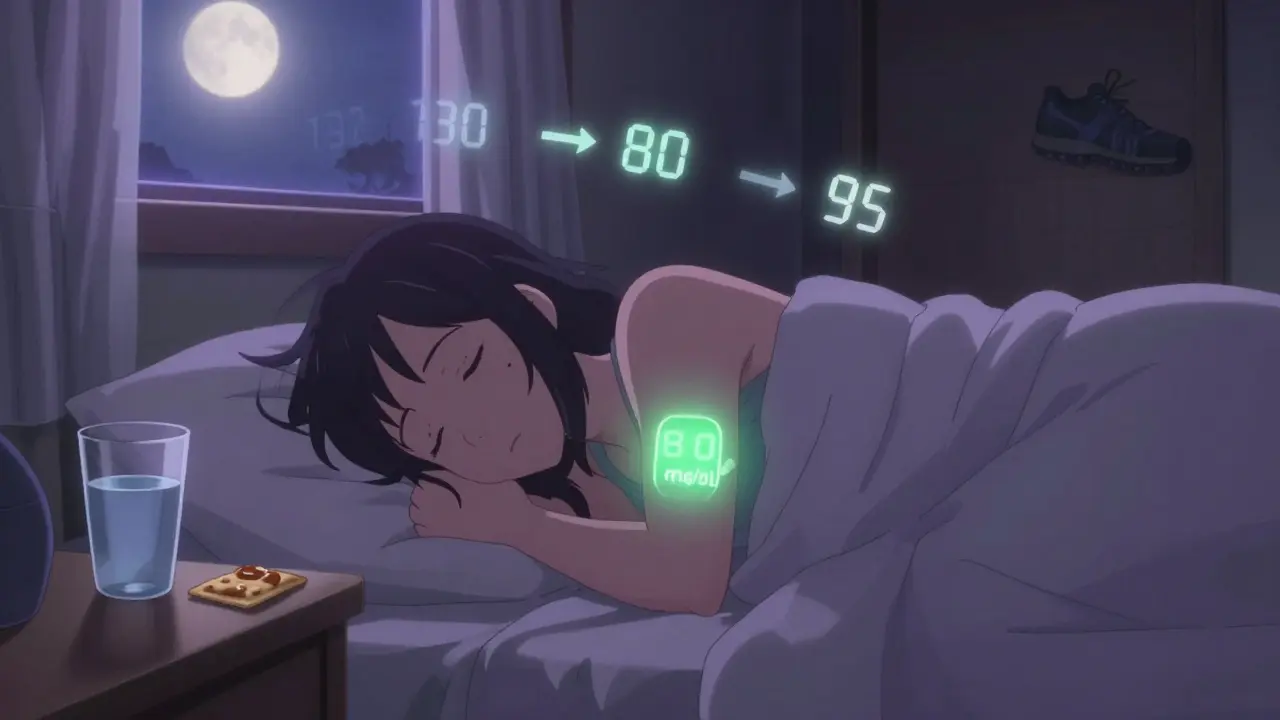
- Check your glucose before bed. If it’s below 130 mg/dL, eat a snack with 15 grams of carbs and a little protein - like a tablespoon of peanut butter on a cracker, or a small cup of cottage cheese.
- If you used a lot of insulin during the day, consider a 10-20% reduction in your nighttime basal rate.
- Use your CGM’s overnight alerts. Set a low alert at 80 mg/dL so you wake up before you crash.
How Technology Is Making It Easier
Technology isn’t just helping - it’s changing the game.
Modern CGMs like the Dexcom G7 have an “exercise mode.” When it detects movement, it lowers alert thresholds by 20 mg/dL. So instead of alerting at 70, it waits until 50 - giving you more time to react before a true low.
Pumps like the Tandem t:slim X2 now have an “Exercise Impact” feature. It uses machine learning to predict your glucose drop based on your workout history, insulin on board, and current trends. It automatically reduces insulin delivery - no manual adjustments needed.
And the future? Closed-loop systems that deliver glucagon during exercise. The NIH is testing a dual-hormone artificial pancreas that can raise blood sugar when it senses a drop. Early results show 52% fewer lows during workouts.
Right now, 68% of people with CGMs check their glucose before exercise. Only 42% of non-CGM users do. The gap isn’t just about tech - it’s about safety.
What to Do When Things Go Wrong
Even with all the planning, things can still go sideways. You’ll have a bad day. Your glucose might drop despite your best efforts. That’s okay. Here’s how to recover:
- Stop exercising immediately.
- Consume 15 grams of fast-acting carbs. Glucose tabs are best - they’re measured, fast, and easy.
- Wait 15 minutes. Check again.
- If still low, repeat. Don’t start back up until you’re above 90.
- After recovery, eat a small snack with protein and complex carbs to prevent a rebound.
And if you’re alone? Always carry glucose. Wear a medical ID. Tell someone where you’re going and when you’ll be back. Don’t be proud. Safety isn’t optional.
How Long It Takes to Get Good at This
There’s no magic fix. Mastering exercise with diabetes takes time - usually 3 to 6 months. You’ll have highs. You’ll have lows. You’ll do the same workout twice and get two totally different results. That’s normal.
One user on Reddit said: “I did the same 5K run at the same time of day with the same insulin on board - one day I was 70, the next I was 180. It’s incredibly frustrating.”
That’s not you failing. That’s your body being complex. The goal isn’t perfection. It’s pattern recognition. Keep a log. Note your workout, your glucose before and after, your carbs, your insulin, your sleep, your stress. After a few weeks, you’ll start seeing trends. You’ll know that on Tuesdays, you need extra carbs after yoga. That on weekends, your basal is more sensitive. That after a heavy leg day, you need a bedtime snack.
Progress isn’t linear. But it’s real. And every workout you complete without a low is a win.





Comments
Andrew Freeman
nah u dont need all this math just eat a banana and go. my sugar does whatever it wants anyway
Vicky Zhang
I just want to say YOU ARE DOING AMAZING!!! Seriously, taking the time to learn this stuff, checking your numbers, planning your snacks, staying safe - it’s not easy but you’re showing so much strength. Every time you lace up your shoes even when you’re scared, you’re winning. I’ve been there, I’ve crashed at 2 a.m. too, and I cried. But you keep going. And that’s what matters. You got this. I’m rooting for you. 💪❤️
Susie Deer
this whole post is american corporate diabetes propaganda. in my country we just eat real food and work hard. no apps no pumps no carbs before running. you people are weak
TooAfraid ToSay
you think this is complicated? try being black and diabetic in america. no insurance no glucose tabs no one cares if you crash at 3 a.m. they just call an ambulance and bill you $20k. this whole post is a luxury. i work two jobs and i still have to guess my sugar. your advice is nice but it’s for people who can afford to care
Robert Way
i tried the 10 sec sprint thing but i think i did it wrong cause i passed out and my phone fell in the pool. now i have a new phone and a new fear of water. also i think my insulin is haunted
Sarah Triphahn
let me break this down for you: you're not managing diabetes, you're performing it. every carb count, every bolus, every CGM alert - it's just performance art for the medical-industrial complex. you think you're in control? you're just a data point in a pharmaceutical marketing funnel. wake up. your body doesn't need algorithms. it needs silence. and maybe a good cry.
Allison Deming
It is deeply irresponsible to encourage individuals with type 1 diabetes to engage in physical activity without first addressing the systemic failures of healthcare access, insulin affordability, and the psychological toll of constant self-monitoring. To frame exercise as a personal responsibility - as if the only barrier to safety is a lack of glucose tabs - is not just naive, it is morally indefensible. The burden should not fall on the patient to outsmart a broken system.
Jason Yan
I’ve been doing this for 12 years and honestly? The biggest thing I learned isn’t about carbs or insulin - it’s about listening. Not just to your meter, but to your body. Some days you feel fine at 110 and you’re golden. Other days you’re at 140 and your legs are screaming. It’s not always math. Sometimes it’s magic. Or muscle memory. Or just plain luck. I keep a journal, not because I need to track, but because I need to remember: I’ve survived this before. I’ll survive it again. And that’s enough.
Dylan Livingston
Oh wow. Another beautifully curated guide to managing a chronic illness with the precision of a Silicon Valley startup. Let me guess - you also meditate with your CGM and journal your insulin-to-carb ratios in a bullet journal with gold foil accents? I’m sure your 10-second sprints are sponsored by Dexcom and your bedtime snack is artisanal almond butter on sourdough baked by your yoga instructor. Meanwhile, I’m eating a bag of gummy bears at 2 a.m. while my pump beeps at me like a broken alarm clock. Thanks for the performative wellness, Sarah.
says haze
The irony is that this entire framework assumes metabolic stability as a baseline. But for many, especially those with insulin resistance or autoimmune comorbidities, the concept of 'predictable glucose response' is a myth. The science here is surface-level. It ignores circadian rhythms, cortisol spikes from stress, sleep deprivation, and gut microbiome variability. You’re treating diabetes like a thermostat when it’s a weather system. No algorithm can account for trauma. No app can fix poverty. And no 10-second sprint will silence the systemic noise.
Sarah -Jane Vincent
this is all a lie. the government and big pharma made diabetes worse so they could sell you sensors and insulin. they want you dependent. the real cure is fasting and drinking apple cider vinegar. i lost my diabetes by not eating for 4 days. they don't want you to know this. check the cia files. i've seen the documents
Henry Sy
man i tried the whole resistance-before-cardio thing and ended up in the ER because i thought 'i got this' and didn't eat enough. now i got a $12k bill and a new rule: if my sugar's below 150, i don't move. period. i used to be a runner. now i'm a couch philosopher who stares at his glucose graph like it's the meaning of life. sometimes i cry. sometimes i eat a whole bag of sour patch kids. i don't judge myself anymore. i just survive.