
Imagine having a target number for your blood sugar if you had diabetes. You check it, adjust your meds, and keep it in range to stay healthy. Gout is a form of inflammatory arthritis caused by high levels of uric acid in the blood, leading to painful crystal deposits in joints. It works the same way. For years, doctors treated gout like a series of random attacks-just painkillers when it flared up. But modern medicine has shifted. Now, we have specific urate targets that act as a finish line. Hit that number, and the crystals dissolve. Miss it, and the pain comes back.
The big question isn't just "should I take medication?" It's "what number am I aiming for, and which drug gets me there safely?" This guide breaks down the science behind serum urate concentration goals, compares the two main drugs-Allopurinol and Febuxostat-and explains how to actually reach those targets without getting discouraged by early setbacks.
Why the Number Matters: The Saturation Point
To understand why we need a target, you have to look at what gout actually is. It’s not just "high uric acid." It’s about saturation. Think of your blood like water and uric acid like salt. If you keep adding salt, eventually, the water can’t hold any more. The extra salt crashes out of the solution and forms solid crystals. In your body, these are monosodium urate crystals, and they love to settle in your joints.
The magic number where this happens is approximately 6.8 mg/dL (0.40 mmol/L). Above this level, new crystals form. Below it, existing crystals start to dissolve. That’s why every major guideline-the American College of Rheumatology (ACR), NICE in the UK, and EULAR in Europe-agrees on one core rule: you must get your serum urate below the saturation point to stop the disease from progressing.
- Saturation Point: ~6.8 mg/dL (0.40 mmol/L)
- Standard Target: <6.0 mg/dL (360 micromol/L or 0.36 mmol/L)
- Severe Gout Target: <5.0 mg/dL (300 micromol/L or 0.30 mmol/L)
- Floor Limit: Do not go below 3.0 mg/dL (180 micromol/L)
Why aim for less than 6.0 mg/dL if saturation is 6.8? Because you need a buffer. Just like you wouldn't drive exactly at the speed limit all day, you want a safety margin to ensure no new crystals form during daily fluctuations. For people with severe gout-meaning visible lumps called tophi are hard deposits of urate crystals under the skin, often near joints, indicating chronic untreated gout, joint damage, or frequent flares-the goal drops even lower to <5.0 mg/dL. This stricter target helps dissolve those stubborn tophi faster.
Allopurinol vs. Febuxostat: Choosing Your Engine
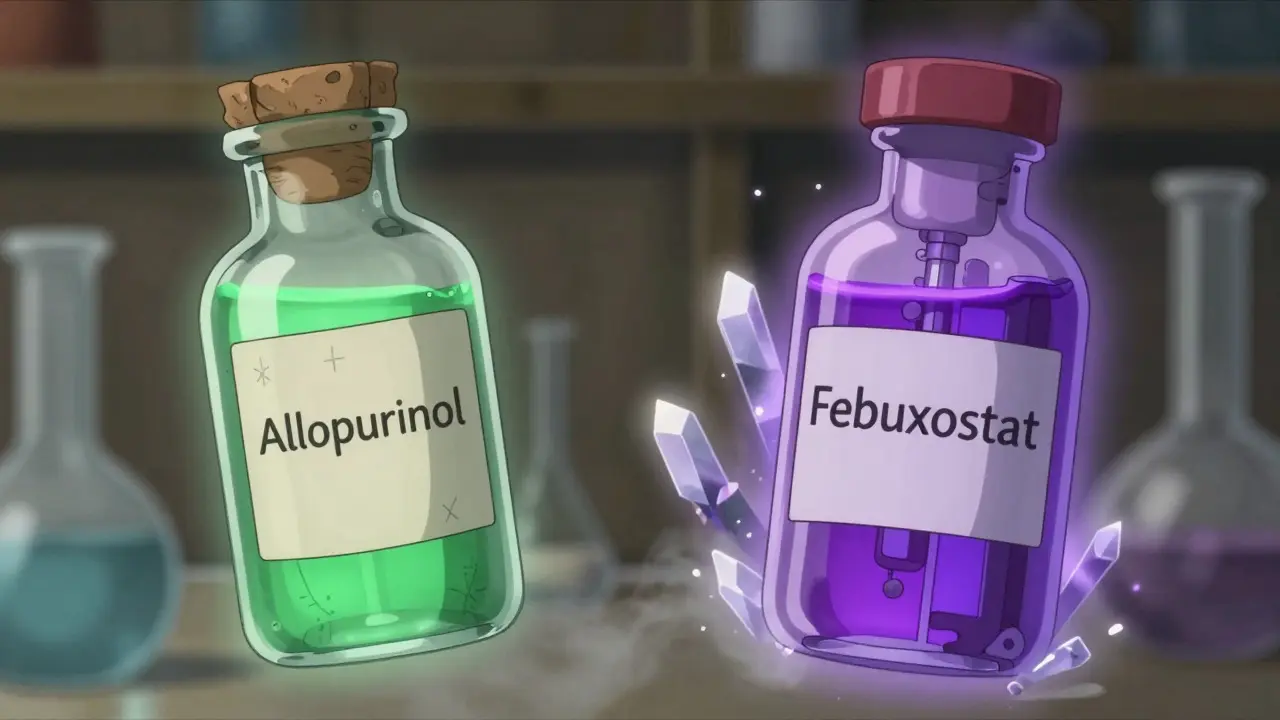
Once you know the target, you need a vehicle to get there. The two most common engines for lowering urate are Allopurinol and Febuxostat. Both work by blocking xanthine oxidase, the enzyme that makes uric acid. But they have different profiles.
| Feature | Allopurinol | Febuxostat |
|---|---|---|
| First-Line Status | Preferred by ACR and EULAR | Equal option per NICE; alternative per others |
| Starting Dose | ≤100 mg/day (lower if kidney issues) | ≤40 mg/day |
| Max Dose | Up to 800 mg/day (in normal kidneys) | 80 mg/day |
| Kidney Function | Dose adjustment needed for CKD ≥3 | No adjustment needed; better for severe CKD |
| Cost (US Approx.) | $4-$12/month | $30-$50/month |
| Key Risk | Hypersensitivity syndrome (rare but serious) | Cardiovascular events (monitor closely) |
Allopurinol is a purine analog that inhibits xanthine oxidase, reducing uric acid production, and is the most widely prescribed first-line treatment for gout globally. It’s cheap, effective, and has decades of safety data. However, it requires careful dosing based on kidney function. If you have Chronic Kidney Disease (CKD), you start low (often 50 mg) and go slow. Many patients fail here because they think 100 mg is the max dose. It’s not. Studies show 30-50% of patients need doses over 300 mg to hit their target, and some need up to 600-800 mg if their kidneys are healthy.
Febuxostat is a non-purine selective inhibitor of xanthine oxidase, offering an alternative for patients who cannot tolerate allopurinol or have significant kidney impairment. It doesn’t rely on the kidneys for clearance, making it safer for people with advanced kidney disease. A 2023 meta-analysis found it helped 15% more patients reach targets in severe CKD cases compared to allopurinol. But it’s more expensive, and there’s been ongoing debate about heart health risks, so doctors monitor cardiovascular history carefully before prescribing it.
The Strategy: Start Low, Go Slow, Test Often
Here is where most people get stuck. They start the pill, feel fine, and never check their blood again. Then six months later, they have another flare. Why? Because they never reached the target. Urate-lowering therapy (ULT) is not a set-and-forget process. It’s a titration journey.
The golden rule is: Start low, go slow, test monthly.
- Initiation: Start with a low dose (e.g., 100 mg Allopurinol or 40 mg Febuxostat).
- Monitoring: Check serum urate levels every 2-4 weeks.
- Titration: If you’re not at <6.0 mg/dL, increase the dose by 50-100 mg increments.
- Maintenance: Once you hit the target, switch to testing every 3-6 months to ensure you stay there.
Data from New Zealand shows only 42% of patients hit their target within the first year. Why? Because many doctors prescribe a fixed dose and walk away. Real-world evidence proves that active management-calling you every month to adjust the dose-boosts success rates significantly. Don’t be afraid to ask your doctor for a titration schedule. Say, "When do we recheck my levels to see if I need a higher dose?"
Navigating the Flare Paradox
You might hear this advice and think, "If I raise my dose, won’t that cause more pain?" Surprisingly, yes-at first. This is called the "flare paradox." When you lower urate levels quickly, the crystals in your joints start to shift and dissolve. Your immune system sees this movement as an attack and triggers inflammation. It’s ironic: the medicine is working, but it hurts while it does.
This is why guidelines recommend taking prophylactic anti-inflammatory medication (like colchicine or NSAIDs) alongside your ULT for the first 3-6 months. It shields you from these initial flares. Community feedback from support groups reveals that 78% of patients need more than six months to fully stabilize, and 43% require high doses of Allopurinol (>400 mg). If you flare up after increasing your dose, don’t stop the ULT. Stick with it, manage the inflammation, and keep pushing toward the target. Stopping resets the clock.

Who Needs Treatment? Asymptomatic Hyperuricemia
A common confusion is whether you need treatment if you have high uric acid but no pain. This is called asymptomatic hyperuricemia. The 2020 ACR Guidelines say: generally, no. Unless you have other risk factors like kidney stones or very high levels, just watching your diet and numbers is usually enough. However, if you’ve had even one gout flare, you likely need ULT. The definition of gout changes once the first crystal deposit causes pain. After that, the goal shifts from prevention to dissolution.
Future Directions and Precision Medicine
We are moving toward smarter treatments. Recent studies, like the 2024 GOUT-PRO study, show that genetic testing can help predict how well you’ll respond to Allopurinol. Genes like ABCG2 affect how your body handles uric acid. In the future, your prescription might come with a genetic profile to tailor the exact dose from day one, rather than guessing through trial and error. Until then, the "treat-to-target" approach remains the gold standard.
The market is also evolving. With new drugs in development and better guidelines, the hope is that fewer people live with chronic gout pain. But right now, the power is in your hands-and your blood tests. Know your number. Aim for <6.0 mg/dL. And don’t settle for less.
What is the ideal serum urate level for gout?
For most patients, the target is below 6.0 mg/dL (360 micromol/L). For those with severe gout, such as tophi or joint damage, the target is lower, below 5.0 mg/dL (300 micromol/L). Levels should rarely drop below 3.0 mg/dL.
Should I take Allopurinol or Febuxostat?
Allopurinol is typically the first choice due to its cost-effectiveness and long-term safety data. Febuxostat is preferred for patients with moderate to severe kidney disease or those who cannot tolerate Allopurinol. Discuss your kidney function and heart health with your doctor to decide.
How long does it take to reach the urate target?
It varies, but many patients require 6 months or more of dose titration. Regular blood tests every 2-4 weeks are essential to adjust the dose until the target is met. Do not assume the starting dose is sufficient.
Will lowering urate cause more gout flares?
Yes, initially. Dissolving crystals can trigger inflammation. This is why doctors prescribe anti-inflammatory cover (like colchicine) for the first few months of treatment. Continue your urate-lowering medication despite these flares.
Do I need treatment if I have high uric acid but no pain?
Generally, no. Major guidelines like the ACR do not recommend urate-lowering therapy for asymptomatic hyperuricemia unless there are complicating factors like recurrent kidney stones. Focus on lifestyle changes instead.