
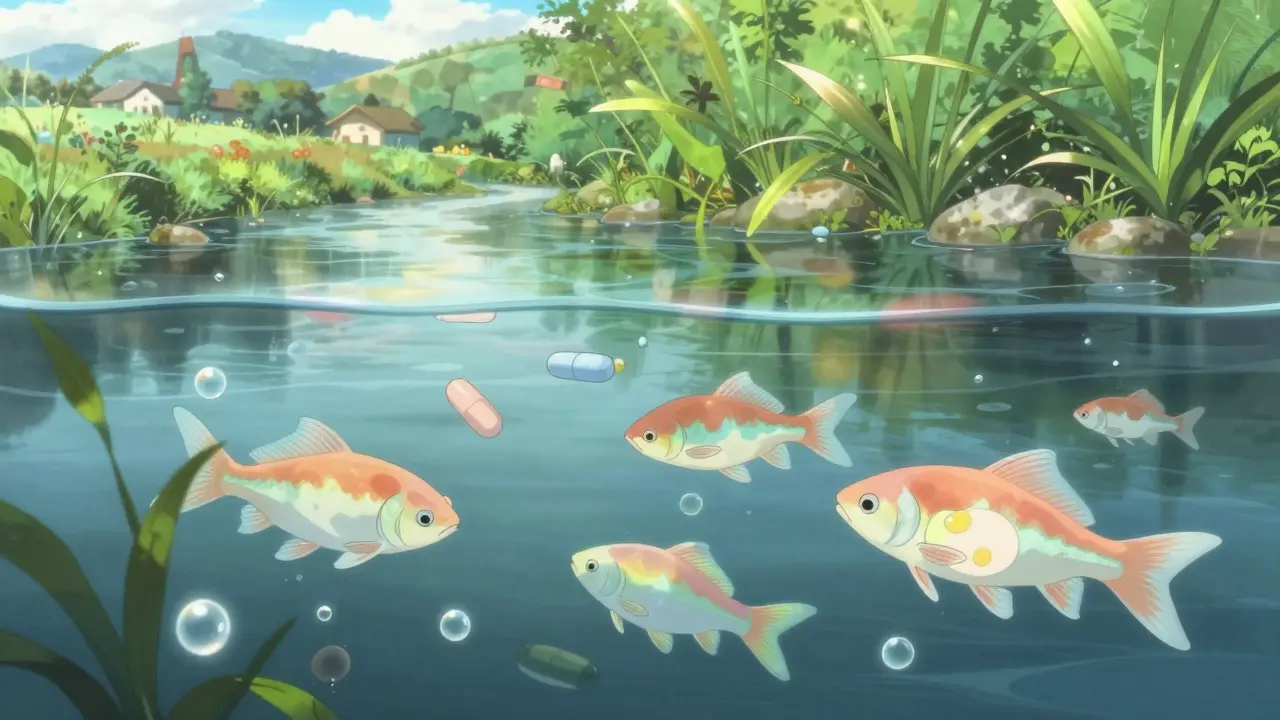
Every year, millions of unused pills, liquids, and patches end up in toilets, sinks, or trash cans across the UK and beyond. It’s easy to think: It’s just medicine. It’ll wash away. But that’s not true. When you flush a painkiller, an antibiotic, or a blood pressure pill, you’re not just getting rid of it-you’re sending it straight into rivers, lakes, and eventually, drinking water.
What Happens When You Flush Medications?
Pharmaceuticals don’t disappear in the sewer system. Wastewater treatment plants were never built to remove drugs. They’re designed to catch solids, kill bacteria, and remove nutrients-not tiny chemical molecules like ibuprofen, fluoxetine, or metformin. These compounds slip right through, entering rivers, streams, and groundwater. A 2002 USGS study found traces of over 80 different pharmaceuticals in 80% of U.S. waterways. Similar findings have since been confirmed in the UK, the EU, and even remote mountain lakes. The problem isn’t just detection-it’s impact. Fish in contaminated rivers show signs of hormonal disruption: male fish developing eggs, altered mating behaviors, and reduced fertility. Studies in the River Thames and other UK waterways have detected estrogen-like compounds from birth control pills, leading to feminization in fish populations. Antibiotics in water contribute to the rise of drug-resistant bacteria-what scientists call antimicrobial resistance (AMR). This isn’t a future threat. It’s happening now, and it’s making infections harder to treat in humans too. Even when medications aren’t flushed, they still pollute. Throwing them in the trash means they end up in landfills. Rainwater washes through these sites, picking up chemicals and carrying them into soil and groundwater. One study found acetaminophen levels in landfill leachate as high as 117,000 nanograms per liter-far beyond what any treatment plant can handle.Why Isn’t This Common Knowledge?
For years, the advice was simple: if you don’t need your medicine, flush it. The FDA even had a list of drugs you were told to flush immediately-mainly powerful opioids like fentanyl and oxycodone-to prevent accidental poisoning or misuse. That list still exists, but it’s tiny: only about 15 medications out of thousands. Most people don’t know that. A 2021 FDA survey found only 30% of Americans knew about take-back programs. In the UK, awareness is similarly low. Many assume flushing is the safest or most hygienic option. Social media has helped change that. Reddit threads like r/ZeroWaste and r/Environment are full of people sharing stories like: “I had no idea flushing meds was bad until I saw a video of fish with eggs. Now I drive 20 minutes to drop off my old pills.” But convenience still wins. If there’s no collection point nearby, people will do what’s easiest-even if it’s harmful.What Should You Do Instead?
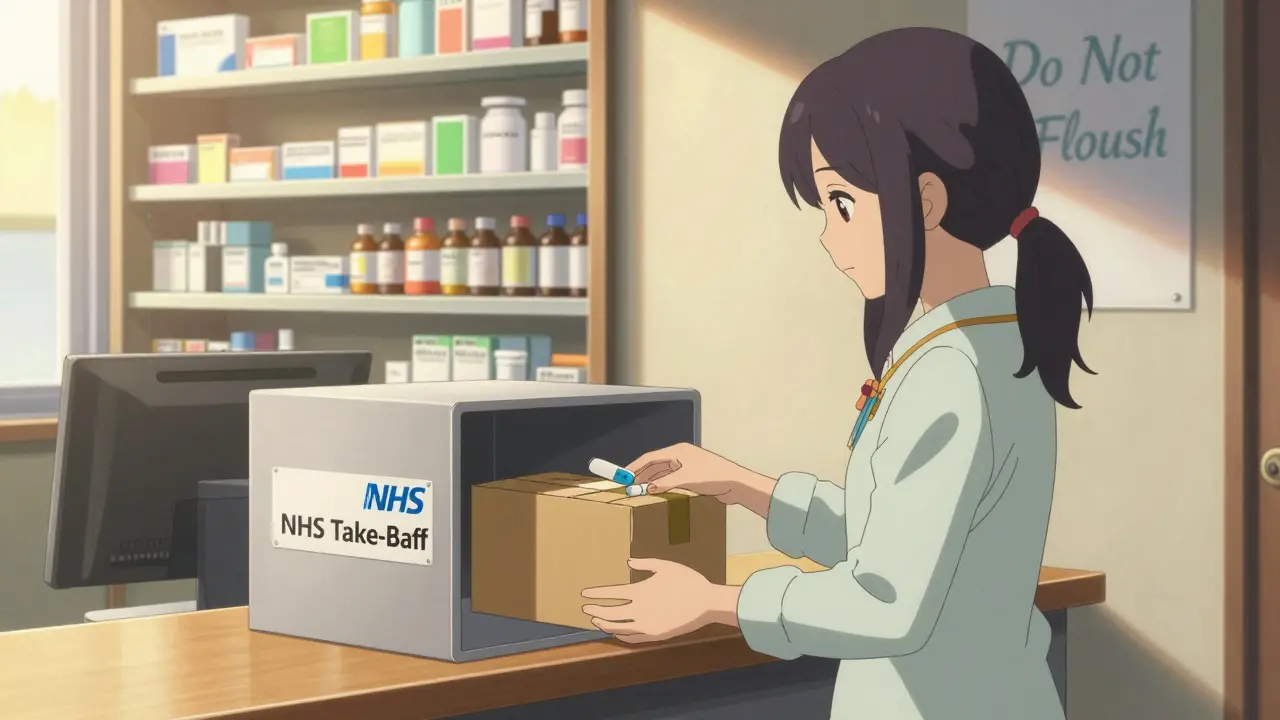
The best solution? Take-back programs. These are secure drop-off locations-usually at pharmacies, hospitals, or police stations-where you can hand over expired, unwanted, or unused medications. The drugs are collected and incinerated under controlled conditions, preventing them from entering water or soil. In the UK, many pharmacies participate in the NHS’s medication return scheme. You can walk in with your old pills, no questions asked. Some local councils also host annual collection events. If you’re in Bristol, check with your local pharmacy or visit the NHS website for nearest drop-off points. You don’t need a receipt. You don’t need to be the original patient. You just need to bring the meds. If no take-back option is available, the EPA and UK Environment Agency recommend a safe at-home method:- Take the medication out of its original container.
- Mix it with something unappealing-used coffee grounds, cat litter, or dirt.
- Place the mixture in a sealed plastic bag or container.
- Throw it in the household trash.
What About the FDA’s Flush List?
The FDA still maintains a short list of medications that, due to high risk of overdose or abuse, should be flushed if no take-back option is immediately available. These include:- Fentanyl patches
- Oxycodone (OxyContin, Percocet)
- Hydrocodone (Vicodin)
- Tapentadol (Nucynta)
- Buprenorphine (Suboxone)
Why Don’t We Have More Take-Back Locations?
It’s not for lack of need. It’s for lack of funding and infrastructure. In the UK, take-back programs are voluntary and patchy. Unlike the EU, where Extended Producer Responsibility (EPR) laws require drug manufacturers to pay for collection and disposal, the UK has no such mandate. Pharmacies aren’t paid to run these programs, so participation is inconsistent. In the U.S., the Secure and Responsible Drug Disposal Act of 2010 allowed pharmacies to set up drop boxes, but only 2,140 collection sites existed nationwide as of 2023-mostly in cities. Rural areas are left behind. The same pattern exists in parts of the UK. If you live outside a major town, you might need to drive 30 miles or more to find a drop-off point.What’s Being Done to Fix This?
Change is coming, but slowly. In England, the NHS is piloting more pharmacy-based collection points. Scotland has launched a national take-back initiative. California passed SB 212 in 2024, requiring pharmacies to provide disposal instructions with every prescription. The EU now requires all new drugs to undergo environmental risk assessments before approval. Some companies are developing at-home deactivation kits-chemical pouches that break down medications safely. But they’re expensive ($30+ per kit) and not widely available. The real solution isn’t tech-it’s access. More drop-off locations. Clearer labeling on packaging. Better public education.What Can You Do Today?
You don’t need to wait for policy changes. Start with your own medicine cabinet.- Check your cabinets twice a year. Toss expired or unused meds.
- Don’t stockpile. Only order what you need.
- Ask your pharmacist: “Where can I safely return these?”
- If you’re unsure whether to flush, assume you shouldn’t.
- Spread the word. Tell friends, family, your book club, your gym group.
What About Over-the-Counter Drugs?
Same rules apply. Ibuprofen, acetaminophen, antihistamines, and cough syrups should never be flushed. Even “harmless” painkillers can harm aquatic life. A 2022 study in Frontiers in Environmental Science found diclofenac-a common NSAID-caused kidney damage in fish at concentrations as low as 1 microgram per liter. That’s less than a grain of salt in a swimming pool.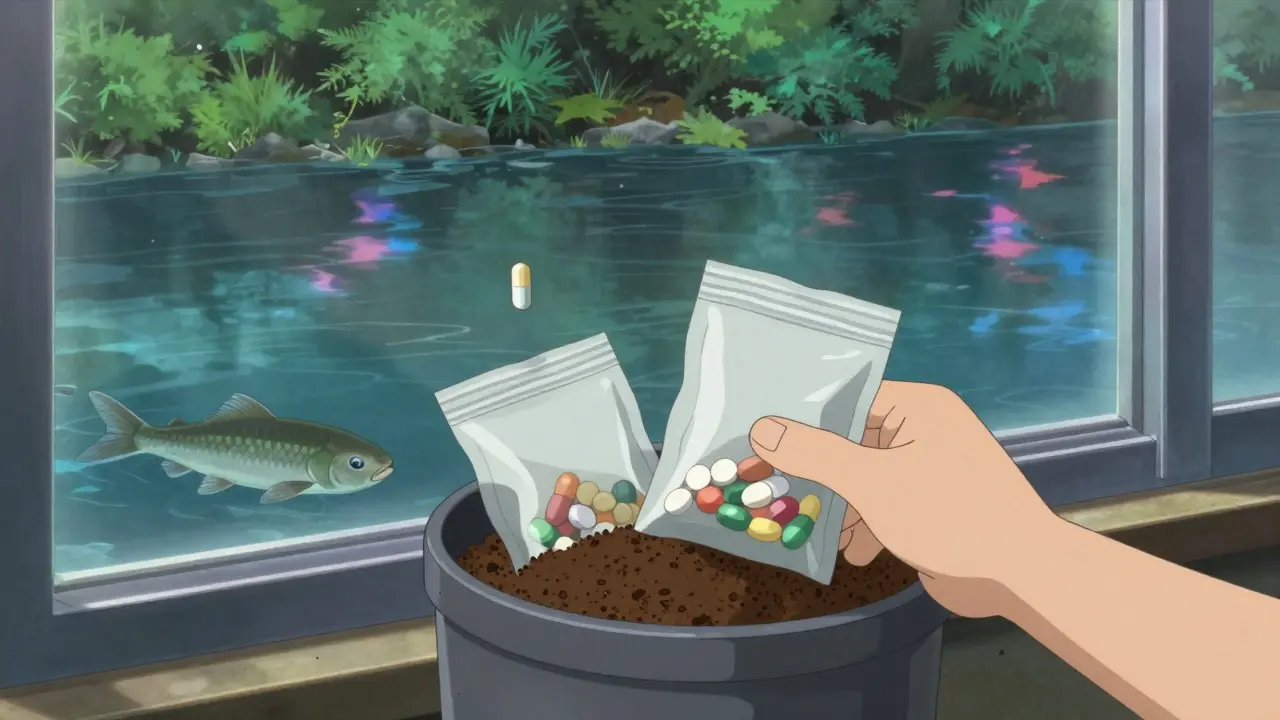
What About Liquid Medications?
Pouring liquid meds down the drain is just as bad as flushing pills. Mix them with coffee grounds or cat litter, seal them, and throw them in the trash. Never pour them out.What About Inhalers or Patches?
Inhalers contain propellants that can harm the atmosphere if incinerated improperly. Many take-back programs accept them. Patches (like fentanyl or nicotine) still contain active drug residue. Fold them in half with the sticky sides together, then dispose of them in the trash or drop them off. Never flush patches.What About Pet Medications?
Same rules. Dog antibiotics, cat thyroid pills, horse painkillers-they all belong in a take-back bin. Don’t assume they’re “different.” They’re still pharmaceuticals. They still pollute.Is it ever okay to flush medications?
Only for specific high-risk opioids listed by the FDA, like fentanyl patches or oxycodone tablets, and only if no take-back option is available within a few hours. For all other medications-including antibiotics, antidepressants, birth control, and pain relievers-flushing is never the right choice.
Can I just throw medications in the trash without mixing them?
It’s not recommended. Unmixed pills can be retrieved by children, pets, or people seeking drugs. Mixing them with coffee grounds, dirt, or cat litter makes them unappealing and harder to recover. It’s a simple step that adds safety.
Do take-back programs accept controlled substances?
Yes. Police stations, hospitals, and many pharmacies in the UK accept controlled drugs like opioids and benzodiazepines. These are handled under strict security protocols. You won’t be questioned. You don’t need ID. Just bring the meds.
Why can’t wastewater plants just filter out drugs?
Traditional plants aren’t designed for pharmaceuticals. They remove solids and bacteria, but drugs are small, stable molecules that pass through filters and biological processes unchanged. Advanced systems like ozone treatment or activated carbon can remove 85-95% of these compounds-but they cost millions to install and maintain. Most plants can’t afford it.
Are natural or herbal supplements safe to flush?
No. Even vitamins, fish oil, or herbal tinctures contain compounds that can affect aquatic life. They’re not regulated like prescription drugs, but they still enter the environment and can disrupt ecosystems. Always use take-back or trash disposal methods.
What if I live in a rural area with no drop-off points?
Use the at-home method: mix meds with coffee grounds or cat litter, seal in a container, and put in the trash. Avoid flushing. Check with your local council-some offer mail-back programs or seasonal collection days. If none exist, contact your MP or local health authority to advocate for better access.
Comments
Johanna Baxter
I just flushed my ex's old antidepressants last week. Honestly? Felt like justice. Now I know I'm a monster. 🤷♀️
Jerian Lewis
The fact that we even have to have this conversation is sad. We treat medicine like trash and wonder why the world’s falling apart.
tali murah
Let me get this straight. We’re expected to drive 30 miles to drop off pills… but Walmart’s got 24-hour checkout lanes. Priorities, people. 🙄
Diana Stoyanova
Look. I used to toss my old ibuprofen like confetti. Then I saw a documentary about fish with eggs. I cried. Not because I’m sensitive-because it’s F*CKING WEIRD. We’re poisoning creatures that didn’t even ask to be here. Now I keep a shoebox in my closet labeled ‘Pills to Not Flush’. It’s my tiny rebellion. You can start small. Just one bottle. That’s all it takes to begin changing the tide.
Gregory Clayton
This is why America’s going down the toilet. First we flush our meds, next we flush our values. Who even came up with this idea? Some European hippie with a compost bin?
Ashley Kronenwetter
While the intent behind this post is commendable, the lack of standardized national infrastructure remains a systemic failure. Disposal responsibility should not fall solely on the individual.
Micheal Murdoch
You don’t need to be perfect. You just need to be better than yesterday. If you’ve never taken old meds to a pharmacy, today’s the day to try. One bottle. One trip. One fish that doesn’t grow eggs. That’s a win.
Lindsey Wellmann
I just threw my grandma’s expired blood pressure pills in the trash… WITH CAT LITTER!!! 🐱💩 I’m basically a superhero now. 🦸♀️
Jacob Paterson
Oh wow, so now I’m guilty because I didn’t know flushing was bad? Who told you this? Some activist with a podcast? Newsflash: I’m not a chemist. If the government wanted this fixed, they’d put drop boxes in every gas station. They didn’t. So I’ll keep doing what’s easy.
Kiruthiga Udayakumar
In India we just throw everything in the river. Why? Because we have no choice. You think your 20-minute drive is hard? Try walking 5 miles to the nearest pharmacy. Then come talk to me about responsibility.
Patty Walters
i just found 3 old bottles in my cabinet. one was from 2017. i mixed em with coffee grounds and sealed em in a ziplock. felt kinda good. like i did somethin right for once.
Phil Kemling
We treat pharmaceuticals like disposable consumer goods, but they’re not. They’re molecular entities with ecological memory. The water remembers. The fish remember. The soil remembers. We just choose to forget.
Jenci Spradlin
my pharmacist said they take back anything except inhalers. i asked why and she said ‘cause they explode’ so now i just keep em in a drawer. i think im gonna burn em in my backyard. jk. maybe.
Micheal Murdoch
I appreciate the passion here, but let’s not pretend this is just about individual action. The real problem is that drug companies don’t pay for disposal. Until they’re held accountable, we’re all just rearranging deck chairs on the Titanic.