
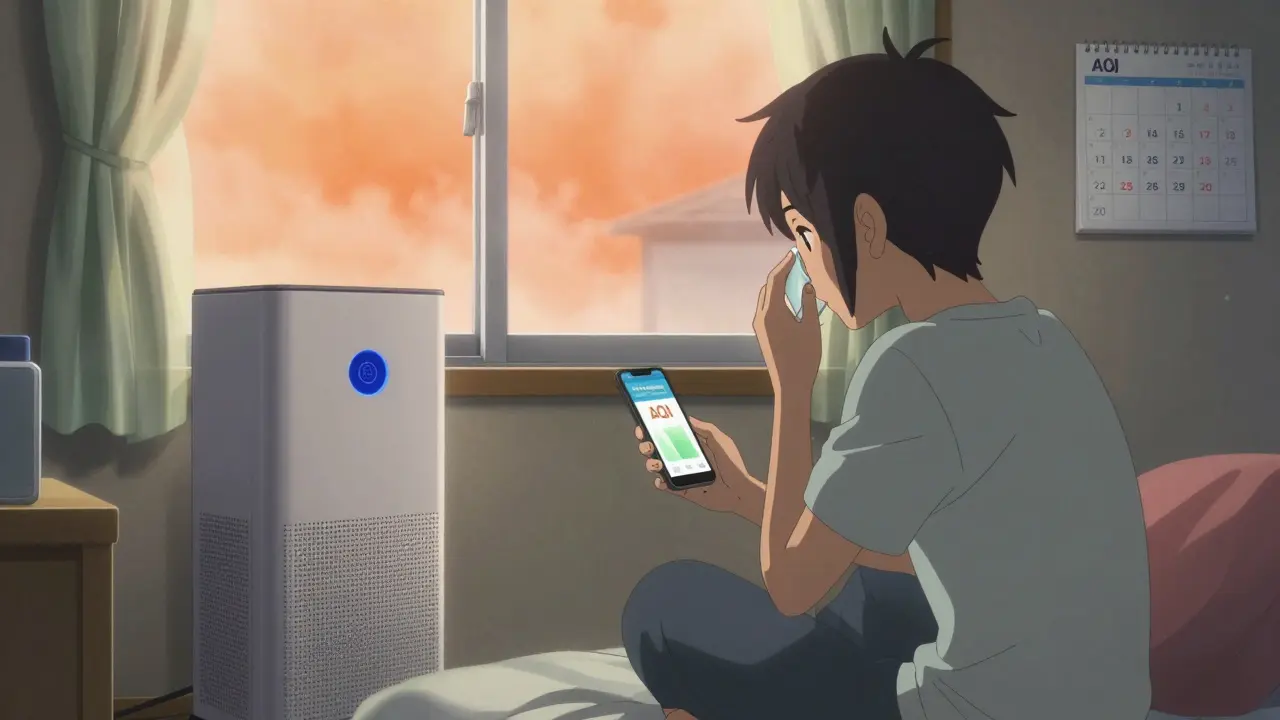
Every year, millions of people with asthma face worse symptoms not because their medication failed, but because the air they breathe is toxic. If you or someone you care about has asthma, you’ve probably noticed that some days feel harder to breathe-even when you’ve taken your inhaler. That’s not just in your head. Air pollution is one of the most powerful triggers out there, and it’s not going away without action. The good news? You don’t have to wait for governments to fix everything. There are real, science-backed steps you can take right now to cut your exposure and breathe easier.
How Air Pollution Makes Asthma Worse
Asthma isn’t just about swollen airways. It’s about inflammation that flares up when your lungs are hit by pollutants. Particulate matter, especially PM2.5 (particles smaller than 2.5 micrometers), slips deep into your lungs and sets off a chain reaction. Nitrogen dioxide from car exhaust, ozone from hot sunny days, and sulfur dioxide from industrial smoke all do the same thing: they make your airways more sensitive, more reactive, and more likely to spasm.
Studies show that on high-pollution days, people with asthma use their rescue inhalers 30-50% more often. Emergency room visits spike. Hospital stays go up. A 2024 review found that during periods of reduced pollution-like during COVID lockdowns-asthma control scores improved by 13.8%. That’s not a small shift. It’s a measurable, life-changing difference.
And it’s not just adults. A 2019 study in The Lancet Planetary Health estimated that air pollution causes 4 million new cases of childhood asthma every year. That’s not genetics. That’s environment. If we can clean the air, we can prevent asthma before it starts.
Check the Air Quality Index (AQI) Like You Check the Weather
You wouldn’t go hiking in a snowstorm without checking the forecast. Why do the same with air pollution? The Air Quality Index (AQI) is a simple scale from 0 to 500 that tells you how clean or dirty the air is. The EPA’s AirNow.gov platform gives real-time updates for every U.S. zip code-and many international apps like AirVisual do the same globally.
- AQI 0-50: Good. No restrictions.
- AQI 51-100: Moderate. Sensitive groups (including asthma patients) should cut back on long outdoor workouts.
- AQI 101-150: Unhealthy for sensitive groups. Everyone with asthma should limit time outside.
- AQI 151-200: Unhealthy. Avoid all non-essential outdoor activity.
- AQI 201-300: Very unhealthy. Stay indoors. Close windows.
One user on the American Lung Association’s forum said, “Using the AirVisual app cut my daughter’s inhaler use in half over six months.” That’s not luck. That’s data-driven behavior. Set up alerts on your phone. Make checking the AQI part of your morning routine.
Make Your Home a Safe Zone
Indoor air can be just as bad as outdoor air-sometimes worse. Cooking, cleaning products, dust, and even outdoor pollution seeping in through cracks can pile up. The key is filtration.
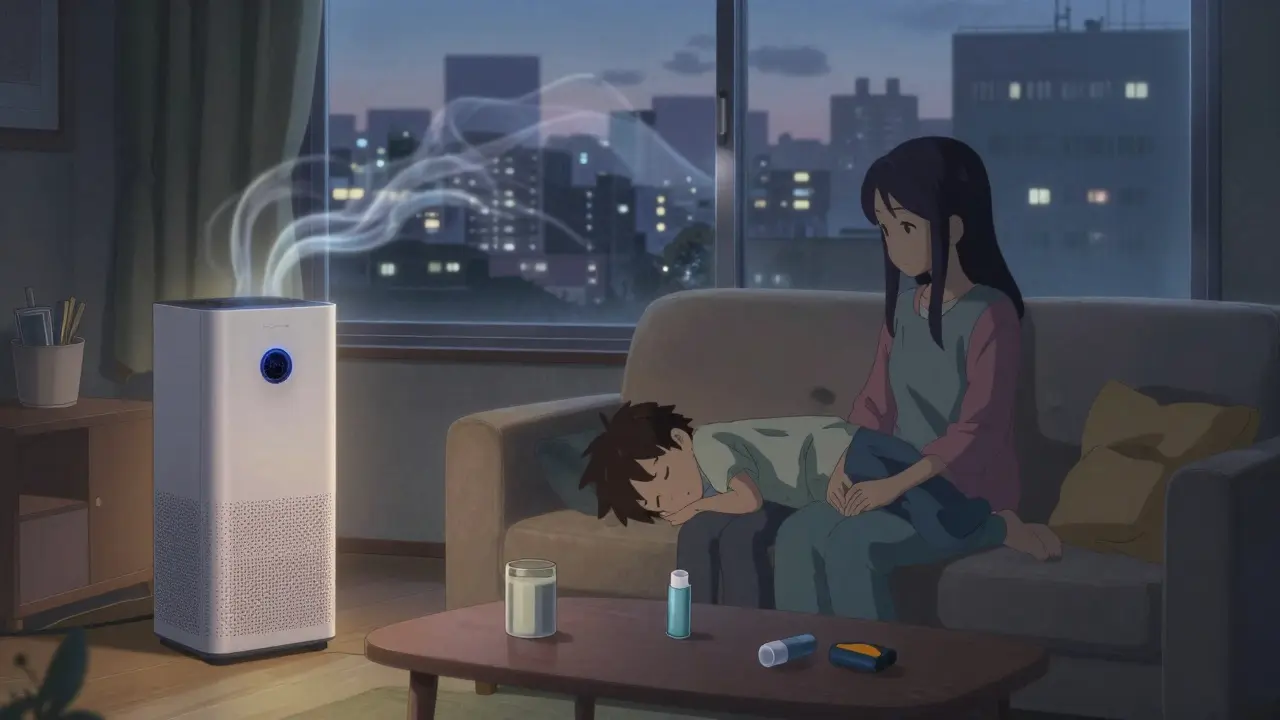
High-Efficiency Particulate Air (HEPA) filters are the gold standard. They trap 99.97% of particles as small as 0.3 microns-exactly the size of the worst pollutants. For whole-home protection, upgrade your HVAC system to a MERV 13-16 filter. For single rooms, get a portable air purifier with a Clean Air Delivery Rate (CADR) that matches your room size. For a 300-square-foot bedroom, aim for a CADR of at least 200.
A 2021 Johns Hopkins study found that homes with HEPA filters had 55-67% lower PM2.5 levels than homes without them. Users report fewer nighttime coughing fits, less wheezing, and fewer inhaler uses. One Reddit user wrote: “The Coway Airmega 400 cut my inhaler use from 4-5 times a week to 1-2. The $700 price tag hurt, but my sleep didn’t.”
But here’s the catch: filters only work if you maintain them. Only 43% of people replace HEPA filters on time. Check your manual. Set a reminder. A dirty filter doesn’t clean air-it recirculates dust.

Smart Choices for Outdoor Days
If you work outside, drive a school bus, or have kids who play soccer after school, you can’t just stay inside. But you can still reduce exposure.
During high pollution days, avoid high-traffic areas. Pollutants like NO2 and PM2.5 are 3-5 times higher within 100 feet of a busy road. If you’re picking up kids from school, park farther away. If you walk to work, choose side streets over main roads. Even a 10-minute detour can make a difference.
For short outdoor tasks-like taking out the trash or walking the dog-wear an N95 respirator. It’s not perfect, but it blocks 95% of particles when fitted correctly. The CDC recommends it during wildfire smoke events. But don’t rely on it for long hours. As one pulmonologist warned: “Masks give a false sense of security, especially for kids who won’t wear them right.”
Also, avoid exercising outdoors during peak pollution hours-usually mid-afternoon to early evening. Early morning or late evening is better. And if you have a garden or yard, avoid watering during high ozone days. Water droplets can carry pollutants deeper into your lungs.
Policy-Level Changes That Actually Work
Individual actions matter. But real change happens when systems change. Schools, cities, and governments have tools to make air safer for everyone.
Massachusetts schools saw a 22-35% drop in indoor PM2.5 after moving bus parking away from windows and banning idling. Parents reported 41% fewer asthma-related school absences. California is replacing all diesel school buses with electric ones by 2035-a move expected to cut children’s exposure by up to 60%.
London’s Ultra Low Emission Zone cut childhood asthma hospitalizations by nearly 12% in two years. Los Angeles saw a 35% drop in indoor pollution in schools after switching to electric buses. These aren’t theoretical. They’re proven.
The EPA’s current PM2.5 standard is 12 μg/m³ annually. But the American Thoracic Society says it should be 8 μg/m³. In January 2024, the EPA proposed tightening it to 9-10 μg/m³. That’s progress-but still not enough. If you care about asthma, contact your local representative. Ask them to support stronger air quality rules.
What Doesn’t Work (And Why)
Not all advice is created equal. Some common tips sound smart but don’t hold up.
- Opening windows to “air out” your home on high-pollution days? That’s like letting smoke in. Keep windows closed. Use recirculation mode on your HVAC.
- Houseplants don’t clean air effectively. They’re nice to look at, but they won’t reduce PM2.5.
- Ionizers and ozone generators are sold as air purifiers, but they actually create ozone-a known asthma trigger. Avoid them.
- Relying on air purifiers in one room while ignoring the rest of the house? You’re only protecting a small area. Prioritize bedrooms and living rooms.
And remember: you can’t filter your way out of a polluted city. If your neighborhood has constant high pollution, your home measures are helpful-but not enough. Advocacy matters. Community action matters. Your voice matters.
Putting It All Together: Your Action Plan
Here’s how to start today:
- Download an air quality app (AirVisual, IQAir, or AirNow) and set daily alerts.
- Check the AQI before every outdoor activity. Adjust plans accordingly.
- Get a HEPA air purifier for your bedroom. Make sure it matches your room size.
- Replace filters every 3-6 months. Set a phone reminder.
- Keep windows closed during high pollution days. Use HVAC on recirculate.
- Move outdoor activities to early morning or evening.
- If you drive kids to school, don’t idle. Park away from entrances.
- Ask your school or workplace if they have an air quality plan.
- Support local policies that reduce traffic pollution and industrial emissions.
It’s not about perfection. It’s about progress. Even small changes add up. One person reducing their exposure by 30% doesn’t change the world. But 10,000 people doing it? That changes the air we all breathe.
Frequently Asked Questions
Can air pollution cause asthma in people who never had it before?
Yes. Long-term exposure to air pollution, especially in children, can lead to the development of asthma. A 2019 study in The Lancet Planetary Health found that pollution contributes to 4 million new pediatric asthma cases each year worldwide. It doesn’t just worsen existing asthma-it can trigger it in otherwise healthy lungs.
Are air purifiers worth the cost?
For many people with asthma, yes. A 2021 Johns Hopkins study showed HEPA filters reduce indoor PM2.5 by 55-67%. Users report fewer symptoms, less nighttime waking, and reduced inhaler use. Portable units cost $50-$800, with filter replacements every 3-6 months. Compare that to the cost of ER visits or missed workdays. For many, the long-term health benefits far outweigh the upfront cost.
Should I wear an N95 mask outdoors on bad air days?
For short outdoor tasks-like walking the dog or running errands-yes. N95 masks block 95% of fine particles when fitted properly. But they’re not meant for long-term use, especially for children or people with breathing difficulties. They can feel restrictive and may not seal well on small faces. Use them as a temporary shield, not a permanent solution.
How do I know if my HEPA filter is working?
You won’t see results immediately, but you’ll notice fewer symptoms over time. Check the filter visually-dust buildup means it’s working. If it’s clogged, replace it. Also, make sure the purifier is placed away from walls (at least 1-2 feet) and in the center of the room. Placement matters as much as the filter itself.
What’s the best time of day to go outside if I have asthma?
Early morning, before 8 a.m., is usually best. Ozone levels rise during the day as sunlight reacts with vehicle emissions. Afternoon and evening are peak times for pollution. Check your app for real-time data, but if you’re unsure, assume morning is safer. Avoid exercising near highways or in heavy traffic.

Comments
J. Murphy
Meh. I check the AQI sometimes. Mostly I just deal with it. My inhaler works fine. Why make a big deal?
Also HEPA filters? My dog sheds more than the air is polluted.
Jesse Hall
This is so helpful!! 😊 I just got my first air purifier last week and my asthma has been WAY better. I didn’t realize how bad my bedroom air was until I saw the numbers. Thank you for the practical tips! 🙌
Namrata Goyal
Air pollution? Please. You think your HEPA filter saves you?
Meanwhile in Delhi we breathe this 24/7 and somehow we're still alive. You Americans act like air is a luxury.
Also your EPA standards? Pathetic. We need real policy, not purifiers for rich people.
Alex Arcilla
LOL I just saw a guy in LA wearing an N95 while walking his poodle.
Meanwhile his car idling outside the school? That’s the real villain.
We’re all just doing TikTok wellness while the infrastructure burns.
Also-houseplants? Bro. I have a cactus. It’s not saving anyone.
Blessing Ogboso
I grew up in Lagos where the air was thick with dust and exhaust, and my mother never had an air purifier. She had a fan and a wet towel over the window. We didn’t know about AQI. We just knew to stay inside when the smoke from the generator was too thick.
The truth is, people with resources can optimize their homes. But for millions, the problem isn’t lack of knowledge-it’s lack of power.
Yes, filters help. But if your child’s school is next to a diesel depot and your city refuses to change the bus routes? No filter will fix that.
We need justice, not just personal hacks.
And yes, I’ve seen the studies. I’ve also seen mothers crying because they can’t afford a new filter.
So yes, do the HEPA thing. But don’t stop there. Push for buses. Push for parks. Push for clean energy.
Your asthma doesn’t care if your filter is MERV 13. It cares if your neighborhood has trees.
And trees don’t come with price tags.
Kevin Y.
Thank you for compiling such a well-researched and thoughtful overview. I have found that consistent use of a HEPA filter in my bedroom has significantly improved my sleep quality and reduced nocturnal symptoms. I also appreciate the emphasis on maintenance-many overlook this critical detail. I would only add that monitoring humidity levels alongside air quality can further enhance respiratory comfort.
Rachele Tycksen
i got a purifier and it made my room smell like plastic?? now i just open the window and deal. maybe the air is bad but at least its real air??
Aaron Sims
So... you're telling me the government didn't tell you this?
Hmm. Interesting.
And you really believe that 'HEPA' is some magic bullet?
What about the 3000 other pollutants they don't measure?
And who funds these 'studies'?
AirVisual? Who owns them?
And why is the EPA only now 'proposing' tighter standards after 30 years of silence?
Coincidence?
I think not.
This whole thing feels like a distraction.
They want you to think you can 'optimize' your way out of systemic poisoning.
Wake up.
The air is poisoned.
And they're selling you the filter.
Rama Rish
Used AQI app. Cut my kid’s inhaler use. Best 5 mins I ever spent.
Kevin Siewe
I’ve been using a HEPA filter for two years now, and it’s made a real difference. I used to wake up wheezing three nights a week. Now it’s maybe once a month.
The key for me was setting a reminder to change the filter-every 4 months, no exceptions. I even have a note on my fridge.
Also, I didn’t realize how much pollution comes in through the cracks around my windows. I sealed them with weatherstripping. It cost $20 and helped more than I expected.
Small steps add up. You don’t need to do everything at once. Just pick one thing and stick with it.